Cero mackerel
Scomberomorus regalis · Scombridae
- Saltwater
- Big pelagics
- Medium
- Size
183 cm
- Weight
7.8 kg
- Depth
1–20 m
Where to fish
- Reef
- Rocky shore
- Offshore
Habitat icons: Flaticon
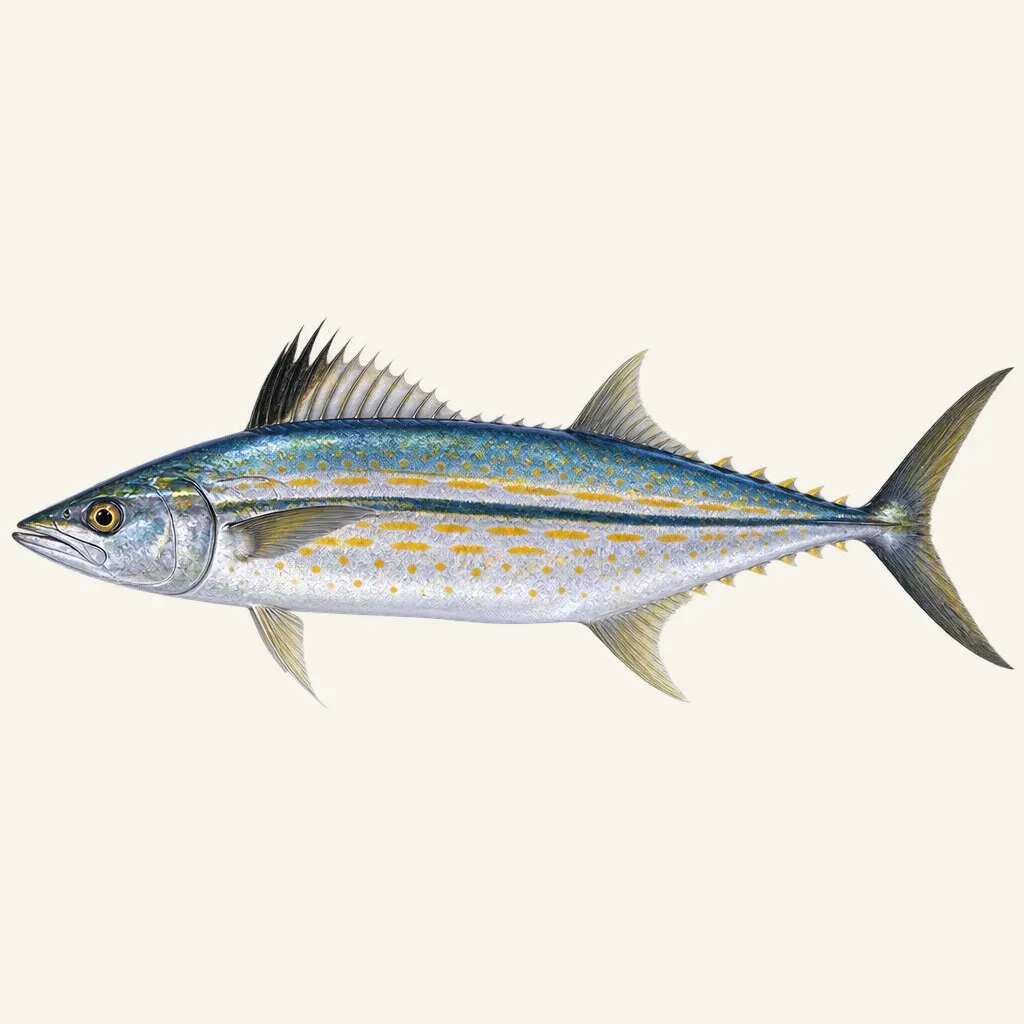
The cero mackerel is a large coastal scombrid of the tropical western Atlantic with a silver body adorned by a characteristic golden-yellow lateral stripe and elongated blotches on the flanks. A fast and gregarious predator, it feeds mainly on clupeids, atherinids and cephalopods.
Calendar
Recorded in 12 countries
Bahamas · Belize · Cayman Islands · Colombia · Cuba · Guadeloupe · Honduras · Martinique · Mexico · Puerto Rico · U.S. Virgin Islands · United States
GBIF occurrence records — native and introduced populations combined.
Its range
The range runs along the western Atlantic from Massachusetts to Brazil, and it includes the Bahamas and the West Indies.
The Bahamian occurrence is worth using. That archipelago is exactly where the Atlantic Spanish mackerel, the species this one is most often mistaken for, does not occur — so a striped or spotted Spanish mackerel seen in Bahamian water is this fish by elimination, before anybody looks at a fin.
Identifying it
One stripe. A single continuous line runs along the middle of the silver flank, and nothing else in the genus has it — the relatives carry spots or wavy bars, never an unbroken mid-lateral band. That character alone identifies the fish.
Above and below the stripe sit several rows of yellow-orange streaks of varying length together with small yellow spots. The overall effect is distinctive enough that the fish has picked up painted mackerel as a name.
The forward third of the first dorsal fin is black. The pelvic fins are relatively long, which is a supporting character worth knowing because it works on a fish seen in the water.
Vertebrae number 47 to 48, sitting between the 41 to 43 of the king mackerel and the 51 to 53 of the Atlantic Spanish mackerel. The lateral line descends gently to the caudal peduncle, the interpelvic process is small and forked, scales are small, and there is no swim bladder.
The water it needs
Clear water around coral reefs, where it is most abundant, and only occasionally in schools.
Depth is the striking figure: 1 to 20 m, and typically in the first metre or so. This is the shallowest and most reef-bound of the western Atlantic Spanish mackerels, at a time when its relatives are patrolling open coast or the shelf edge.
That reef association determines everything else about the fish. It is not a long-distance migrator following a thermal front along a coastline; it is a predator working the drop-off and the reef flat, present where the coral is and absent where it is not.
Areas
- Around coral reefs
- Shoals and drop-offs
- Clear coastal waters
- Passes between islands
Techniques
- Light trolling around reefs
- Metal lure casting
- Live bait under float
- Drift fishing
Baits
- Live sardines
- Small herrings
- Small squid
- Thin metal spoons
What it eats
Clupeoids of the genera Harengula, Jenkinsia and Opisthonema, silversides, and a proportion of squid and shrimp.
The named genera say something the habitat description only implies. These are the small silver fish of clear water around reefs, not the open-water schools of the shelf, so the diet confirms where the predator spends its time and rules out the offshore ground its relatives use.
How to catch it
Water clarity governs. Unlike its cousins, which handle turbidity and work the open coast, this fish is looked for around coral, in the top metre or two, where the bottom is visible from the boat.
The clarity that makes it findable also makes it wary. Approach and presentation carry more weight here than the ground-covering that produces results on the migratory species; a heavy trolled spread over a reef flat achieves less than a light one delivered quietly.
Encounters tend to involve a few fish rather than a mass. The species schools only occasionally, so a spot that produces one is worth working carefully rather than abandoning for a search.
The size figures need reading together. The greatest length and the greatest weight on record cannot describe the same animal — an odd pairing that says the two extremes were taken from very different fish, and in any case this is a long slender species nowhere near the mass of the narrow-barred mackerel of the Indo-Pacific. Maturity is around 40 cm, with the range starting at 38.
Regulations
Check the local regulations in force (legal size limits, closed seasons, bag limits).
For guidance only. Legal sizes, quotas and open seasons vary by location and season: always check the local regulations in force before fishing.
Other names
Cero in English, a short name with no equivalent in the other Spanish mackerels, taken from Caribbean Spanish. Painted mackerel is also current and refers to the mid-lateral stripe and the yellow streaking.
Cero has the advantage of being unambiguous, which is unusual in this genus: king mackerel, kingfish and Spanish mackerel all name several unrelated fish depending on the ocean, while cero names one. Where the fish is called cero mackerel or a spotted mackerel instead, the ambiguity comes straight back.
Sources: fishbase.se · api.gbif.org