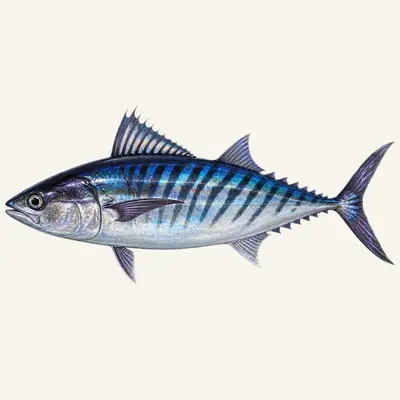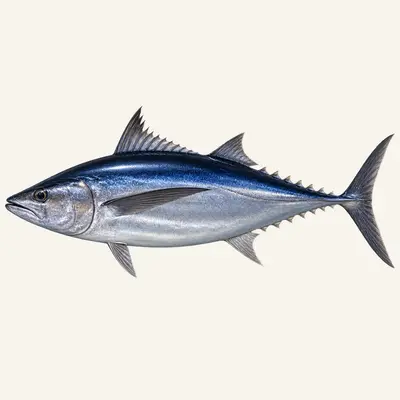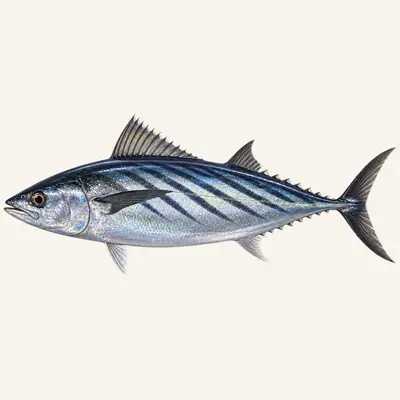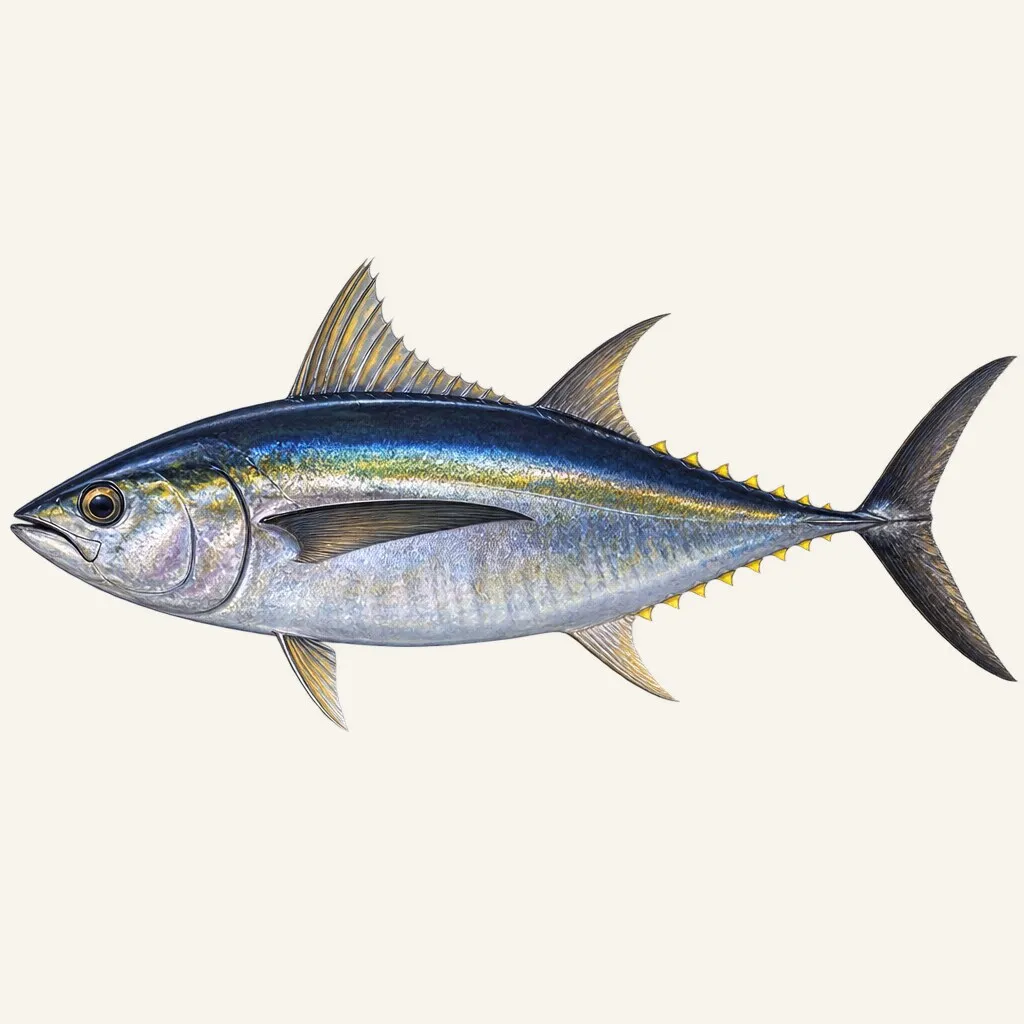
Blackfin tuna
Thunnus atlanticus · Scombridae
- Saltwater
- Big pelagics
- Medium
- Regulated
- Size
72–108 cm
- Weight
5.3–21 kg
- Depth
0–50 m
Where to fish
- Reef
- Offshore
Habitat icons: Flaticon
The blackfin tuna is the smallest tuna of the western Atlantic, recognizable by its black-edged pectoral and pelvic fins. With its streamlined Scombridae body, it inhabits warm coastal waters and upwelling zones along the American Atlantic.
Calendar
Recorded in 8 countries
Bahamas · Colombia · Cuba · Mexico · Puerto Rico · U.S. Virgin Islands · United States · Venezuela
GBIF occurrence records — native and introduced populations combined.
Its range
The species does not leave the western Atlantic. It runs from off Martha's Vineyard, Massachusetts, to Trinidad and Rio de Janeiro and on into southern Brazil, between 43°N and 28°S.
Confinement to a single ocean margin is unique in the genus, where every other species holds at least a whole ocean. The cause is thermal: this fish requires water of at least 20 degrees, which closes off the high-latitude routes the others use to pass from one basin to the next.
Identifying it
It is the smallest member of the genus, an ordinary fish measuring 72 cm to the fork. In the tropical western Atlantic a tuna of that format has few rivals for the identification.
The counts are those of a standard Thunnus: 13 dorsal spines, 14 to 15 soft rays, 13 to 14 in the anal, and 39 vertebrae. The body is fusiform, oval in section, and offers nothing else to work with.
Breeding
The spawning grounds lie well offshore, outside the coastal strip where the fish is usually met. Whatever else is unclear about the species, that separation is established, and it means the water it is caught in is not the water it breeds in.
Maturity comes at about 49 cm, the earliest in the genus in absolute terms. That is less than half the length this tuna has available, where the large bluefins wait until a quarter of theirs.
The water it needs
The depth range stops at 50 m. That is the constraint defining the animal: where a bigeye works 500 m of water column, this one lives in a layer ten times thinner, immediately under the surface and nowhere else.
It forms large mixed schools with skipjack, with which it shares that layer. A gathering spotted offshore is therefore rarely made up of one species.
Areas
- Warm coastal waters
- Coral reef edges
- Warm current zones
- Tropical open ocean
Techniques
- Light trolling
- Surface popping
- Live bait fishing
- Coastal jigging
Baits
- Small live baitfish (anchovies)
- Squid
- Surface lures
- Sardines
What it eats
The menu is more varied than the depth would suggest: surface fishes, squid, amphipods, shrimps, crabs, and the larvae of stomatopods and decapods, with a notable share of crustaceans for a tuna.
Deep-sea fishes appear on the same list, although the animal never goes below 50 m. The contradiction is only apparent — those mesopelagic prey climb towards the surface after dark, and that is where they are taken.
How to catch it
The largest fishery for it operates off southeastern Cuba, with live bait and pole. The method says most of what is needed: a school held up with bait, fish hooked on sight, a quick rhythm.
Two practical consequences follow. The useful layer is thin, so there is nothing to be gained by going deep — all of it happens in the first 50 m. And the company of skipjack means sorting, because a mixed school gives two species on the same bait and the blackfin is not necessarily the one that gets there first.
The modest size allows light tackle, which puts this tuna within reach of small craft where the others demand the open ocean.
Regulated — Often governed by quotas, size limits, seasons, or reporting rules.
Regulations
Check the local regulations in force (legal size limits, closed seasons, bag limits).
For guidance only. Legal sizes, quotas and open seasons vary by location and season: always check the local regulations in force before fishing.
Other names
Blackfin tuna in English, atún aleta negra in Spanish, thon à nageoires noires in French: three languages, one character.
The epithet atlanticus is just as accurate, and unusually so for a genus in which the geographic names are mostly hostages to fortune. This is the only member of it whose range fits inside a single ocean, so the name is going to keep being true.
Sources: fishbase.se · api.gbif.org