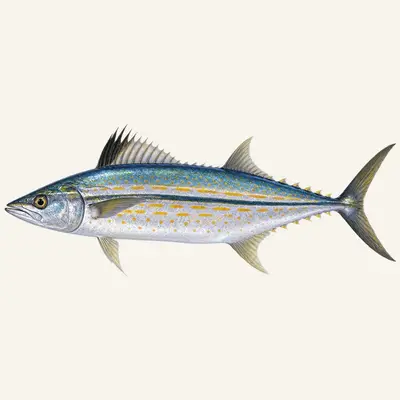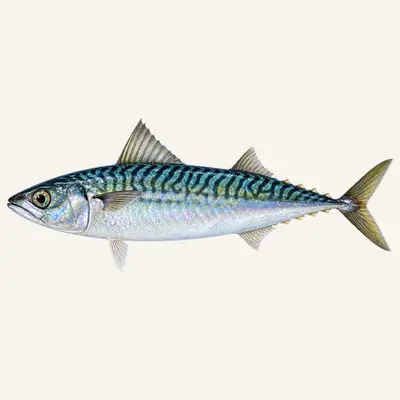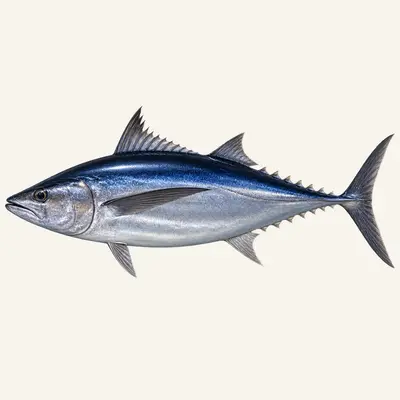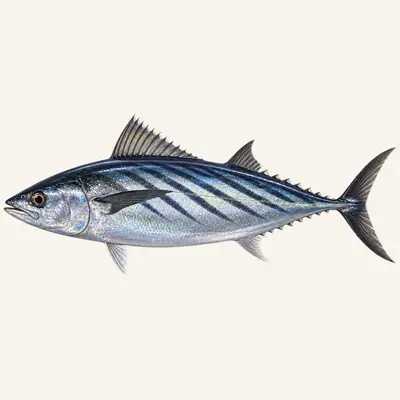
Bullet tuna
Auxis rochei · Scombridae
- Saltwater
- Big pelagics
- Medium
- Size
50 cm
- Lifespan
5 years
Where to fish
- Rocky shore
- Offshore
Habitat icons: Flaticon
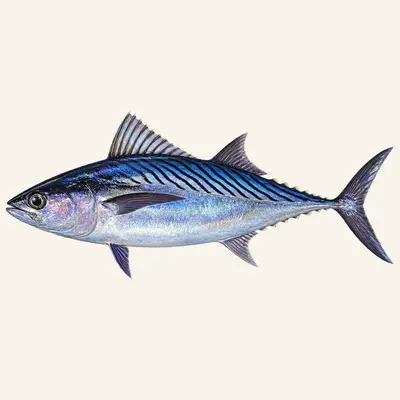
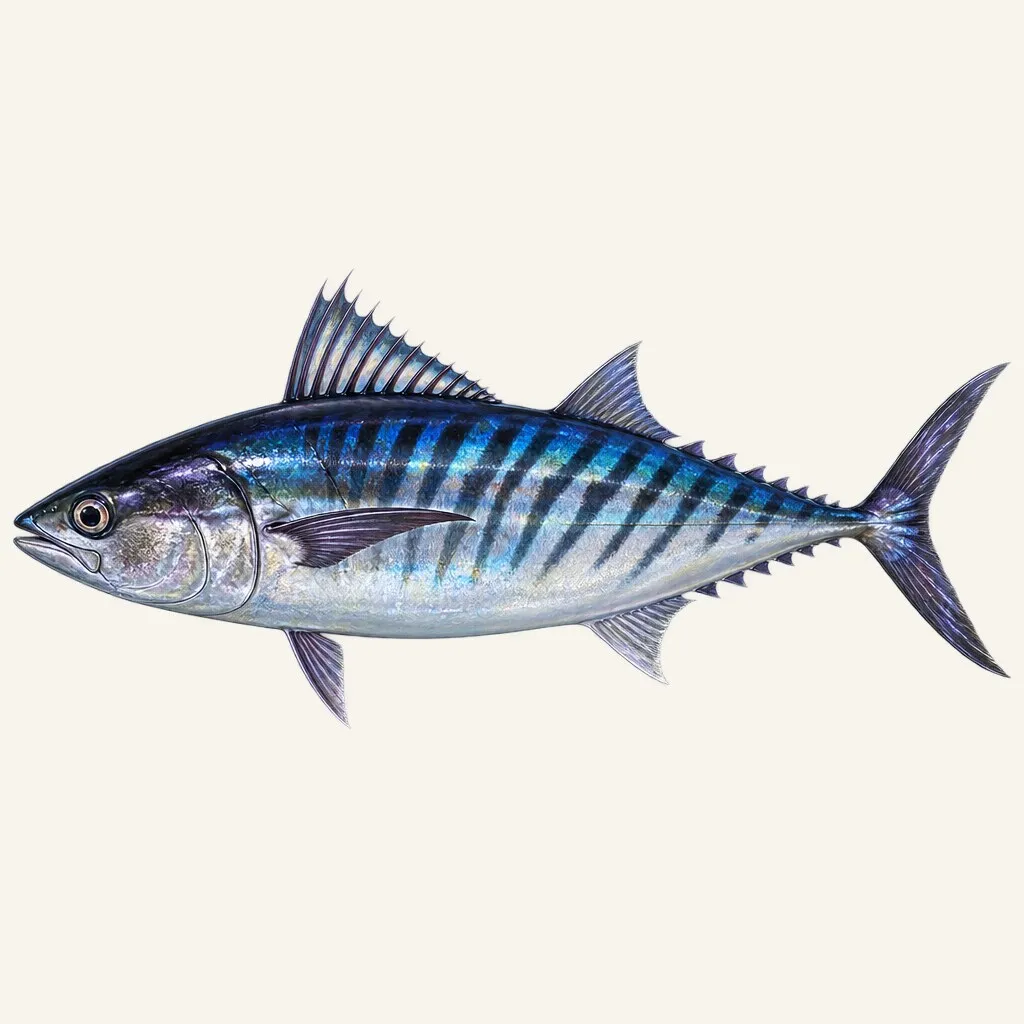
The bullet tuna (Auxis rochei) is a small pelagic scombrid with a metallic blue back marked by dark oblique stripes on the rear dorsal area and a silvery belly. A gregarious and very fast species, it hunts at the surface in tight schools in warm oceanic and coastal waters of all tropical and warm-temperate seas.
Calendar
Recorded in 28 countries
Algeria · Australia · Brazil · Colombia · Côte d’Ivoire · Equatorial Guinea · French Guiana · Gabon · Ghana · Guadeloupe · India · Indonesia · Ireland · Italy · Japan · Liberia · Martinique · Nigeria · Portugal · Réunion · São Tomé & Príncipe · Seychelles · Sierra Leone · Spain · Taiwan · Tanzania · Thailand · United States
GBIF occurrence records — native and introduced populations combined.
Identifying it
Fifteen or more dark bars stand upright across the scaleless part of the back, broad and close to vertical. That pattern is the species. The number is a floor rather than a count to take seriously — 15 at the least — and it is the width and the attitude of the bars that do the work, because the frigate tuna carries thin markings lying along the body instead of across it.
The area those bars occupy is smaller here, and for a reason that can be felt rather than seen. The corselet stays thick towards the rear: beneath the origin of the second dorsal fin it is still more than six scales deep, where on the other species the same measurement has fallen to five or fewer. More armour behind means less bare skin, and the bars are therefore printed on a narrower panel.
The pectoral fin gives a third check and it is a negative one. Drop a vertical line from the front edge of the bare area: this fin does not reach it. On the frigate tuna the same fin passes it. The test is worth a moment because it does not depend on markings, which fade.
The rest belongs to the genus rather than to the species. The body is stout, elongate and round in section. The teeth are small and conical in a single row. A large single-pointed flap sits between the pelvic fins. On each side of the tail root a strong central keel runs between two smaller ones. The dorsal has 9 to 12 spines and 10 to 13 soft rays, the anal 12 to 14.
Colour, while it lasts: a bluish back turning deep purple or nearly black over the head, a white belly, and pectoral and pelvic fins purple outside and black on their inner faces.
Breeding
Fecundity is on record and it scales with the animal: between 31,000 and 103,000 eggs per spawning, according to the size of the fish. The spread is more than threefold, and it is the whole of the argument in the conservation section below.
Maturity is recorded from 35 cm. For one of the smallest tunas in the family that is late within its own growth, and it leaves few seasons of spawning in a life that does not run past five years.
Eggs and larvae are left in open water with nothing to hold them.
The water it needs
This is the more coastal of the two. Adults are taken principally in inshore water and around islands, from about 10 m down, in tropical water reaching 28 degrees, and the species tolerates brackish conditions. It schools.
Islands matter in that description. An oceanic island offers the coastal conditions this fish wants in the middle of a basin that otherwise holds none, which is how a species described as inshore comes to be caught thousands of kilometres from a continental shelf.
Areas
- Open sea surface
- Continental shelf edges
- Upwelling zones
- Offshore rocky coasts
Techniques
- Trolling with feather lure
- Shore spinning with metal lure
- Light vertical jigging
- Trailing line fishing
Baits
- Silver metal lure
- Trolling feather
- Dead sardine or anchovy
- Soft fry lure
What it eats
Small fishes, with anchovies named specifically, then crustaceans — crab and stomatopod larvae above all — and squid.
The anchovy is the entry that matters for anyone fishing it. A predator working an identified shoal species can be met where that shoal is, and the birds that mark an anchovy shoal mark this fish as well.
How to catch it
Fast lures at the surface over marked activity, or a bait presented on the edge of a shoal of anchovies. The fish is also taken in encircling nets and on troll lines, and the two techniques between them describe its habits: it is netted because it schools, and trolled because it feeds at speed.
Its size is what recruits it into other fisheries. This is among the smallest of the tunas, and a live one on a hook is a standard bait for the large pelagics — a fish that is caught to be used rather than kept.
The bar pattern is the detail to verify with the fish in hand. The two members of the genus resemble each other closely enough to be confused in a bucket and in the catch statistics, and an upright broad bar is the quickest thing to look at.
It goes to market fresh and frozen, and also dried or salted, smoked and canned.
Conservation
The fecundity figures set this species apart from most small scombrids in one specific way. Between 31,000 and 103,000 eggs per spawning, depending on size, means the reproductive contribution of a large individual is several times that of a small one. The size composition of the catch therefore matters here, not only its tonnage: a fishery that removes the upper end of the range takes out more spawning than the same weight taken from the bottom of it.
Maturity from 35 cm compounds that. A fish only becomes useful to the population fairly late in its own growth, so the window between first spawning and the end of a five-year life is narrow, and the individuals inside that window are the ones producing the hundred thousand eggs.
The genus is also more finely divided than its market names imply. The eastern Pacific population of this species is treated as a subspecies of its own, Auxis rochei eudorax, and the frigate tuna has an eastern Pacific subspecies in parallel. Where the fish has been studied most closely it has turned out to be several things, which is a warning about the places where it has not.
Regulations
Check the local regulations in force (legal size limits, closed seasons, bag limits).
For guidance only. Legal sizes, quotas and open seasons vary by location and season: always check the local regulations in force before fishing.
Other names
Bullet tuna in English, after the shape of the head and body rather than any speed record.
The vernacular names are a mess and the mess is worth knowing about. Spanish has melva and melvera, and melva is also used for the frigate tuna; Italian tombarello is likewise applied loosely across the genus. Both species regularly go under the same local name, which corrupts declared catches and field identifications together — and a name shared between two fish of near-identical appearance is a name that will never be corrected by the person using it.
Sources: fishbase.se · api.gbif.org