Australian salmon
Arripis trutta · Arripidae
- Saltwater
- Big pelagics
- Medium
- Size
47–89 cm
- Weight
1.0–9.4 kg
- Lifespan
26 years
- Depth
30–39 m
Where to fish
- Estuary
- Beach
- Rocky shore
- Offshore
Habitat icons: Flaticon
A hard-fighting, schooling marine fish of southeastern Australia and New Zealand, unrelated to true salmon despite its name.
Calendar
Recorded in 2 countries
GBIF occurrence records — native and introduced populations combined.
Its range
Southern Australia including Tasmania, Lord Howe Island and Norfolk Island, usually from Brisbane to western Victoria and rarely as far as Western Australia; and New Zealand, with the Chatham and Kermadec Islands.
The two ends of the range are described differently, and the difference is informative. The Australian end has a usual span and a rare extension beyond it, which is how a temperature edge looks in a record. The New Zealand end simply lists the subtropical Kermadecs and the cool Chathams together, a wide thermal spread inside one country's waters.
Identifying it
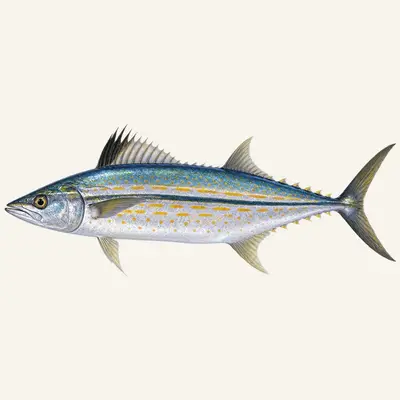
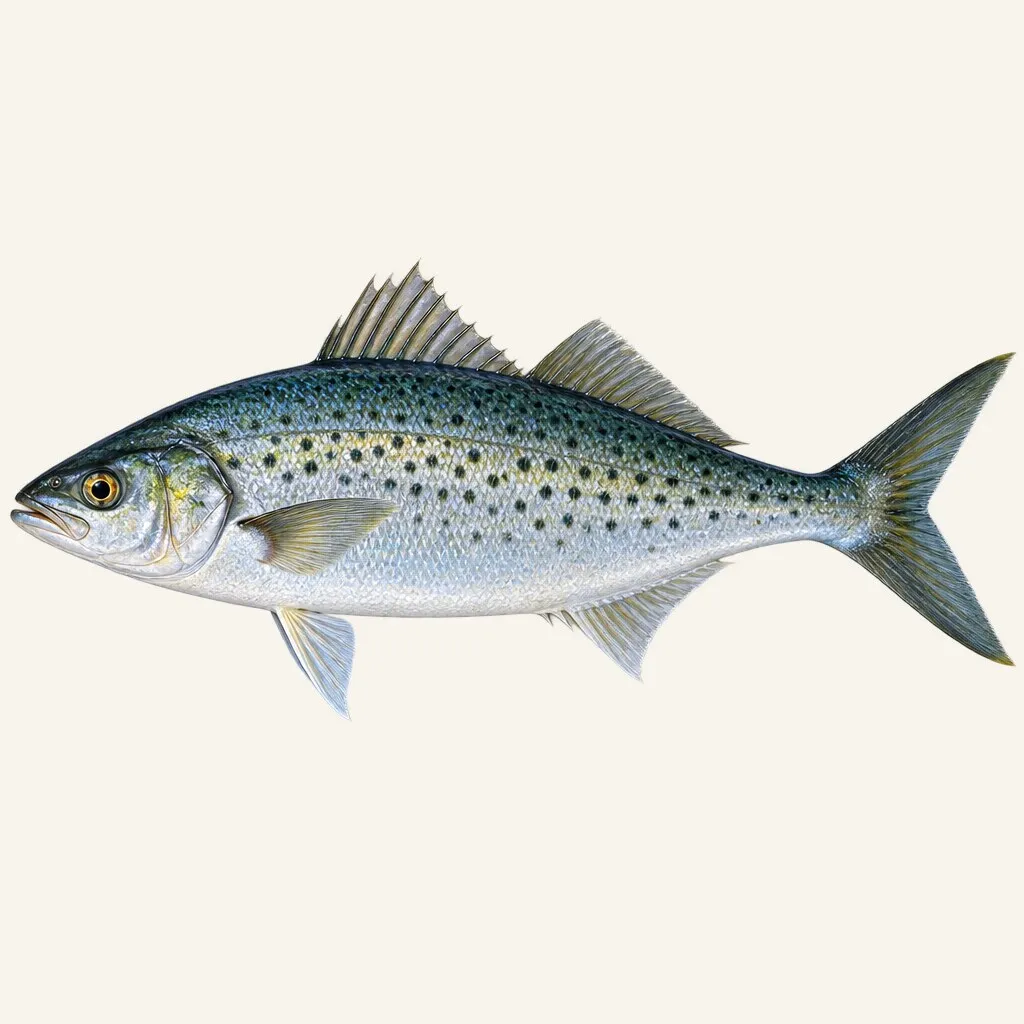
Adults are dark blue-green above and silvery below, with irregularly defined spots arranged along the flank in indistinct rows. Both qualifiers are load-bearing — irregularly defined, indistinct — because the marking is a smudge rather than a pattern, and calling the fish spotted overstates what is actually there.
Nine dorsal spines with 15 to 17 soft rays behind them, three anal spines with nine or 10, and 25 vertebrae. The body is fusiform and compressed.
Common length is 47 cm and the maximum reported age 26 years, which is a long life for a schooling pelagic fish of that build.
Breeding
The record is cautious and the caution is worth keeping: eastern Australian salmon are probably serial batch spawners. Probably, and in batches — the eggs go out in instalments across a season rather than in one event.
Maturity comes at 32.5 cm, in a range of 29 to 36. Against a 26-year lifespan that is early, and it means most of the fish in any school have already spawned and will spawn many times more.
The water it needs
Continental shelf water, including estuaries, bays and inlets, with a recorded band of 30 to 39 m. It enters rivers.
Behaviour splits by age and the record is specific about it. Juveniles school in shallow coastal bays and estuaries. Adults move in large schools along the shore, and they will cross reefs in depths just sufficient to cover their bodies. They also form the large surface aggregations in deep water noted above.
A fish of this size crossing a reef top in water barely deep enough to cover it is a visible event, and it is a fishing signal rather than a curiosity. What it is up there for is the small fish the shallows hold.
Areas
- Southeastern Australia (NSW, Victoria, Tasmania)
- South Australia
- New Zealand coasts
- Surf beaches and rocky headlands
- Estuaries and open bays
Techniques
- Surf and shore spinning
- Metal lures and poppers
- Saltwater fly fishing
- Light trolling
- Bait fishing with cut bait
Baits
- Shiny metal slugs
- Poppers and stickbaits
- Pilchard or fish strips
- Baitfish-imitating streamers
- Squid
What it eats
Three diets in one species, and they follow size. Fish under 10 cm feed predominantly on copepods. Adults feed mainly on fishes — but also on pelagic crustaceans, and the record names one in particular, the krill Nyctiphanes australis. Food is taken off the seabed as well.
The krill is the entry that explains the species' most conspicuous behaviour. Large surface aggregations in deep water are not a shoal of predators searching for a shoal of prey; they are what happens when a swarming animal is eaten by a schooling one. A krill swarm is a patch of food dense enough to hold thousands of fish in open water with no structure underneath them at all.
So this fish works two entirely different tables: bait fish in the shallows along the shore, and swarming plankton offshore. Anything written about it as a straightforward piscivore is a simplification of its own record.
How to catch it
Location is not the hard part of this fishery. Large schools run along the shore, they feed at the surface, and they cross reef tops in water barely deep enough to cover them. This is a fishery of watching first and casting second.
It is a shore fishery above all, off the beaches and rocky points of southern Australia and New Zealand, and the record lists three uses resting on the same schools: a commercial fishery, a game fishery, and — usually — bait.
Fast retrieves near the surface work because they imitate the small fish a school is driving. Where the fish are on krill instead, the same approach fails for a reason that has nothing to do with presentation: nothing in that school is looking for a prey item of that size.
Conservation
Nothing in the file records a decline, and the biology is on the reassuring side: maturity at 32.5 cm against a 26-year lifespan means most fish spawn well before they reach a size that interests anyone.
The exposure is in the schooling. Large surface aggregations, inshore and offshore, are visible, predictable, and workable by commercial and recreational fleets at the same time on the same population. A species that concentrates itself is easy to catch efficiently, and efficiency is the one thing a schooling fish has no defence against.
The juvenile dependence on shallow bays and estuaries adds the usual independent pressure from coastal development, and it falls on the year class rather than on the adults.
The species has not been assessed, so none of this is being tracked where it would normally be recorded.
Regulations
Minimum sizes and bag limits vary by Australian state and New Zealand: check local regulations.
For guidance only. Legal sizes, quotas and open seasons vary by location and season: always check the local regulations in force before fishing.
Other names
Australian salmon is the English name and it is wrong in the ordinary way: the fish is not a salmonid, and it belongs to Arripidae, a small Australasian family that this catalogue holds no other member of. In New Zealand it is kahawai, from Māori, and that is the one widely used name for the animal that does not assert a relationship it does not have. The record itself writes eastern Australian salmon when it needs to be specific about a population.
The binomial repeats the mistake in Latin. Trutta is the trout. So two European fish, neither of them related to this one, have been used to name it at once — a salmon in the vernacular and a trout in the epithet, on the same animal.
Sources: fishbase.se · api.gbif.org