Chub mackerel
Scomber japonicus · Scombridae
- Saltwater
- Big pelagics
- Medium
- Size
30–64 cm
- Weight
0.2–2.9 kg
- Lifespan
18 years
- Water temp.
10–27 °C
- Depth
0–300 m
Where to fish
- Rocky shore
- Offshore
Habitat icons: Flaticon
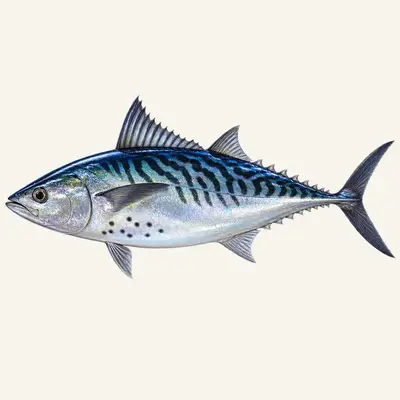
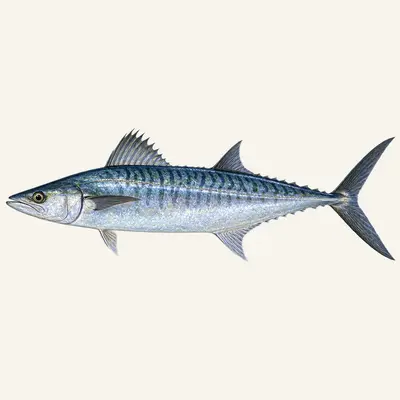
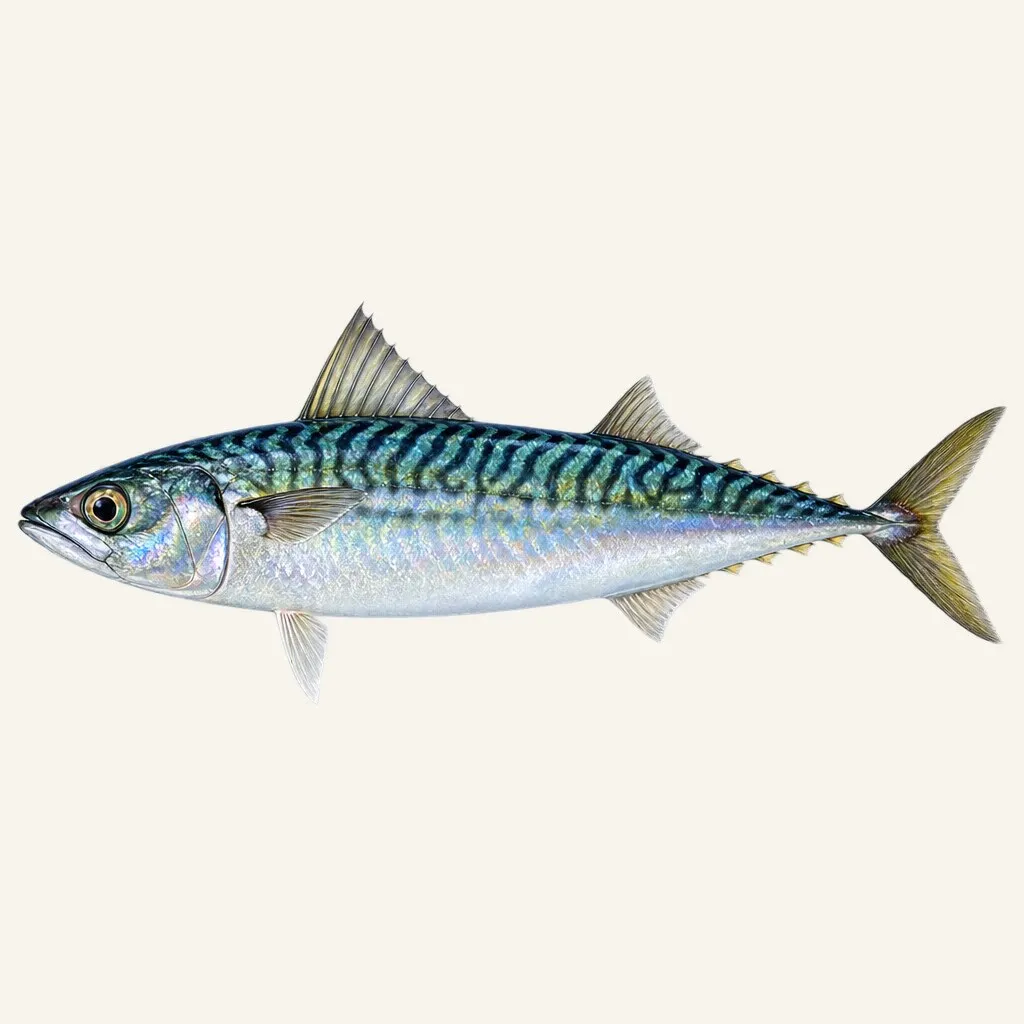
The chub mackerel is a slender, fusiform fish with a blue-green back crossed by dark wavy lines and a silvery, spotted belly; a coastal pelagic species found in temperate and tropical seas worldwide.
Calendar
Recorded in 27 countries
Argentina · Cameroon · Canada · Chile · China · Colombia · Congo - Brazzaville · Côte d’Ivoire · Equatorial Guinea · France · Gabon · Ghana · Guinea · Guinea-Bissau · Israel · Japan · Liberia · Mexico · Mozambique · Namibia · Nigeria · Senegal · Sierra Leone · South Africa · Spain · Taiwan · United States
GBIF occurrence records — native and introduced populations combined.
Its range
The range is anti-tropical, which is to say it occupies the warm-temperate belts on either side of the tropics and skips what lies between. It runs from South Africa, the Western Cape round to Natal, and from Madagascar to the Philippines, north as far as Russia and the Gulf of Alaska, south as far as Chile. It is absent from the northern Indian Ocean and from the Red Sea.
Three corrections in the record are worth relaying, because between them they invalidate a great deal of published material. Reports of this species from the Atlantic, the Mediterranean included, refer to Scomber colias. Reports from the Red Sea and the northern Indian Ocean refer to Scomber australasicus. This mackerel is therefore neither a Mediterranean nor an Indian Ocean fish, whatever a large body of older literature says.
Identifying it
This mackerel has a swim bladder. Its Atlantic namesake, the mackerel of European markets, has none, and the presence or absence of that one organ separates two fish that are otherwise built to the same drawing.
It is not a dissection curiosity. A mackerel without a bladder sinks whenever it stops swimming and is condemned to permanent movement. This one can hold a depth without working for it, and the behaviour of the species follows directly: it settles near the bottom through the daylight hours, climbs into open water after dark, and in Asian waters drops into deep water and goes inactive for the winter. None of those three things is available to a fish that has to swim to stay up.
The internal characters are the ones to check on a specimen in hand, and on two of them the two mackerels answer each other directly. Twelve to fifteen interneural bones sit beneath the first dorsal fin here, against 21 to 28 in the published description of the Atlantic fish. The first haemal spine lies behind the first interneural process here, and in front of it there. Both counts are recorded on both sides, which is what makes them usable rather than merely present. There are 31 vertebrae.
Externally, the gap between the two dorsal fins is shorter than the base of the first, or equal to it — never longer. A single conspicuous spine stands ahead of the anal fin, tied to the rays behind it by a membrane while plainly not belonging to them. Five finlets run along the top edge of the caudal peduncle and five along the bottom. The interpelvic process is small and single, and there is no corselet worth the name.
Counts: 9 to 11 dorsal spines, 11 to 12 soft rays behind them, one anal spine and 12 to 14 anal rays.
The back carries narrow stripes that zigzag and undulate; the description of the Atlantic mackerel gives markings with relatively little undulation to them, so the degree of waviness is a comparison the two accounts make between themselves. The belly of the Pacific population is unmarked.
Breeding
Spawning most often occurs between 15 and 20 degrees, in successive batches through the season.
Fecundity is recorded per unit of mass rather than per fish: 250 to 300 eggs for every gram of fish, which works out at 100,000 to 400,000 eggs for a female across the size range. Expressing it that way is more informative than a total, because it says that output tracks weight strictly, with no disproportionate advantage to a large individual.
Maturity arrives around 26.1 cm, against a recorded lifespan of 18 years. The gap between those two numbers is the striking part: this fish spends the great majority of its life as a breeding adult, and a population accordingly holds a long series of age classes rather than three or four.
The water it needs
A coastal pelagic species, and to a lesser extent an epipelagic to mesopelagic one over the continental slope. The recorded band runs from the surface to 300 m, with 50 to 200 the usual working range, in water from 10 to 27 degrees.
Schooling is organised by size and it begins at about 3 cm. That precision deserves attention: the sorting by calibre is installed before the fish is as long as a finger, and it is maintained thereafter. Mixed schools also form, with the eastern Pacific bonito, the jack mackerel and the South American pilchard.
The daily rhythm is the fact to hold onto. Adults stay close to the bottom by day and rise into open water at night to feed.
Areas
- Coastal pelagic waters
- Upwelling zones
- Around headlands and rocky points
- Under bird aggregations
Techniques
- Feather lure fishing
- Metal lure casting
- Surface trolling
- Drifting with live bait
Baits
- Coloured feathers
- Metal lures
- Small squid
- Fish strips
What it eats
Copepods and other crustaceans first, with fishes and squid alongside them.
The timing is the interesting part. Feeding happens in open water after dark, which means the whole of it is compressed into the hours the animal spends off the bottom. A fish holding deep through the daylight is not feeding then, and the daily ration has to be taken inside a single window.
The mixed schools follow from the menu. Sharing water with a pilchard and a jack mackerel means sharing the plankton with them too.
How to catch it
The day-night cycle decides everything else. Near the bottom in daylight, in open water at night: one piece of ground demands two different approaches depending on the hour, and getting it wrong means fishing an empty layer rather than a poor one.
Schools sorted by size from 3 cm onwards make the first fish informative. A capture announces a calibre, and a school of small fish stays a school of small fish, so there is no point working through them in hope of something larger.
The swim bladder has a consequence that runs opposite to its Atlantic relative's. A gas-filled bladder is the thing that makes barotrauma possible at all, and this fish spends its daylight hours at depths where that matters, so a release from 150 m is not the same proposition as a release from the surface layer at night.
The species is used as bait as a matter of course, and it is farmed commercially in Japan. Both facts mean there is always a market for a catch, whatever its size.
Conservation
In the eastern central Pacific the stock is treated as straddling — it crosses the economic zones of several states and stretches of high seas in the course of its movements. No single country can manage it alone, and its trajectory depends on agreements rather than on national decisions.
Fecundity strictly proportional to mass has a consequence that cuts against the usual advice. There is no particular argument here for sparing the large individuals, because a kilogram of large fish and a kilogram of small ones carry the same number of eggs. What counts is the tonnage taken, not the size at which it is taken — the opposite of the position for most long-lived fish.
The winter behaviour deserves a mention of its own. In Asian waters the fish concentrate in deep water and remain inactive for a season, which makes them findable in a predictable place at a predictable time of year. A species that gathers and stops moving is a species whose whereabouts a fishery does not have to guess at.
Regulations
Check the local regulations in force (legal size limits, closed seasons, bag limits).
For guidance only. Legal sizes, quotas and open seasons vary by location and season: always check the local regulations in force before fishing.
Other names
Chub mackerel is the standard English name and Pacific mackerel the regional alternative on the American coast. In Japan it is saba, and among the most heavily consumed fish in the country.
Trade names confuse it constantly with Scomber colias of the Atlantic, which is unsurprising: that fish was for a long time included in this species and carried this name, and the two were separated only after the market had settled on its own vocabulary. A packet labelled chub mackerel says nothing certain about which ocean it came from.
Sources: fishbase.se · api.gbif.org