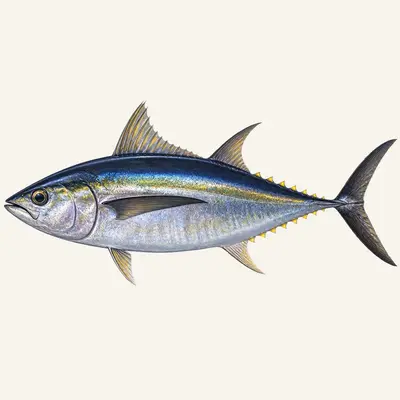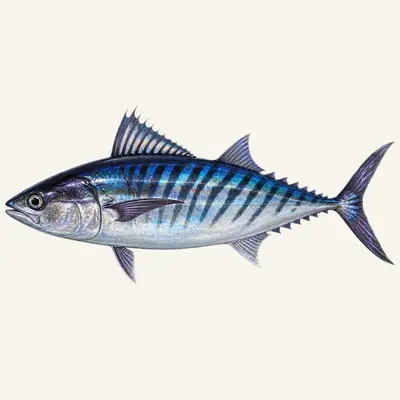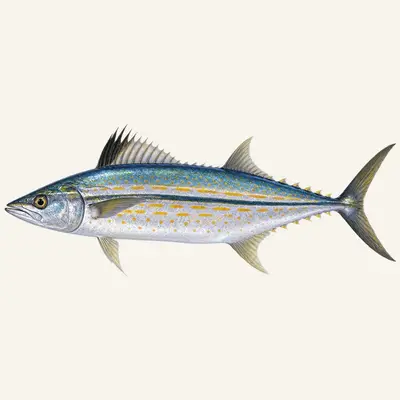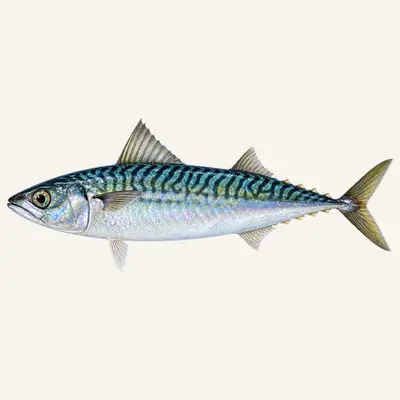
Bigeye tuna
Thunnus obesus · Scombridae
- Saltwater
- Big pelagics
- Medium
- Regulated
- Size
180–250 cm
- Weight
90–210 kg
- Lifespan
17 years
- Water temp.
13–29 °C
- Depth
0–1,500 m
Where to fish
- Offshore
Habitat icons: Flaticon
The bigeye tuna is a large pelagic tuna in the Scombridae family, recognisable by its massive head and large eyes adapted for deep-water hunting. Found in all tropical and temperate oceans, it regularly dives to hundreds of metres to feed, unlike shallower-ranging tunas.
Calendar
Recorded in 65 countries
Anguilla · Antigua & Barbuda · Australia · Bahamas · Belgium · Bermuda · Brazil · British Indian Ocean Territory · British Virgin Islands · Canada · Cape Verde · Caribbean Netherlands · Chile · Christmas Island · Cocos (Keeling) Islands · Comoros · Congo - Brazzaville · Côte d’Ivoire · Cuba · Denmark · Dominica · Dominican Republic · Equatorial Guinea · Faroe Islands · France · French Guiana · French Southern Territories · Gabon · Germany · Ghana · Greenland · Guadeloupe · Guinea · Guyana · Haiti · Iceland · India · Indonesia · Ireland · Kenya · Liberia · Madagascar · Martinique · Mauritania · Mayotte · Mexico · Mozambique · Netherlands · Norway · Portugal · Puerto Rico · São Tomé & Príncipe · Senegal · Seychelles · Sierra Leone · Somalia · Spain · Suriname · Svalbard & Jan Mayen · Tanzania · U.S. Virgin Islands · United Kingdom · United States · Venezuela · Western Sahara
GBIF occurrence records — native and introduced populations combined.
Its range
Occurrence here is not a fixed map. Where the fish turns up tracks seasonal and climatic changes in surface temperature and in the depth of the thermocline: what it is looking for is a thermal structure, and that structure travels. A ground that produced one year can be empty the next without the stock having changed in abundance at all.
The species holds tropical and subtropical water in all three oceans, from 52°N to 48°S, and does not enter the Mediterranean.
Identifying it
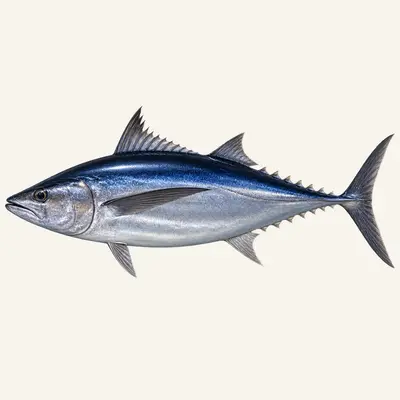
The character that identifies an adult misleads on a juvenile, and it is the pectoral fin. Past 110 cm fork length that fin is moderately long, between 22 and 31 per cent of the same measurement. Below 110 cm it is very long, as long as an albacore's, so a small bigeye passes for a small albacore — the commonest error in the genus.
Two things settle a small fish. The tip of the pectoral is rounded here and drawn to a point in an albacore. And the first gill arch carries 23 to 31 rakers, fewer than a yellowfin of the same length would show.
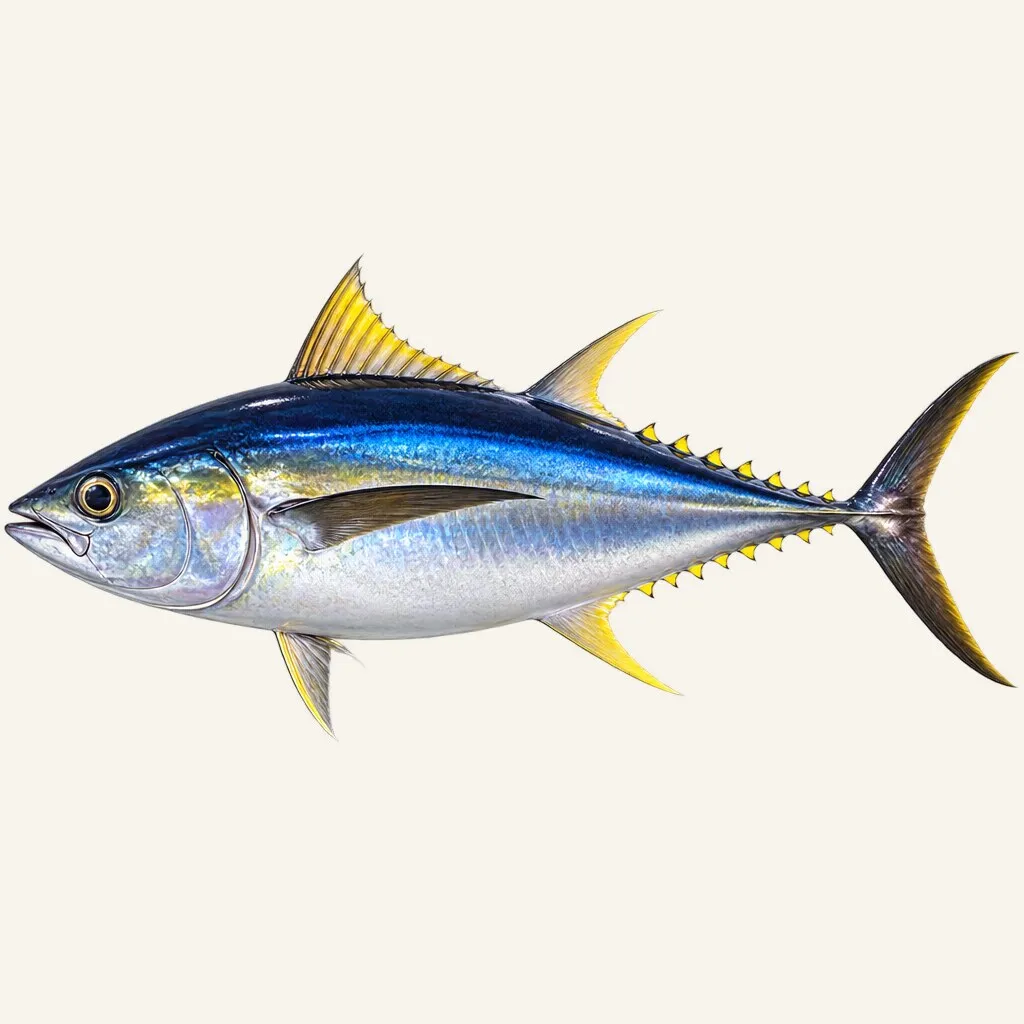
The rest is a heavy fusiform body, slightly flattened at the sides, the two dorsals divided by nothing more than a narrow gap. Eight to ten finlets follow the second dorsal and seven to ten the anal. Two flaps make up the interpelvic process. Scales are very small, the corselet of thicker ones present without standing out, and the caudal peduncle is exceedingly slender, carrying a strong lateral keel with a smaller one above and below it.
The livery is clean. Metallic dark blue over the back, whitish on the lower flank and belly, and on a living fish an iridescent blue band running the length of the side. First dorsal deep yellow, second dorsal and anal a paler yellow, finlets bright yellow edged with black.
Two characters need the fish opened. The underside of the liver is striated, and a swim bladder is present. On a quay, with the head and the fins gone, those are what remain to argue with.
Breeding
The moon sets the calendar. Spawning runs over the full-moon periods, in successive releases one or two days apart, and the whole business is spread across several months. In tropical water that regime holds all year.
Maturity comes at about 112 cm, within a range of 100 to 125. Set against a life of 17 years, that is late for a tropical tuna, and the entire conservation problem of the species descends from it.
The water it needs
Depth is what defines it. The recorded range reaches 1,500 m and ordinary activity covers the first 500, where most tropical tunas work a far thinner slice of the column.
Thermal tolerance runs from 13 to 29 degrees, but the optimum narrows to 17 to 22. A tight preferred band combined with a deep swimming habit puts the fish under the thermocline for a large part of the day.
Age has to be separated out. Juveniles and small adults school at the surface, alone or mixed with other tunas, and take readily to floating objects. Adults keep to deep water. These are two superposed populations, and the depth being worked decides which of them is met.
Areas
- Deep open ocean
- Below the thermocline
- Around offshore FADs
- Deep-water upwelling zones
Techniques
- Deep jigging
- Slow deep-sea trolling
- Night FAD fishing
- Deep live bait
Baits
- Deep-water squid
- Live baitfish (mackerel, sardine)
- Heavy jigs
- Natural deep lures
What it eats
Fish, cephalopods and crustaceans, across a wide range of each, taken by day and by night alike.
Round-the-clock feeding of that kind fits an animal that follows prey through the column instead of waiting for it to arrive at the top. A predator working 500 m of water has no reason to keep surface hours.
How to catch it
Everything turns on the layer. Presenting in the top twenty metres means fishing for juveniles around a drifting object; reaching an adult means getting under the thermocline, into water that surface trolling never touches. Depth fixes the size of fish encountered far more reliably than the choice of ground does.
Reading the water is therefore a vertical exercise: thermal break, thickness of the mixed layer, position of the thermocline. The classic offshore signs — birds, flotsam, a weed line — all point at the young end of the stock.
In tropical water the spawning calendar gives one more marker, since reproductive activity settles onto the full moons.
Regulated — Often governed by quotas, size limits, seasons, or reporting rules.
Conservation · Vulnerable (IUCN) — This species is threatened with extinction. Always release it (no-kill), handle it with the utmost care and check local rules — fishing for it may be prohibited.
Conservation
The fishery takes this fish before it breeds, and that is the whole of the matter. Juveniles gather at the surface around drifting objects, exactly where the encircling gear of the open ocean operates; adults hold depth, out of that gear's reach. A stock whose catchable fraction is almost entirely immature does not replace what is removed from it, and maturity at 112 cm pushes the mismatch further still.
The decline measured on that basis leaves the bigeye in a distinctly worse position than the yellowfin, which shares its water, its surface schools and the gear that takes both. The difference is not in the intensity of the pressure but in what the pressure reaches: on this species, surface gear almost never meets a breeder.
Value keeps the effort up. The flesh supplies the Japanese sashimi trade, where it is sought after, on top of the canning and freezing lines.
Regulations
Check the local regulations in force (legal size limits, closed seasons, bag limits). Species under monitoring — verify ICCAT/IOTC/WCPFC quotas.
For guidance only. Legal sizes, quotas and open seasons vary by location and season: always check the local regulations in force before fishing.
Other names
Bigeye tuna in English, and the eye is what nearly every language chose: patudo in Spanish and Portuguese, mebachi in Japanese, where the word carries the same sense. The convergence is not accidental for an animal that spends its days below the thermocline in very little light. A large eye is the equipment for that, and the name records the equipment.
French went the other way with thon obèse and thon ventru, naming the silhouette, and Italian followed the Latin into tonno obeso.
The English name is not exclusive, which is worth knowing before trusting a catch report. Bigeye scad, bigeye trevally and bigeye thresher share the adjective with fishes that have nothing else in common with this one, so the word on its own identifies an eye rather than a species: it is the second half of the name that carries the information.
Sources: fishbase.se · api.gbif.org