Blue marlin
Makaira nigricans · Istiophoridae
- Saltwater
- Coastal
- Hard
- Regulated
- Size
290–500 cm
- Weight
206–636 kg
- Lifespan
20 years
- Water temp.
22–31 °C
- Depth
0–1,000 m
Where to fish
- Offshore
Habitat icons: Flaticon
The Atlantic blue marlin is one of the largest open-ocean fish, commonly exceeding 400 kg, distinguished by its long spear-shaped bill and sickle-shaped dorsal fin. A pelagic fish of warm and temperate Atlantic waters, it swims alone at high speed thanks to its hydrodynamic body.
Calendar
Recorded in 12 countries
Australia · Brazil · Colombia · Côte d’Ivoire · Gabon · Guinea · Indonesia · Mexico · Seychelles · South Africa · United States · Venezuela
GBIF occurrence records — native and introduced populations combined.
Its range
Tropical and temperate water throughout the Atlantic, between roughly 50 degrees north and 45 south, in a thermal envelope of 22 to 31 degrees. That is the range under the convention this catalogue follows. Under the other convention in use, it is half of it.
The split rests on the lateral line. The reference followed here separates an Atlantic species from an Indo-Pacific one chiefly on the pattern of that canal network. Many scientists decline to accept the character as diagnostic at species level and treat the whole thing as one pantropical animal present in the Atlantic, the Indian and the Pacific.
Nothing about that is settled, and it decides how every paper on the fish should be read. Depending on the author in front of you, this species occupies one ocean or every warm sea on the planet. A catch series compiled under one reading cannot simply be added to a series compiled under the other.
Identifying it
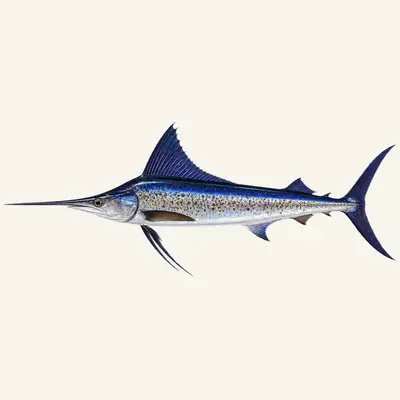
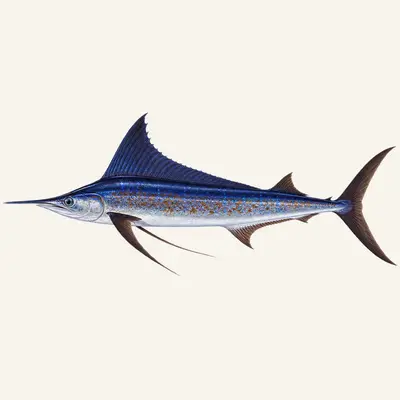
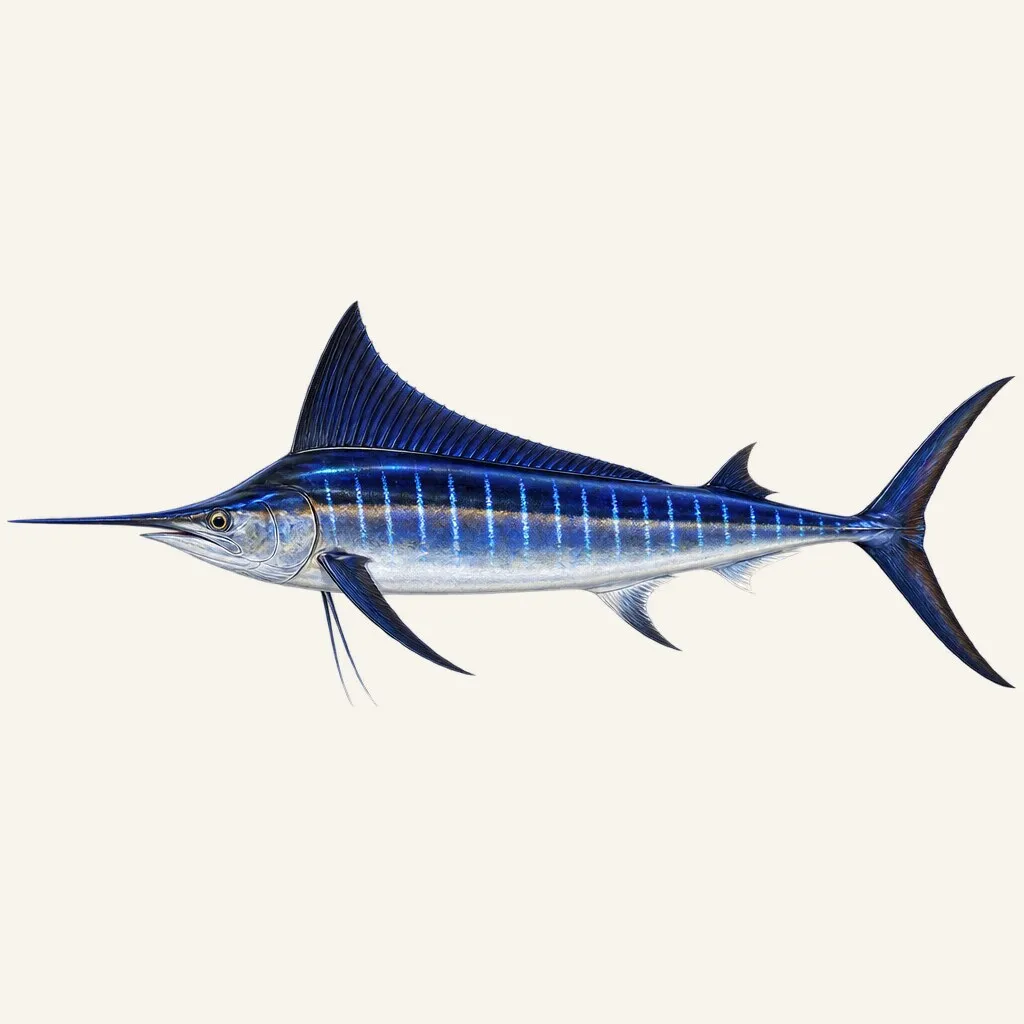
The first dorsal fin is plain. Blackish, or a dark blue, unbroken across the whole membrane. That plainness is worth treating as a character rather than as the absence of one, because the membrane of that fin is exactly where the Atlantic billfishes carry their marks when they have any — the white marlin's published description gives black dots on it.
Under the fin run about 15 rows of pale cobalt stripes, on flanks that pass from blue-black along the back to silvery white beneath. The stripes are faint. They do not settle an identification alongside the boat, and anyone expecting the crisp banding of a striped marlin will not find it here. A steadier detail sits lower down: the bases of the anal fins carry a tinge of the same silvery white.
The character that actually defines the species is not on the outside at all. Its lateral line is not a line. It is a network of interconnecting canals, and reading it means having the fish in hand and the skin cleaned. Everything unresolved about this animal's name comes out of that one structure.
Forty-five to fifty soft rays in the dorsal, 19 to 23 in the anal, and not a spine in either.
Breeding
Males mature at about 80 cm and females at about 50, and the females go on to grow the larger of the two. Both halves of that sentence run against the usual arrangement: here the sex that ends up bigger is also the sex that starts breeding earlier and smaller.
The practical reading is straightforward. A heavy fish is a female, and she passed the size at which she first spawned a very long way back.
Ova taken before ripeness are opaque, white to yellow, three to five tenths of a millimetre across. Ripe eggs running from the ovary are transparent, spherical and measure a full millimetre — a doubling in diameter, which is a much larger change in volume than the figures suggest at a glance.
The water it needs
An oceanic animal, recorded from the surface down to 1,000 m.
Water colour governs where it turns up, at least in the northern Gulf of Mexico, where the fish shows a preference for blue water. The hedge in that statement belongs to the source and is worth keeping: the observation is well established in one sector and stated for that sector.
It rarely gathers into schools. The normal encounter is a single fish, and the individuals are scattered.
Areas
- Tropical and subtropical open sea
- Gulf Stream current
- Submarine canyons and trenches
- Offshore thermal fronts
Techniques
- Offshore trolling
- Large surface lures
- Offshore live bait fishing
- Natural squid rigging
Baits
- Live tuna
- Rigged natural squid
- Large trolling lures
- Mahi-mahi
What it eats
Fishes make up most of it, filled out with octopus and squid. The list is unremarkable for an open-water predator of this size.
What is not unremarkable is the timing. Feeding takes place during daytime. Very few records carry that detail for a large pelagic, and it changes how the rest of the page reads: a predator that hunts in daylight, in the clearest water available to it, is hunting by sight. The preference for blue water and the daytime schedule are one fact stated twice.
How to catch it
Three constraints organise a trip, and all three come out of the record rather than out of custom.
Blue water rather than green. Daylight rather than dark. And single scattered fish rather than a body of them, which means ground has to be covered rather than occupied — a spot cannot hold what does not aggregate.
Each of those narrows the others. Blue oceanic water in daylight is a specific set of hours over a specific set of sea, and it has to be reached before it can be worked. The fishing is a passage rather than a session, and the distances are what make it one.
Females run larger, so a heavy fish is one that has been breeding for years. That is the argument for putting it back, and it is a stronger one here than the usual appeal to size.
Regulated — Often governed by quotas, size limits, seasons, or reporting rules.
Conservation · Vulnerable (IUCN) — This species is threatened with extinction. Always release it (no-kill), handle it with the utmost care and check local rules — fishing for it may be prohibited.
Conservation
The unresolved species question is a management problem before it is a taxonomic one. If the Atlantic and Indo-Pacific blue marlins are a single animal, the stocks are counted together and the total is large. If they are two, each is far smaller than the combined figure suggests, and the Atlantic one is being assessed against a number that includes fish in another ocean. Managers have to choose an answer that science has not supplied.
Ageing is the second weak point, and it is unusual enough to state plainly. The maximum reported age sits close to 20 years, and that figure was reached through a series of deductions applied to radiocarbon dating rather than read directly off a hard structure. Stock assessment runs on age structure. This one is reconstructed.
Set against those, one element is genuinely favourable. Females spawn from about 50 cm, and no fishery of any kind is working at that size. Recruitment is not depending on the fish that get caught.
The last difficulty is arithmetic. An animal that lives as scattered single individuals and rarely schools cannot be counted directly — not from the air, not from a survey vessel, not from anything but what is landed. Abundance is inferred from catch, and catch responds to effort as much as to abundance.
Regulations
Check the local regulations in force (legal size limits, closed seasons, bag limits).
For guidance only. Legal sizes, quotas and open seasons vary by location and season: always check the local regulations in force before fishing.
Other names
Blue marlin, and Atlantic blue marlin where the basin has to be stated. That qualifier is the whole of the taxonomic argument compressed into an adjective: under one convention it names the species, under the other it names half of a pantropical one.
The Iberian languages went to the needle — aguja azul in Spanish, agulhão-azul in Portuguese — and describe the bill as a tool for piercing. English, German and Italian all kept marlin, which comes from the marlinspike, the tapered iron a sailor drives into the lay of a rope to open it. Two metaphors for the same rostrum, one from sewing and one from rigging.
The epithet nigricans means blackening. It describes the fins, which are brown-black, and not the fish, whose back is blue.
Sources: fishbase.se · api.gbif.org