Bowfin
Amia calva · Amiidae
- Freshwater
- Predators
- Medium
- Size
53–109 cm
- Weight
1.0–9.8 kg
- Lifespan
30 years
- Water temp.
15–20 °C
Where to fish
- Lake
- River
Habitat icons: Flaticon
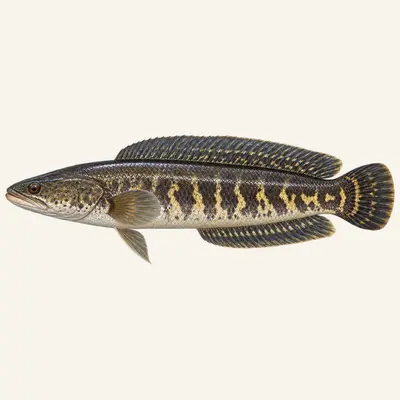
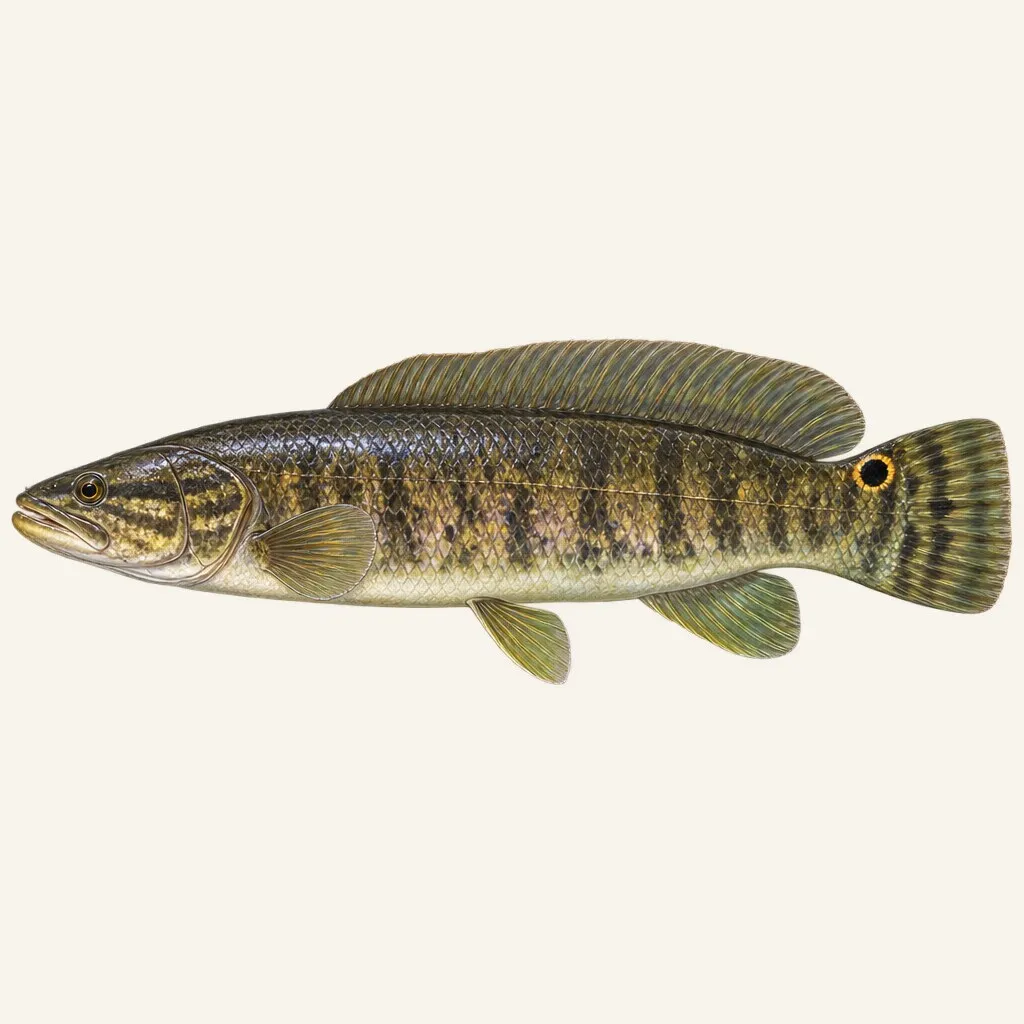
Archaic fish of the Amiidae family, with a cylindrical, robust body, long dorsal fin and broad head; the male bears a distinctive eyespot at the base of the tail.
Calendar
Recorded in 2 countries
GBIF occurrence records — native and introduced populations combined.
Identifying it
Forty-two to 53 soft rays in the dorsal fin, 9 to 12 in the anal. The fin above starts a third of the way down the body and runs almost to the tail; the fin below is a short triangle. That mismatch is the silhouette, and it settles the identification at a distance.
The counts behind it are all high: 80 to 90 vertebrae, 10 to 12 branchiostegal rays. The head is conic, the mouth large with the maxilla reaching well past the eye, the jaws set with strong conical teeth, and the anterior nostrils open at the base of short barbels.
Colour is a reticulation. Dark olive over the back breaks up against paler flanks; the belly is cream or greenish; the head is yellow to brown with darker horizontal bars, the tail light olive with irregular vertical ones. The lower fins are vivid green.
One mark is a sex character and it is the useful one. Adult males carry a black spot bordered in yellow to orange at the upper base of the tail, faint or absent in females. Reading it takes a second and it identifies the sex of the fish in the hand, which matters in the spawning season for reasons set out below.
Breeding
Males nest in colonies. Each one builds, then guards the eggs and after them the young, and the nests are grouped — so what is at stake in one corner of a swamp is not a clutch but a settlement of them.
Building means clearing: the male strips vegetation out of the site. The eggs are adhesive and fasten to decaying plant material and standing weed. Spawning is done at night, with the fish most active at dusk and at dawn either side of it.
Hatching takes 9 days and the young emerge at 8 mm, still carrying an adhesive organ that holds them to roots or lays them on the bottom inside the nest. Once that organ is absorbed they leave it, and the male keeps station outside the nest around a tight swarm of larvae until they swim freely.
Two facts about the adults sit oddly against all of that. Males are always smaller than females, and females live longer. The sex doing the guarding is the smaller and the shorter-lived of the two.
Maturity arrives at around 53 cm, anywhere between 38 and 68.
The water it needs
The lethal temperature is given to one decimal place: 35.2 degrees. Very few entries in this catalogue come with a figure that precise, and for this animal it is the limit that actually limits, because the usual ones do not.
Oxygen does not. The bowfin breathes air, facultatively, when it needs to, and that is what lets it hold in swamps, sloughs, lakes and the pools and backwaters of lowland streams in the state those waters reach by late summer — warm, still, stripped of oxygen and lethal to most of what was in them in spring. It is also recorded aestivating, which is surviving the loss of the water rather than the loss of its oxygen.
So the ceiling here is thermal rather than respiratory. Between the band the species is normally logged in, 15 to 20 degrees, and the temperature at which it dies, there is a wide margin that air breathing keeps available — and it is that margin, not the teeth or the diet, which decides where the fish can be.
Vegetation is the other constant. Adults are found near it, and the nest requires it.
Areas
- Wooded swamps
- Floodplains
- Cluttered shallow lakes
- Vegetated oxbow lakes
Techniques
- Soft plastic lures
- Live bait mid-water
- Night bottom fishing
- Surface lures
Baits
- Earthworms
- Small live fish
- Crayfish
- Fish-imitating soft plastics
What it eats
It hunts by smell and it feeds by suction. The record has the species using scent as much as sight and taking food by gulping water, so the movement that fills the animal with air at the surface brings prey into it below, and neither depends on being able to see.
That is the right way round for the water involved. A stained, weed-choked, muddy backwater is a poor place to hunt by eye, and this animal's answer was not a better eye.
The list is broad and the record calls it voracious and opportunistic: fishes, including sport species, frogs, crayfish, insects, shrimps. Small juveniles start on microcrustaceans and insects.
The clause about sport fishes is the one that shaped the reputation, and the same file then classes the bowfin as of no interest to fisheries and as a gamefish, in consecutive lines. It has been both at once for a long time.
How to catch it
Dusk and dawn are the windows the record names, with spawning at night between them, so a warm-season session straddling the light covers the activity.
Scent brings the fish to the bait, and that changes what the water needs to be. Colour, stain and thick weed are not handicaps in this fishery: a bait working by smell where a lure cannot be seen is playing to the animal's own method. The list here runs both ways — soft plastics and surface lures on one side, live bait held in midwater and static night fishing with worm, small live fish or crayfish on the other.
The teeth set the terminal tackle. Strong conical jaw teeth on a fish of 53 cm common length will find any weakness ahead of the hook.
Then there is the fish in the hand. Thirty years is the recorded ceiling on age, and the family is down to this one living species. A large bowfin is old twice over, in its own life and in its line.
Conservation
Two things in the file bear on this species, and neither of them is its abundance.
The first is where it breeds. Colonial nesting needs shallow, vegetated, standing water — swamps, sloughs, floodplain backwaters — which is the exact category of habitat that drainage takes out first. Tolerance of heat and low oxygen protects an adult bowfin from most of what degrades its water. It does not protect the nest against the water being gone.
The second is the male on that nest. Through the season he is fixed over a cleared patch of shallow weed with a brood he is the whole defence of, and the black-and-orange spot at the base of his tail identifies him in the hand in a second. That is an unusual amount of information to be handed about the consequence of a decision, and it removes the excuse of not having known.
Regulations
Check the local regulations in force (legal size limits, closed seasons, bag limits).
For guidance only. Legal sizes, quotas and open seasons vary by location and season: always check the local regulations in force before fishing.
Other names
Bowfin is the accepted name and it points at the fin that identifies the animal, which makes it one of the more useful names in this catalogue. The alternatives in North American use are less helpful. Dogfish belongs to several small sharks. Grinnel and grindle are local and travel badly. Mudfish gets applied to other things in the same swamps.
Five of the six catalogue languages give up on describing it and take the genus name instead — Amia in Spanish, Italian and Brazilian Portuguese, amie in French. German built a compound, Kahlhecht, a bald pike, which pairs the epithet with a fish this one is not related to.
Calva means bald or bare. Amia holds one living species, and the record calls it a lone survivor of the family Amiidae and a living fossil, the second phrase inside the source's own quotation marks.
Sources: fishbase.se · api.gbif.org