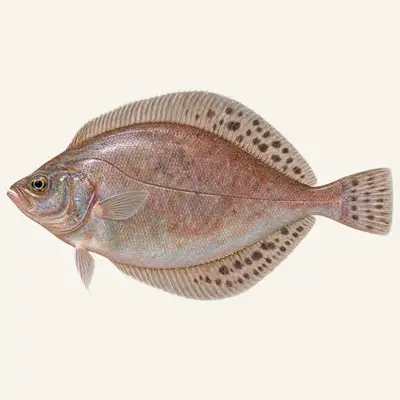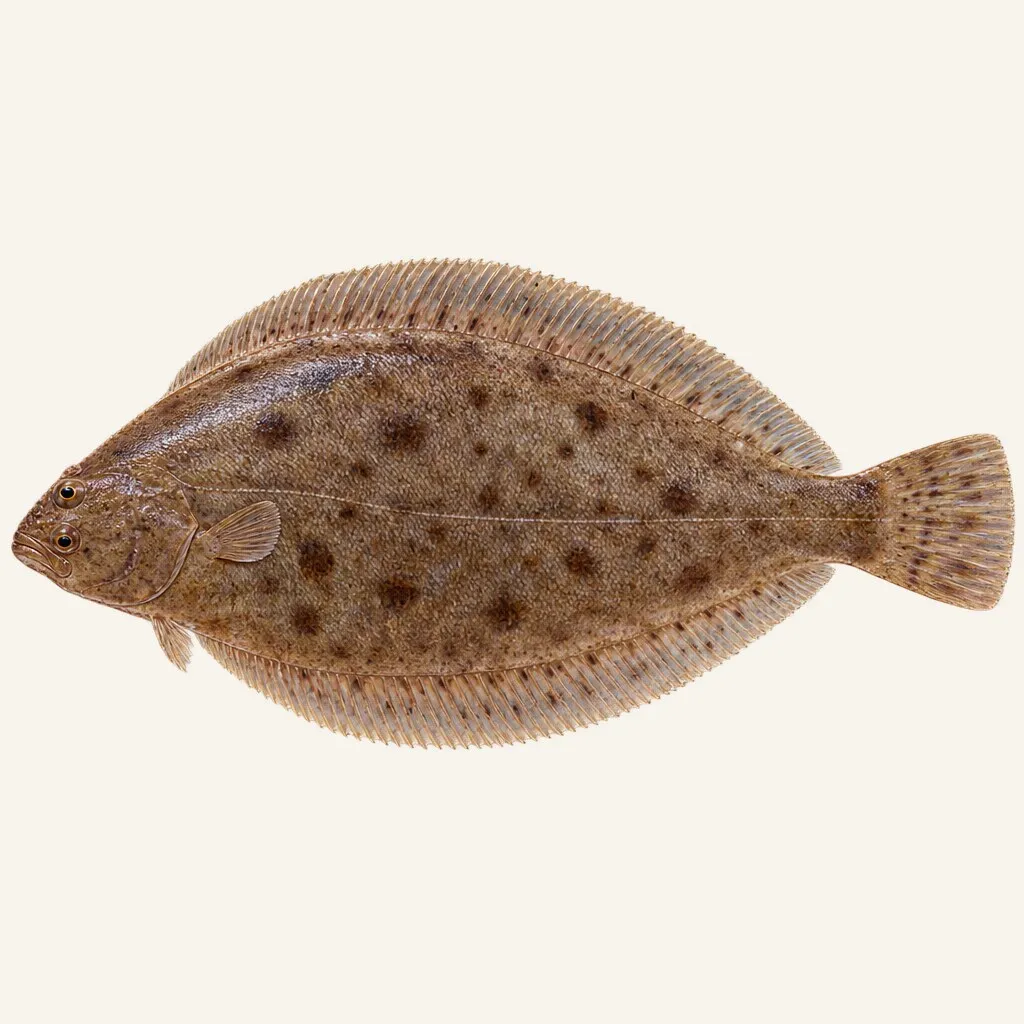
Common sole
Solea solea · Soleidae
- Saltwater
- Flatfish
- Medium
- Size
35–70 cm
- Weight
0.4–3.0 kg
- Lifespan
26 years
- Water temp.
8–24 °C
- Depth
0–150 m
Where to fish
- Estuary
- Beach
Habitat icons: Flaticon
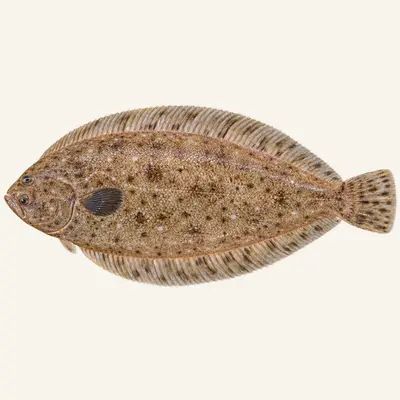
The common sole is an oval flatfish with brownish-grey skin, lying flat on sandy or muddy bottoms along European coasts. Its small, arched mouth is well suited for probing sediment in search of worms and small invertebrates.
Calendar
Its range
The range takes in three seas that a coastal flatfish has no obvious business in. Beyond the open Atlantic coast it holds the western Baltic, the Sea of Marmara and the south-western Black Sea, reaching the last two through the Bosporus — narrow, shallow doorways into brackish basins. The northern limit is Trondheim Fjord; southward it runs to Senegal, with Cape Verde offshore.
Between those ends temperature does the work. Adults live between 8 and 24 degrees, and that envelope closes the range at both extremities without any coastline being involved.
Inside the envelope the occupation is granular rather than continuous. A fish that spends the day buried needs sand or mud, and a rocky shore holds none of it whatever the temperature. The map is read bay by bay.
Identifying it
A true sole is determined from underneath, and the character is the nostril. On the blind side the anterior nostril stays small — no enlargement, only a low rim around it — and it sits much nearer the front edge of the head than the mouth cleft, in a ratio of one and a half to nearly two. On the eyed side that same nostril carries a tube pointing backwards, and the tube just reaches the front border of the lower eye, sometimes not even that. Those two proportions are what separate the genuine soles from the several flatfishes that pass for them on a slab.
Above, the head is featureless by design. The preopercle is buried under skin and the opercle is fully scaled, so nothing on it projects and nothing on it cuts. The mouth is small, arched and set low, opening downwards. The scales are rectangular and ctenoid, rough under a hand run from tail to head.
The fins go almost all the way round. Dorsal and anal are long and spineless, joined to the caudal by a well-developed membrane without the caudal peduncle ceasing to be distinct — a combination few flatfishes share. The dorsal starts far forward, level with the upper eye. Counts run 69 to 97 dorsal rays, 53 to 80 anal rays, 46 to 52 vertebrae.
Both eyes lie on the right side. Reversed fish, with the eyes on the left, do occur; they are the same species, and the anomaly changes nothing else about the determination.
One character settles the species where its southern congener occurs. On the eyed-side pectoral this fish carries a compact black blotch confined to the rear of the fin, not a blackening of the whole outer half.
Breeding
Three to five years pass before a sole spawns, at a length of 25 to 30 cm. First maturity is put at 30.3 cm, and the animal reaches 26 years: the breeding life is long, and it starts late.
Spawning takes place in shallow coastal water at 6 to 12 degrees, in successive batches. On the Atlantic seaboard it occupies February to May — off Galicia, for instance — while in warmer water, the Mediterranean included, it can begin at the start of winter. The calendar therefore shifts by several months across the range, and a date means nothing without a coast attached to it.
Incubation lasts about five days at twelve degrees. The larval phase runs some 35 days at eighteen, spent in open water, and it closes with the metamorphosis that brings both eyes onto one side and lays the fish down on its blind flank.
One detail contradicts everything else about the animal. Adults are frequently taken in midwater during their spawning migrations: a fish that spends its life inside the sediment leaves it in order to breed.
The water it needs
A sole is not on the bottom but in it. It burrows into soft ground, sandy or muddy, and spends the daylight covered. Ordinary depth is 10 to 60 m, the recorded range reaches 150, and the fish withdraws seaward in winter.
It is solitary. That is what separates it from the shoaling flatfishes, and it changes how a mark is judged: ground that gave up one sole does not necessarily hold ten.
The first two or three years happen somewhere else entirely. Juveniles occupy coastal nurseries — bays, estuaries, shallow soft-bottomed ground — before moving out to deeper water. The species also enters brackish water, which is why estuaries belong on the nursery list rather than at the edge of the range.
Areas
- Fine sand beaches at low tide
- Coastal muddy bottoms
- Sandy estuaries and lagoons
- Shallow flats near river mouths
Techniques
- Night bottom fishing on sandy ground
- Light surfcasting
- Bottom fishing with flat sinker
- Very slow dragging along the bottom
Baits
- Lugworms and ragworms
- Peeled shrimps
- Small marine worms
- Mussel pieces
What it eats
Worms, molluscs and small crustaceans, taken off and out of the sediment at night. The mouth accounts for the entire list: small, arched and turned downwards, it is a tool for collecting rather than seizing, and nothing on the menu can flee.
Feeding at night is a rhythm rather than a preference, and it is absolute enough to count as a practical fact. By day the fish lies buried, sometimes less than a body length from a bait on the sand, and nothing happens.
How to catch it
The mouth sets the tackle before anything else does. A small, downward-opening mouth takes a small hook and a bait scaled to it — marine worms are the standard — presented flat on the bottom rather than above it.
The hour is not negotiable. Feeding is nocturnal, so the session is nocturnal.
The ground follows from the burrowing: beaches and soft foreshores, channels, the margins of banks. Rock wastes a tide.
The season follows the fish's own vertical movement. Winter withdrawal offshore takes it beyond casting range; the return to shallow coastal water to spawn, at 6 to 12 degrees, brings it back within reach of the shore. In the Mediterranean that sequence runs several months earlier.
Then the age structure. Common length is 35 cm and first maturity falls near 30, but three to five years pass before a fish arrives there. A good share of what a beach produces has not yet spawned, which gives the return of small fish a direct bearing on what the sector holds later.
Conservation
A large part of this stock depends on one intertidal sea. The Wadden Sea is the most important nursery ground the species has, and juveniles spend two to three years in such places before going offshore. Whatever happens in those shallows — dredging, freshwater input, siltation, hard engineering of the shoreline — acts on an entire year class, and no fishing gear need be involved.
That is the mechanism behind a trait recorded without explanation: recruitment is very variable. The chain is short and every link of it is coastal. Spawning happens inshore, the larvae drift, metamorphosis coincides with arrival on the nursery, and the nursery holds them for years. A short chain passes a bad season through intact.
The species is at the same time among the most heavily fished flatfishes in Europe, and the available data have not supported a global verdict on its abundance; what exists is regional, worked out fishery by fishery. The consequence for a shore angler is indirect but real. The state of one sector cannot be inferred from the state of its neighbour.
Regulations
Check the local regulations in force (legal size limits, closed seasons, bag limits).
For guidance only. Legal sizes, quotas and open seasons vary by location and season: always check the local regulations in force before fishing.
Other names
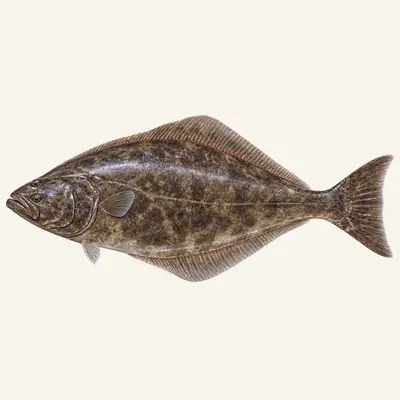
Common sole and Dover sole both name this fish in Britain, the second after the port that supplied the London market rather than after any variety. The name has since travelled badly. In North America, Dover sole on a menu is usually Microstomus pacificus, an unrelated Pacific flatfish, so a market name is not a determination. Irish usage adds black sole for the same animal.
Solea is the Latin for a sandal, or the sole of a foot, and the scientific name simply says it twice. German took a different image with Seezunge, sea tongue, and Spanish followed it with lenguado. Between them the fish is either something worn under a foot or something inside a mouth.
Sources: fishbase.se · api.gbif.org