Dogtooth tuna
Gymnosarda unicolor · Scombridae
- Saltwater
- Big pelagics
- Medium
- Size
190–248 cm
- Weight
101–131 kg
- Water temp.
20–28 °C
- Depth
0–250 m
Where to fish
- Reef
- Rocky shore
- Offshore
Habitat icons: Flaticon
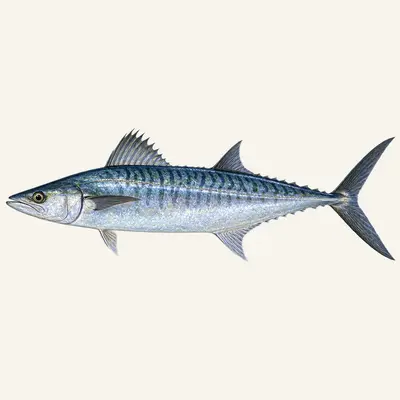
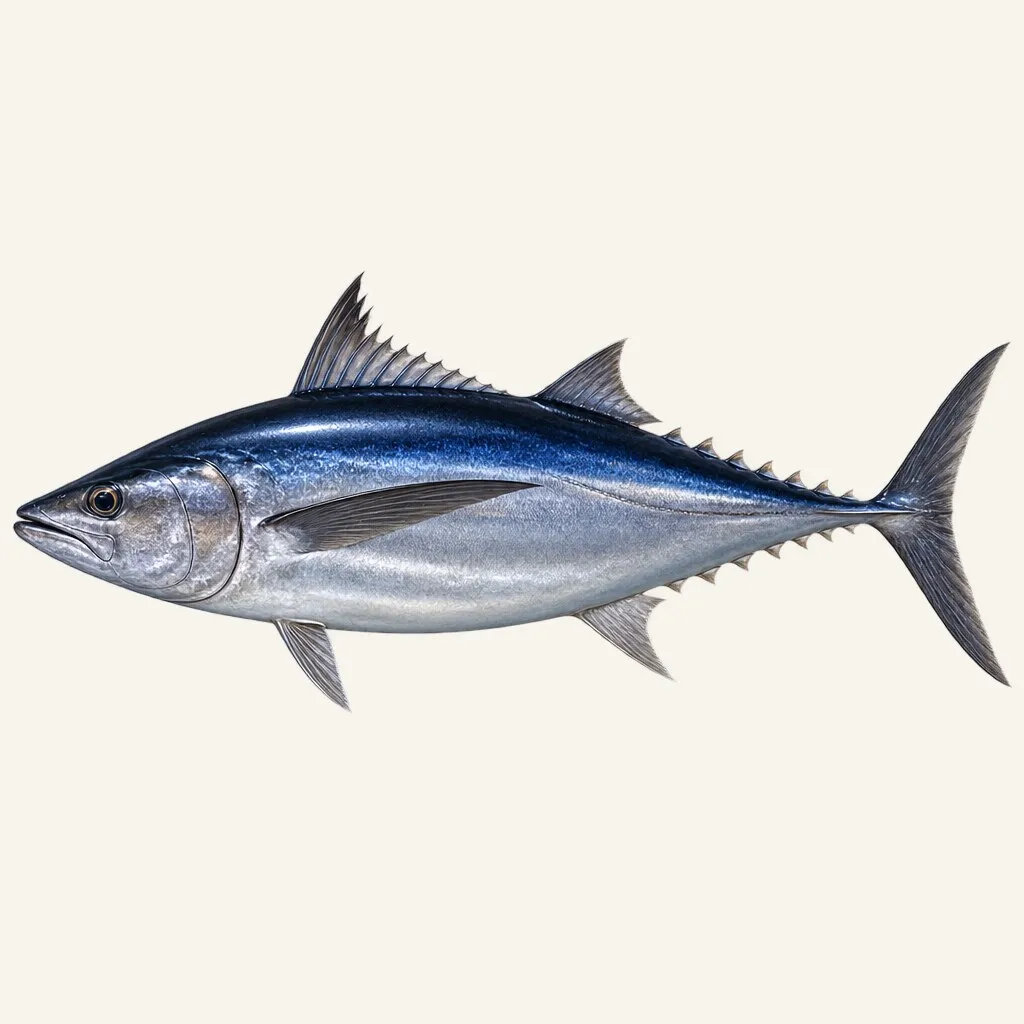
The dogtooth tuna (Gymnosarda unicolor) is a large Indo-Pacific pelagic tuna with a streamlined silver body, distinguished by its prominent conical teeth and lack of stripes on the belly. A powerful solitary predator, it hunts in deep blue water around reefs and drop-offs.
Calendar
Recorded in 16 countries
American Samoa · Australia · Egypt · Fiji · French Polynesia · Guam · Indonesia · Japan · Maldives · Marshall Islands · Mayotte · New Caledonia · Northern Mariana Islands · Philippines · Réunion · Seychelles
GBIF occurrence records — native and introduced populations combined.
Its range
Red Sea and East Africa eastward to French Polynesia, north to Japan, south to Australia, between 31°N and 30°S.
The eastern limit is the informative one. The range stops at about 130°W, in the middle of the Pacific, and warm water carries on from there all the way to the American coast without the fish following it. What runs out at that longitude is not temperature but coral: the eastern Pacific has warm surface water and very little reef, and this species needs the second thing rather than the first.
Read the map that way and the range stops being a latitude band and becomes an outline of tropical reef, western Indian Ocean to central Pacific, with a narrow thermal envelope of 20 to 28 degrees drawn round it.
Identifying it
The body carries no lines, no spots and no markings of any kind. The back and upper sides are a brilliant blue-black, the lower sides and belly silver, and between them there is nothing to read. The epithet records that emptiness, and on a large fish it is the first thing to notice, because every neighbouring scombrid has something written on it.
The teeth are the second thing. Fourteen to 31 large conical teeth stand in the upper jaw and 10 to 24 in the lower — large in the plain sense, individually visible, set in a mouth that reaches back to the middle of the eye. Two patches of villiform teeth sit on the upper surface of the tongue as well.
Then the gill rakers, which run to only 11 to 14 on the first arch. That is a low count, and it belongs with the dentition: an animal that seizes whole prey has no use for a fine sieve behind the jaws.
Three further characters are worth carrying. The lateral line is strongly undulating rather than sweeping down in a smooth curve. The interpelvic process is large and single, not a pair of small flaps. And behind the corselet the body is naked except along the lateral line, the dorsal-fin base and the caudal keel.
Counts: 13 to 15 spines in the first dorsal, whose upper edge is almost straight, 12 to 14 soft rays behind it, 12 or 13 in the anal, and 38 vertebrae. Six or seven finlets follow the second dorsal and six the anal, the pectorals carry 25 to 28 rays, and the tail base is slender with one well-developed keel between two smaller ones on each side. The tip of the first dorsal is dark; the other fins are grey.
The water it needs
This is a tuna that lives on the reef.
The record describes an offshore species found mainly around coral reefs, in water from the surface to 250 m and between 20 and 28 degrees. That association reorganises everything else about the animal, because it is not how the family works. Its relatives are creatures of open water that come to a reef occasionally or not at all; this one is described the other way round.
It is also, for a scombrid, almost unsociable. It is generally solitary, and where it does travel in company the groups run to six individuals or fewer. There is no shoal here to locate, no surface commotion to spot from a mile off, and no assumption that a second fish is nearby because a first one was.
Areas
- Outer reef drop-offs
- Offshore seamounts
- Deep reef passes
- Pelagic current zones
Techniques
- Deep jigging
- Big lure trolling
- Surface popper
- Live bait trolling
Baits
- Heavy metal jig
- Large surface popper
- Live bait (small mackerel)
- Sinking soft lure
What it eats
Small schooling reef fishes — scads, fusiliers, surgeonfishes, fairy wrasses — and squids.
The bottom of that list is the surprise. Fairy wrasses are small, delicate planktivores of the reef face, and they are being eaten by a predator whose common capture length is around 190 cm. Nothing in the diet is an offshore animal. The fish is not hunting the blue water it swims through; it is working the shoals that live against the coral and depend on it.
That single observation explains the solitary habit better than any argument about temperament. A reef face is a linear feature holding a finite number of prey shoals. It supports a patrolling predator that covers ground; it does not support a thousand of them travelling together, because there would be nothing at the end of the patrol.
How to catch it
The position is the drop-off, and the fish is met rather than intercepted. Because a shoal is not the target, the work is covering structure — the outer edge of a reef, a pass, a seamount — and returning to the same relief, which is where a solitary patrolling animal will come past again.
The main commercial method on record is pole-and-line. That deserves a moment: a hand method, taking one fish at a time onto a fixed length of line, applied to an animal of this size. It works only because the fish comes within reach of a boat held over the reef, which is exactly the property that separates this species from the open-ocean tunas.
The dentition sets the tackle. Large conical teeth make short work of unprotected line, and they will also open out a hook that was chosen for a smaller fish. Nothing about the terminal end of the rig should be scaled to the bait.
Adults may be ciguatoxic, and here the warning fits the animal for once. Ciguatoxin is manufactured at the base of a coral food chain; most scombrids carrying such reports are oceanic fish for which the pathway is obscure. This one lives on the reef, eats reef fish and grows very large, which places it at precisely the end of the chain where the burden concentrates. Cooking and freezing do nothing to it, and whether a given stretch of reef is affected is answered by the people who fish it.
Conservation
Two figures that most species pages can lean on are simply not in the file: there is no length at first maturity recorded for this species, and no maximum reported age. Nothing supports a yield calculation, a minimum size or a rebuilding estimate, because the two numbers those calculations start from have not been established.
What is known is the shape of the exposure. A solitary animal attached to reef structure is fished spot by spot. Removing the fish that patrols a particular drop-off does not thin a stock spread over an ocean; it empties that drop-off, and nothing arrives from a neighbouring shoal to replace it, because there is no shoal. Depletion in a species like this is local first and visible last, and it registers as a mark that stopped producing rather than as a change in any landing figure.
The fishery itself is described as minor commercial with a sport component, and the catch is canned and frozen. Small total volume across a very large range is a comfortable position on paper. It is compatible with a great many individual pieces of reef having been quietly fished out.
Regulations
Check the local regulations in force (legal size limits, closed seasons, bag limits).
For guidance only. Legal sizes, quotas and open seasons vary by location and season: always check the local regulations in force before fishing.
Other names
All six languages here name the teeth: dogtooth tuna, thon à dents de chien, atún de diente de perro, Hundszahn-Thun, tonno dente di cane, atum-dente-de-cão. Six for six is unusual agreement, and it is agreement on the character the description also opens with.
The scientific name went in the opposite direction and named two absences. Gymnosarda is the naked bonito, for the bare skin behind the corselet, and unicolor is for the body without markings. Both are confirmed word for word in the diagnosis — the fish is naked posterior to the corselet, and it carries no lines or spots — but between them they describe what is not there, while every fisherman who ever handled one named what is.
Sources: fishbase.se · api.gbif.org