Eastern Pacific bonito
Sarda chiliensis · Scombridae
- Saltwater
- Big pelagics
- Medium
- Size
102 cm
- Weight
11 kg
- Depth
0–100 m
Where to fish
- Offshore
Habitat icons: Flaticon
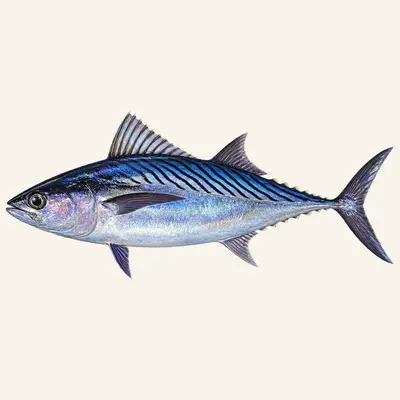
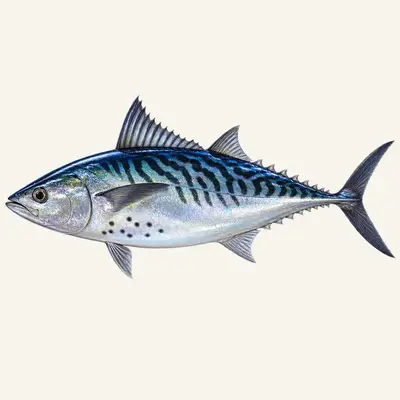
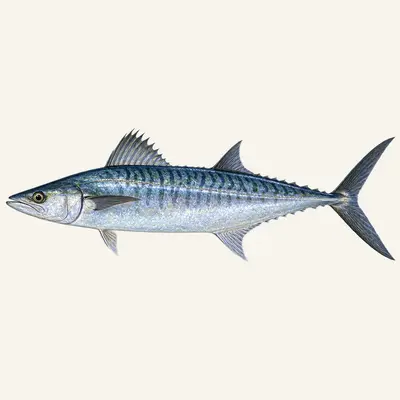
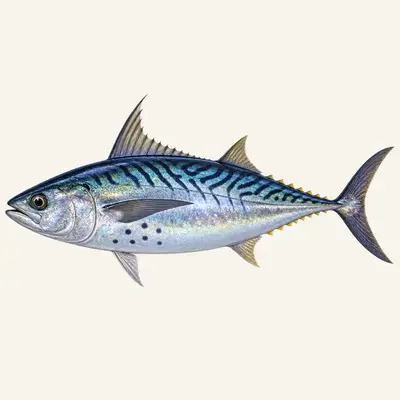
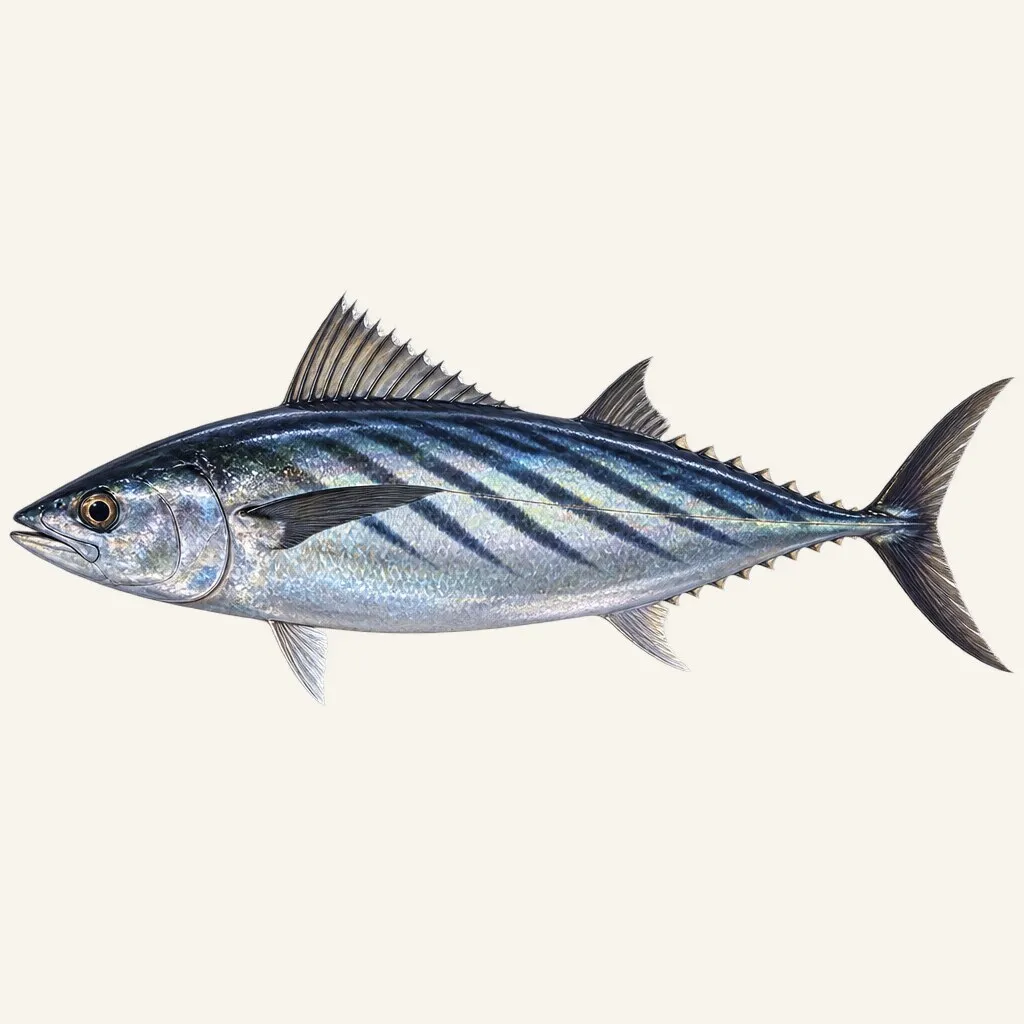
The eastern Pacific bonito is a coastal and pelagic Scombridae of the cold Humboldt Current waters along the Pacific American coasts. Its back striped with dark oblique lines on a blue-green background and its tapered body make it easily identifiable among coastal pelagics.
Calendar
Recorded in 4 countries
Chile · Colombia · Mexico · United States
GBIF occurrence records — native and introduced populations combined.
Its range
The range is cut into two halves that touch nowhere. The northern half runs from the waters off Alaska to the tip of Baja California, with the Revillagigedo Islands offshore; the southern half occupies northern Peru down to Talcahuano in central Chile. Between them lie several thousand kilometres of tropical coast without a single record.
That antitropical shape comes from currents rather than from latitude. The two halves face the two cool systems of the eastern Pacific, one running down along North America and the other up along Chile and Peru; the warm equatorial belt separating them belongs to neither, and the fish has no business there.
The separation is old and recognised in the nomenclature: the northern half carries a subspecies name of its own, lineolata. That is what gets done when two populations have no contact and nobody can say what passes between them.
Identifying it
Forty-two to 46 vertebrae: the lowest total in the genus, and the first thing to count on a doubtful fish. The anal fin follows the same logic with 12 to 15 soft rays, again the shortest series among the bonitos. The first dorsal carries 17 to 19 spines.
Two organs serve once the fish is opened. The spleen is large and obvious as soon as the belly is looked into. The liver has two elongate lateral lobes and a short middle one, an arrangement constant in the bonitos and absent in the tunas of comparable size.
The format is the largest in the genus, but the margin over its congeners comes to a few centimetres, which rules out determining any bonito by size.
Breeding
Spawning is discontinuous. The female does not release her eggs in one go but in batches spread through the season, so the state of the ovaries at any one moment says nothing about the total.
That total is considerable for the size of the animal. A female of 3 kg, under a third of the maximum weight of the species, produces several million eggs in a season. Fecundity does not wait for large individuals, which changes what a middling fish is worth to the population.
Sexual maturity falls at two years of age, around 47 cm. Two years is also the age at which a fish on this coast has reached the size the fishery is interested in.
The water it needs
This is a coastal fish, in the first hundred metres of water, and it does not leave the shelf.
Inside that band, distribution is ordered by size. Juveniles hold the inshore edge; older individuals are met further out. The gradient is consistent and documented, and it amounts to a chart on its own.
The shoals themselves form by calibre. A group of these bonitos is uniform, and two sizes do not mix in one gathering.
Areas
- Cold water upwelling zones
- Eastern Pacific continental shelf
- Coastal pelagic waters
- Humboldt Current
Techniques
- Fast lure trolling
- Metal lure casting
- Coastal live bait fishing
- Vertical jigging
Baits
- Anchovy and sardines
- Metal lures
- Squid
- Chrome jigs
What it eats
Small schooling fishes, squid and shrimps make up the ordinary diet. The list is unremarkable for a pelagic of this format; what counts is the density of forage on this coast, and that is a direct product of the cold water rising along the continent.
How to catch it
One feature makes this bonito accessible: it can be caught from the shore. Piers, jetties and beaches sit among the documented positions, alongside private boats and party boats. Almost everywhere else the family demands a boat and open water; here the fish comes within casting range.
The sorting of shoals by calibre has a direct bearing on how a run of fish is read. There is no point working a group of small ones in the hope that a large one is hiding among them.
Going up in size means going out. The gradient from the shore towards the offshore edge is the only reliable lever on this species, and it is paid in miles run rather than in a change of rig.
Conservation
The size gradient and the geography of the fishing overlie each other badly. Shore and pier fishing, which carries most of the recreational effort on this coast, works exactly where the young fish hold, while the older ones offshore escape that share of the pressure.
What saves the situation is the timetable of maturity. Two years, 47 cm: a fish taken at the common size of the catch has already been through at least one spawning season, and the massive fecundity of average females does not depend on large individuals surviving.
There remains the fact that the species is counted under one name while it lives as two populations separated by the tropics. A total that adds Chile to California reports on neither of them, and a collapse in one would pass unnoticed inside the sum.
Regulations
Check the local regulations in force (legal size limits, closed seasons, bag limits).
For guidance only. Legal sizes, quotas and open seasons vary by location and season: always check the local regulations in force before fishing.
Other names
Eastern Pacific bonito is the catalogue name; Pacific bonito is the usual shortening in Californian usage, and the two mean the same animal.
The scientific name points at Chile, where the species was described, while half its range sits at the other end of the continent. Older Californian series are often published under the subspecies name alone, and anyone comparing two data sets needs to know that both are talking about the same fish before drawing anything from them.
Sources: fishbase.se · api.gbif.org