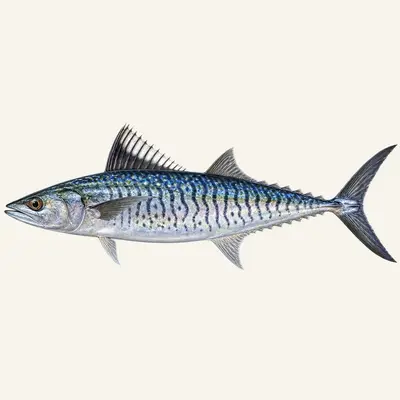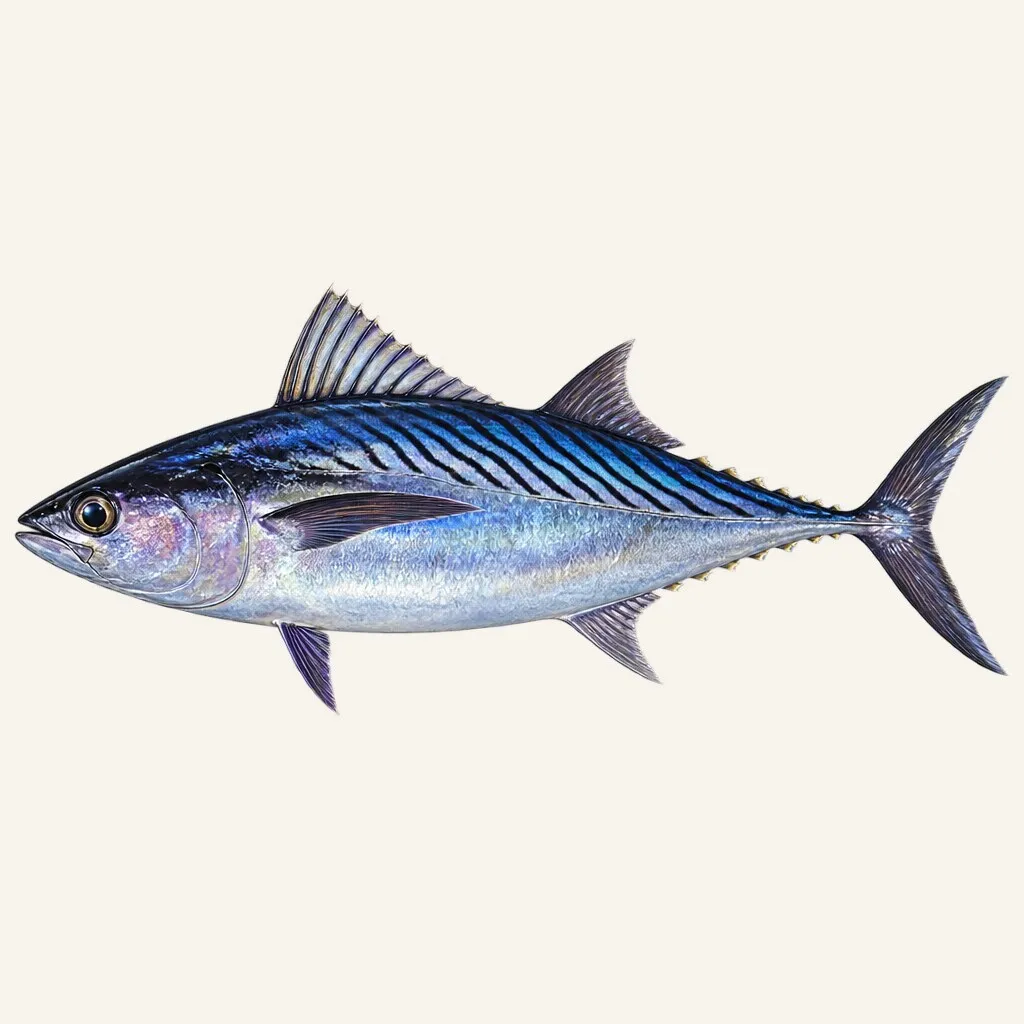
Frigate tuna
Auxis thazard · Scombridae
- Saltwater
- Big pelagics
- Medium
- Size
60–65 cm
- Weight
2.7–1.7 kg
- Lifespan
5 years
- Water temp.
27–28 °C
Where to fish
- Offshore
Habitat icons: Flaticon
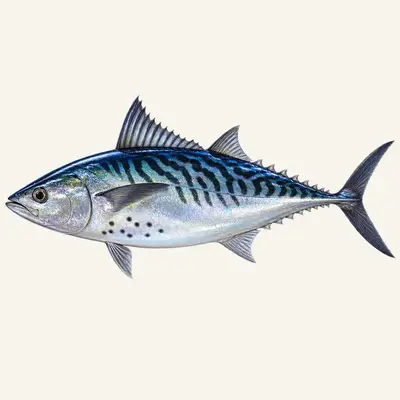
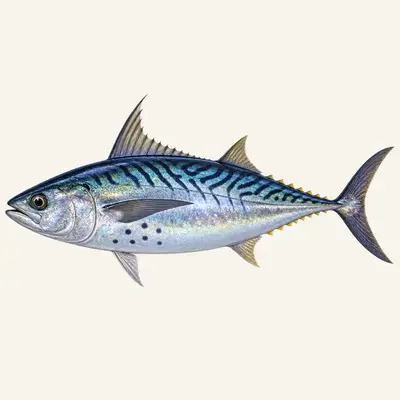
The frigate tuna is a stocky, compact tuna with a blue-green back bearing characteristic wavy or vermiculated markings on the posterior dorsal area, found in warm coastal and oceanic waters worldwide.
Calendar
Recorded in 27 countries
Australia · British Indian Ocean Territory · Comoros · Côte d’Ivoire · Equatorial Guinea · Faroe Islands · French Southern Territories · Gabon · Ghana · Guinea · Ireland · Japan · Kenya · Liberia · Madagascar · Mauritania · Mayotte · Mozambique · New Zealand · São Tomé & Príncipe · Senegal · Seychelles · Sierra Leone · Somalia · Spain · Tanzania · United Kingdom
GBIF occurrence records — native and introduced populations combined.
Identifying it
The corselet tapers away to almost nothing. That band of thickened scales across the shoulders is well developed at the front on both species of the genus, but on this one it narrows behind until it measures no more than five scales from top to bottom beneath the origin of the second dorsal fin. Run a thumb back along the flank under that fin and the armour has effectively run out.
What the taper leaves behind is a large expanse of bare skin, and the markings live on it: dark wavy lines, 15 or more of them, narrow, running lengthwise or nearly so — oblique at most, never upright. Read the direction of the lines rather than counting them: it is the direction that separates this fish from the bullet tuna, whose bare skin carries broad bars standing on end.
Two further checks are quick. The pectoral fin is short, but long enough to reach past the vertical line dropped from the front edge of that bare area. And the two dorsal fins are separated by a wide gap, at least as long as the base of the first fin, so that the profile shows two distinct fins rather than one interrupted crest.
The first gill arch carries 36 to 42 rakers in total. The fin counts are worth having for placing the fish in the genus and not much more, because the published ranges overlap those given for the bullet tuna almost end to end: 10 to 12 dorsal spines, 10 to 13 soft rays behind them, and 10 to 14 anal rays. That overlap is why the markings and the corselet do the work.
A note on the name belongs in this section rather than at the end of the page. Many authors have used Auxis thazard as a name covering the bullet tuna as well, in the belief that the genus held a single worldwide species. A good deal of older writing about this fish is therefore about two.
Breeding
The spawning season shifts from one area to another with temperature and other conditions, and in some places it extends through the entire year.
Maturity is reached around 29.5 cm, from 29 upwards, and the oldest fish recorded is five years old. Both figures point the same way: this is an animal that breeds early in a short life, and a population turns itself over almost completely within a handful of seasons.
The water it needs
Adults are epipelagic in neritic and oceanic water alike, from around 50 m, in warm water of 27 to 28 degrees.
That double occupation is the unusual part. Most small scombrids commit to one side or the other — a shelf fish or an offshore fish — and this one is described in both. It means a boat working the coastal band and a boat working far outside it are both in its range, and neither is at the margin of it.
Areas
- Surface pelagic waters
- Oceanic convergence zones
- Around oceanic islands
- Under bird aggregations
Techniques
- Metal lure casting
- Light feather fishing
- Surface trolling
- Light jigging
Baits
- Light metal lures
- Light feathers
- Small squid
- Small live fish
What it eats
Small fishes and squid, then planktonic crustaceans at the megalops stage, then stomatopod larvae.
Two entries on that list are named larval stages: the megalops of crabs and the larva of the mantis shrimps. A predator that feeds on those is working in the plankton as much as on free-swimming prey, and that is the explanation for the habitat. An animal capable of eating what drifts is not obliged to follow forage shoals, and it can therefore hold water on the shelf and water off it with equal success.
How to catch it
The fish is worth as much as prey as it is as a capture, and the record says so without hedging. Because it is abundant, it counts as an important element of the food web and specifically as forage for other species of commercial value, and it is eaten by larger fishes including other tunas.
Two practical consequences follow. It is taken on fast-trolled lures over surface activity, and it serves as live bait for the large pelagics that its own presence has drawn in. On a day when it is showing, the question is which of the two jobs it is being caught for.
Before naming a capture, check the direction of the lines on the bare flank. The two members of the genus are confounded in buckets and in landings statistics alike, and the confusion is old enough to have got into the literature.
It is marketed fresh and frozen, and also dried or salted, smoked and canned.
Conservation
Five years of life and maturity below 30 cm produce fast renewal, which shields the species from direct overfishing in a way that few heavily exploited scombrids are shielded.
The real question is functional. A fish described as an important element of the food web and as forage for commercially valuable species does not carry only its own value: what happens to it is passed on to the predators that depend on it, and that link is rarely counted in a stock assessment. The tonnage taken from this animal is subtracted twice, once from the fishery and once from everything that eats it.
The persistent confusion with its congener then complicates any monitoring at all. Two species reported under one name cannot be managed separately, and the merged series cannot be unpicked after the fact.
Regulations
Check the local regulations in force (legal size limits, closed seasons, bag limits).
For guidance only. Legal sizes, quotas and open seasons vary by location and season: always check the local regulations in force before fishing.
Other names
Frigate tuna in English. The word frigate refers to the fast, lightly built warship, and it is attached to several unrelated fast-moving sea animals, so it carries no information about relationships.
Spanish uses melva for this fish, and applies the same word to the bullet tuna, which finishes off any hope of separating the two through vernacular names. The eastern Pacific population is recognised as a subspecies in its own right, Auxis thazard brachydorax, so a record from that ocean is not strictly comparable with one from elsewhere.
Sources: fishbase.se · api.gbif.org