King mackerel
Scomberomorus cavalla · Scombridae
- Saltwater
- Big pelagics
- Medium
- Size
70–184 cm
- Weight
3.4–45 kg
- Lifespan
26 years
- Depth
5–140 m
Where to fish
- Reef
- Rocky shore
- Offshore
Habitat icons: Flaticon
King mackerel - a fast coastal predator found over outer reefs, with larvae developing in warm surface waters.
Calendar
Recorded in 4 countries
Brazil · Guadeloupe · Puerto Rico · United States
GBIF occurrence records — native and introduced populations combined.
Its range
The range runs down the western Atlantic from Canada and Massachusetts to São Paulo in Brazil, with an outlying occurrence at St Paul's Rocks in the mid-ocean.
Depth is recorded from 5 to 140 m, but the working figure is 5 to 15. The wide range suggests a fish of the water column; the usual range says it is a surface animal almost all of the time, and the two should not be confused when planning where to put a bait.
Identifying it
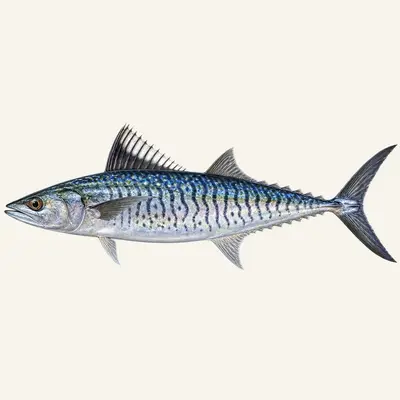
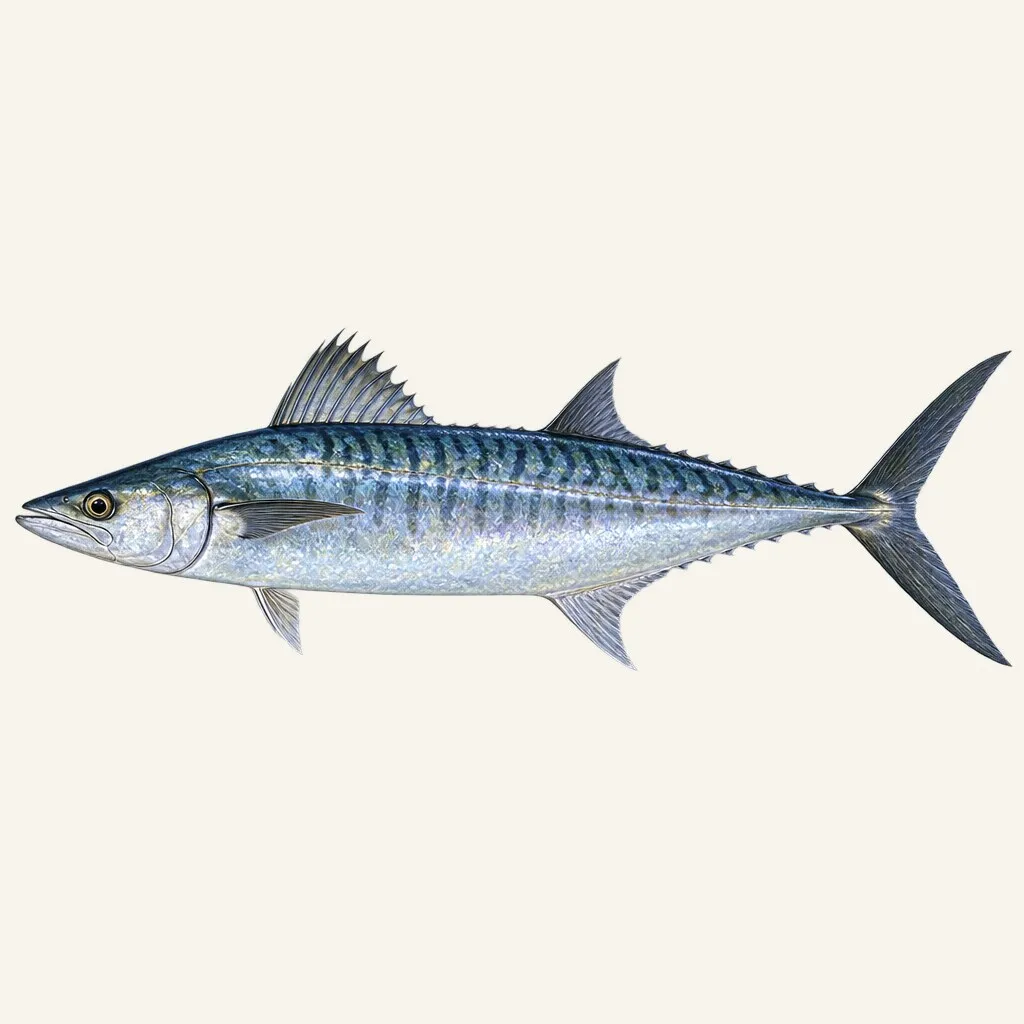
The lateral line answers the question. On this fish it drops abruptly below the second dorsal, in a distinct step, where the two Spanish mackerels sharing the same coast show a gentle sweep down towards the tail. It is the first thing to check and it is usually the last thing needed.
The second character is an absence. Adults carry no black area on the forward part of the first dorsal fin. Both the Atlantic Spanish mackerel and the cero do carry black there, so a fish with a clean first dorsal is this one — a check that works at arm's length on a wet deck.
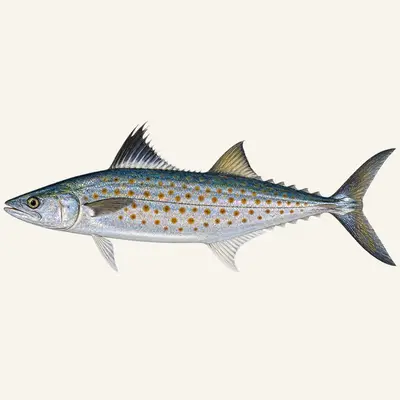
Juveniles are the difficult stage, and predictably so: they are marked with bronze spots in five or six irregular rows, which is close enough to a spotted Spanish mackerel to account for most misidentifications. The spots fade with age.
The remaining characters are internal or fine. The body is entirely covered with scales, the interpelvic process is small and forked, the intestine has two folds and three limbs, and there are 41 to 43 vertebrae — the lowest count among the western Atlantic species here. There is no swim bladder, as throughout the genus, so the fish holds its depth by swimming and does nothing else.
The water it needs
Outer reef areas hold it most reliably. Larvae develop in surface water between 26.3 and 31 degrees, at salinities of 26.9 to 35 parts per thousand, which is a narrow envelope and confines successful spawning to a fraction of the adult range.
The adults migrate in large schools over long distances along the Atlantic coast of the United States, and they do it as far as water temperature allows. Temperature, not the calendar, is what governs the movement: a cold year shifts the whole passage, and a warm one extends it northward. Anyone waiting on a date rather than on a sea surface reading will be early or late.
Areas
- Coastal pelagic waters
- Shoals and wrecks
- Warm current areas
- Around reefs and sandbars
Techniques
- High-speed trolling
- Live bait under balloon float
- Plug casting
- Vertical jigging
Baits
- Live menhaden
- Live mullet
- Long metal lures
- Diving plugs
What it eats
Fish, principally, with small quantities of penaeid shrimps and squids.
A schooling predator feeding on schooling prey moves with its food rather than holding ground, and that is the second half of the explanation for the scale of its migrations. It follows the bait; the bait follows the temperature.
How to catch it
Track the water, not the season. Because presence at any given point depends on surface temperature rather than on the month, a temperature chart predicts the run better than a diary does, and the same mark can be empty in one year and full a fortnight earlier in the next.
The species carries recreational, commercial and artisanal fisheries throughout its range, which has produced a deep body of established technique — this is not a fish anyone has to work out from first principles.
Then the health warning, which is specific and not theoretical: this fish is potentially ciguatoxic in certain areas. Ciguatera is not destroyed by cooking or by freezing, it accumulates with size so the largest fish carry the most, and whether it is present depends entirely on where the fish was caught. Local knowledge about the ground is the only useful precaution, and it matters most for exactly the fish anybody would want to keep.
Conservation
Maturity in this species covers an extraordinary spread, from 45 to 114 cm with an average around 65. That width has a blunt consequence: a metre-long fish may still never have spawned, and size is therefore not a reliable proxy for reproductive contribution the way it is in many species.
The longevity makes the point that matters on this coast. This fish lives 26 years; the Atlantic Spanish mackerel alongside it lives five. Two species caught in the same nets, off the same beaches, by the same boats, with a fivefold difference in generation length — one rebuilds from a good year class within a season or two, the other takes decades to replace its oldest fish. They cannot be managed on the same rules, and the fact that they are landed together is precisely why they get treated as though they could be.
Migration in large schools along a heavily fished coastline adds sequential exposure: every fishery along the route works the same stock, and each of them sees only the fraction passing its own stretch.
Regulations
Check the local regulations in force (legal size limits, closed seasons, bag limits).
For guidance only. Legal sizes, quotas and open seasons vary by location and season: always check the local regulations in force before fishing.
Other names
King mackerel is the standard English name, kingfish the common shortening — and kingfish is the problem. In Australia and New Zealand it means a large amberjack; along parts of the American coast it also names a drum, an unrelated fish entirely. The word travels badly and no international discussion of kingfish means anything without a scientific name attached.
The epithet cavalla comes from the Iberian word for mackerel, which spread through Caribbean Spanish and Portuguese and lodged in the scientific name.
Sources: fishbase.se · api.gbif.org