Garfish
Belone belone · Belonidae
- Saltwater
- Big pelagics
- Medium
- Size
45–94 cm
- Weight
0.1–1.3 kg
- Depth
2–22 m
Where to fish
- Estuary
- Beach
- Rocky shore
- Offshore
Habitat icons: Flaticon
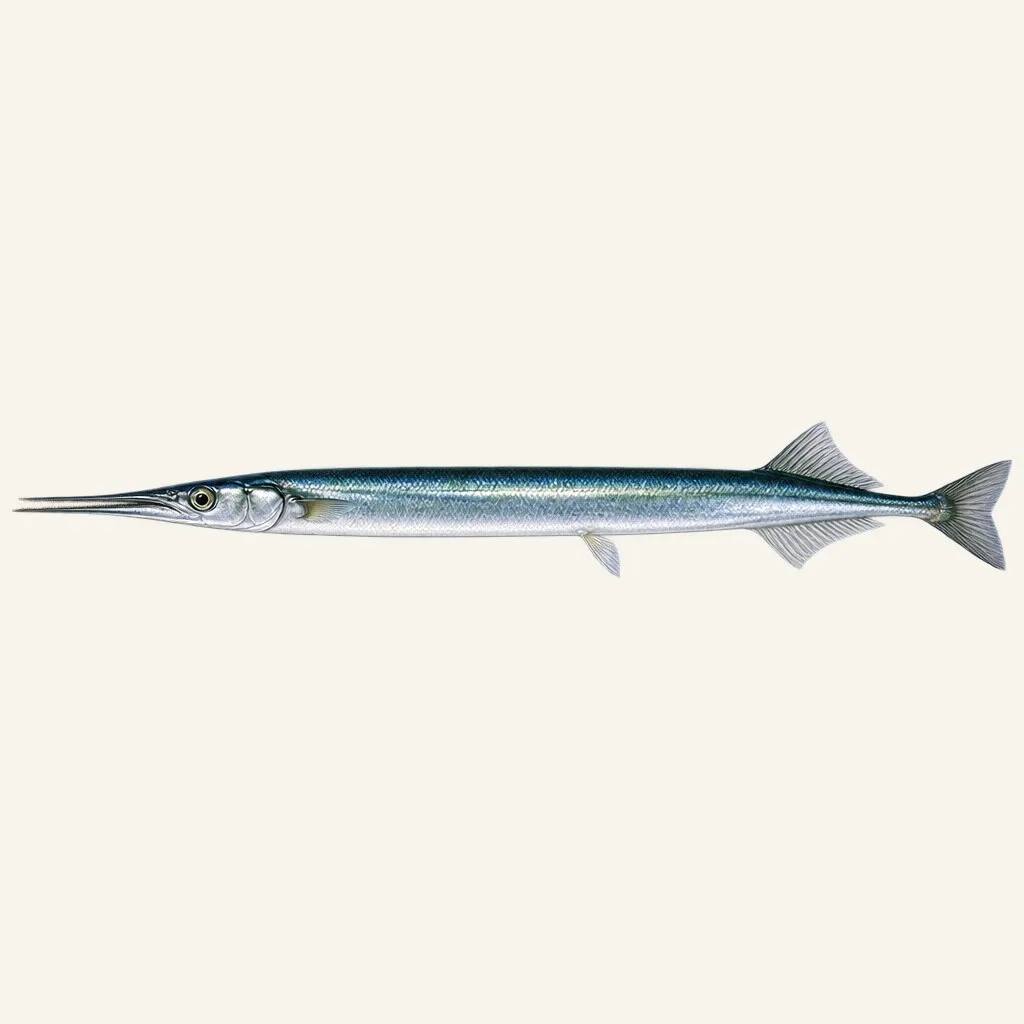
Elongated silvery marine fish with a needle-like body, a long toothed beak and distinctive green-coloured bones.
Calendar
Recorded in 15 countries
Brazil · Croatia · Denmark · France · Germany · Greece · Italy · Netherlands · Norway · Poland · Spain · Sweden · Ukraine · United Kingdom · United States
GBIF occurrence records — native and introduced populations combined.
Its range
The eastern Atlantic and the Mediterranean, roughly 65°N to 14°N.
Three subspecies were recognised in 1970, and their ranges are worth carrying separately: one in the northeast Atlantic, one in the Black Sea and the Sea of Azov, and one in the Mediterranean with the adjacent Atlantic — Madeira, the Canaries, the Azores and south to Cape Verde. A fourth name has since been applied to fish from France to the Canaries, the Mediterranean included.
So a garfish from the Sea of Azov and one from Madeira are not quite the same animal, and the literature has been divided about how to say so for over half a century.
Identifying it
A small garfish cannot be named from the adult description, because it does not yet have the characters in it.
Juveniles carry a greatly elongated jaw, proportionally longer than the adult's, and they lack the black lobe at the rear of the dorsal fin that the adult has. Vomerine teeth, on the roof of the mouth, appear only above 20 cm. Three of the marks a key would use arrive with growth rather than with the fish.
The adult is unmistakable. Both jaws are drawn out into a long fine beak, the lower a little longer than the upper, and the teeth in it are comparatively large and widely spaced. The body is very elongate and circular in section. Dorsal 16 to 20 soft rays, anal 19 to 23, and no spines at all.
Then the count that stops a reader: 75 to 84 vertebrae. A fish that shape has to be assembled out of a great many short segments, and that number is what it takes.
Breeding
The eggs are anchored, and the anchor is unusual. They carry tendrils on their surface and may be found attached to objects in the water — floating or submerged, whatever happens to be there.
That is neither a free pelagic spawning nor a deposit on the bottom. It is opportunistic attachment inside the surface layer where the fish already lives, which is consistent with everything else about the animal: it does not go anywhere else to breed, because it does not go anywhere else at all.
The water it needs
It lives close to the surface, and its migratory pattern is described as similar to the mackerel's. The recorded depth band is two to 22 m, within a range running from about 65°N down to the tropics.
Surface here is not a preference but a permanent address. There is no season in which this becomes a bottom fish, and no part of the water column below the top few metres worth searching.
Areas
- Piers and breakwaters
- Sandbank edges
- Estuaries
- Surface waters off beaches
- Rocky points
Techniques
- Float fishing
- Light lure spinning
- Livebait fishing
- Fly fishing
- Light surfcasting
Baits
- Fish strips
- Small dead fish
- Marine worms
- Mackerel slivers
- Small shiny lures
What it eats
Small fishes, particularly clupeids, and anchovies in the Black Sea.
A beak with widely spaced teeth is a grasping tool rather than a swallowing one: prey is seized across the body and turned before it goes down, which is what a long thin mouth full of spaced teeth is built to do. The turning takes a moment, and the moment is what is felt at the rod before anything is properly hooked.
How to catch it
The surface, and nothing else. Garfish are taken a few centimetres under the film, on sight, from a jetty or a stopped boat, and they give their position away by being plainly visible in daylight.
Two facts then decide the outcome. The record notes that the fish leaps out of the water when hooked, repeatedly and hard. And the beak that has to hold the hook is long, thin and bony, with very little in it for a point to seize. Multi-hook rigs and tangle-thread arrangements are the classical answer to that combination, and they exist for the same reason equivalent rigs exist for the gars: a mouth made of bone does not take a hook the way a mouth made of flesh does.
Common length is 45 cm.
The last thing happens in the kitchen. This catalogue's own description of the species singles out the green bones, and they are exactly that — the skeleton is genuinely green. It is harmless, it surprises everyone once, and it has cost the fish its reputation in more than one market.
Regulations
Check the local regulations in force (legal size limits, closed seasons, bag limits).
For guidance only. Legal sizes, quotas and open seasons vary by location and season: always check the local regulations in force before fishing.
Other names
Garfish is the English name, and it is the source of a durable confusion with the gars of North America — five of which this catalogue holds, every one of them called a gar in English. Those are freshwater fish of an entirely different order, with a comparable beak and nothing else in common. Garpike, the other English name for this species, makes matters worse by importing a third unrelated fish.
The other languages avoid the problem by naming the needle instead: aguja in Spanish, agulha in Portuguese, aguglia in Italian. German keeps the pike and adds the beak, Hornhecht; French says orphie, which asserts nothing about anything.
Sources: fishbase.se · api.gbif.org