Kawakawa
Euthynnus affinis · Scombridae
- Saltwater
- Big pelagics
- Medium
- Size
60–100 cm
- Weight
2.6–14 kg
- Lifespan
6 years
- Water temp.
18–29 °C
- Depth
0–200 m
Where to fish
- Estuary
- Reef
- Offshore
Habitat icons: Flaticon
Lives in open waters but always stays close to the coastline. Juveniles may venture into bays and harbours.
Calendar
Recorded in 34 countries
Australia · China · Egypt · Faroe Islands · Fiji · French Polynesia · Germany · India · Indonesia · Italy · Japan · Jordan · Madagascar · Malaysia · Maldives · Mayotte · Mexico · Mozambique · New Caledonia · Papua New Guinea · Philippines · Réunion · Saudi Arabia · Seychelles · Solomon Islands · South Africa · Sri Lanka · Taiwan · Tanzania · Thailand · United Arab Emirates · United Kingdom · United States · Wallis & Futuna
GBIF occurrence records — native and introduced populations combined.
Its range
Warm water throughout the Indo-West Pacific, oceanic islands and archipelagos included, from 35 degrees north to 38 south. A handful of stray specimens have been collected in the eastern central Pacific.
Those strays are the informative part. A species described as highly migratory nonetheless stops at a longitude in the middle of the largest ocean on earth, and the few fish found beyond it are recorded as individuals rather than as an extension. Whatever holds the eastern edge in place is not a shortage of ability to travel.
Identifying it
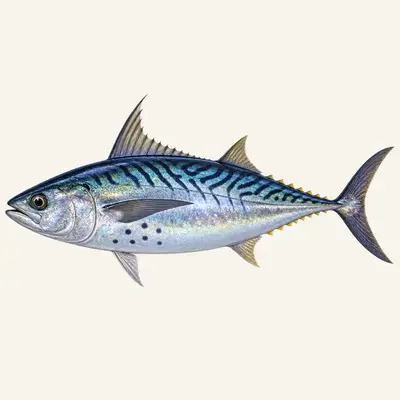
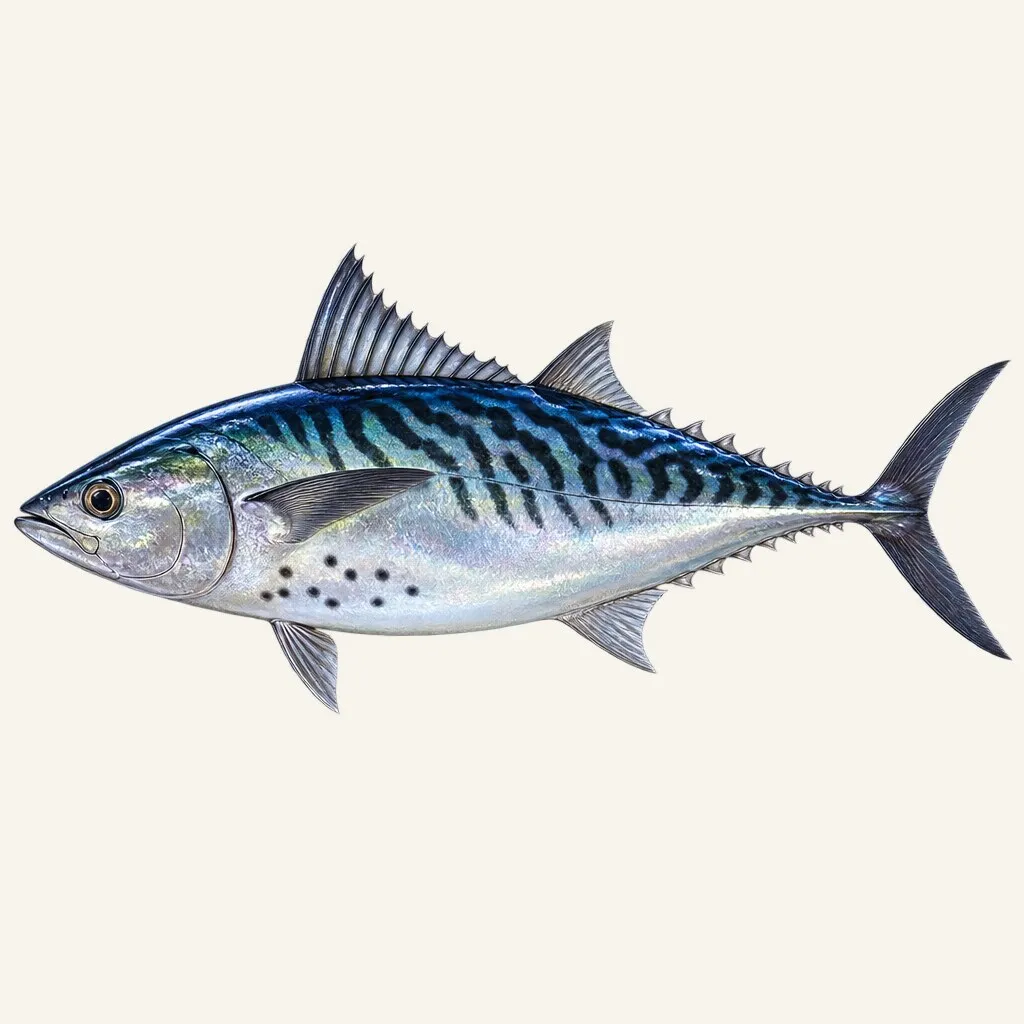
Count the rakers on the first gill arch: 29 to 34 in total. That is the figure that identifies this fish, and it is worth knowing that it is needed, because the character most people would reach for does not work. The deeply hollowed profile of the first dorsal — front spines much taller than the ones halfway along — belongs to the Atlantic little tunny just as much, and cannot separate them.
Two more checks are external. The interspace between the two dorsal fins is narrow, no wider than the eye, and the pectoral fin is short enough that it never reaches that interspace. Between the pelvic fins sit two flaps, not one forked process.
The pattern has a limit, and the limit is the point. A complicated arrangement of stripes covers the dark blue back, and it stops forward at the middle of the first dorsal — it does not run on towards the head. The lower flanks and belly are silvery white. Several dark spots usually sit between the pelvic and pectoral fins, though they are not always present, so their absence proves nothing.
Behind the fins the animal is finely built: the second dorsal is much lower than the first and is followed by eight to 10 finlets, the anal by six to eight, and the caudal peduncle is very slender with one prominent keel between two small ones. The body is naked except for the corselet and the lateral line, the teeth are small and conical in a single row, and there are 39 vertebrae.
The fin counts are too broad to help: 11 to 14 spines in the first dorsal, 11 to 15 soft rays in the second, 11 to 15 in the anal.
The water it needs
Open water, and never far from the shoreline. Those two statements sit together in the record and they are not in conflict: the fish uses the water column freely, down to 200 m, within a band that stays in sight of land. Young fish go further in still, into bays and harbours. The thermal range is 18 to 29 degrees.
The schooling behaviour is the remarkable part, and the numbers attached to it are specific. This species forms multi-species schools graded by size, travelling with other scombrids, and those schools run from 100 individuals to more than 5,000.
Read the two qualifiers carefully, because together they describe something unusual. The school is sorted, but it is sorted by dimension and not by species. Fish of one length travel together whatever they are, and the composition of a school is therefore a fact about size rather than about kinship.
Areas
- Shallow coastal zones
- Lagoons and fringing reefs
- Passes and river mouths
- Near-shore pelagic waters
Techniques
- Metal lure casting
- Light trolling
- Surface live bait fishing
- Coastal jigging
Baits
- Small live fish
- Metal lures
- Light jigs
- Whole squid
What it eats
Highly opportunistic, and the word the sources use for how it feeds is indiscriminately: small fishes above all, clupeoids and atherinids in particular, then squid, crustaceans and zooplankton.
That indiscriminacy is consistent with the way the animal travels. A fish moving inside a mass of several thousand of its own kind and its neighbours does not get to pick; it eats what the mass encounters, and the mass encounters whatever lies in its path. Selectivity would be wasted on it.
How to catch it
Proximity to the shore is the opening fact, and it is rare in the group. This is a tuna that comes to a small boat or to a rod worked from the coast, where its offshore relatives require a passage.
The schools are the signal and they are visible from a distance — surface commotion, birds working over it, water broken by fish. What a capture does not do is identify what is there. Several scombrids of matched size run together, so the second fish is not necessarily the same species as the first.
Nothing is really refused. Surface lure, sinking lure or natural bait all find takers on a school in action, and the size of the offering matters more than the type, since size is what the school has been sorted on.
Commercially the fish comes mainly to surface trolling, and also to gill nets, in fisheries that land several species at once.
Format and biology are modest and consistent: a common capture around 60 cm, maturity at about 42 cm with figures reported from 40 to 65, and six years of recorded life.
Conservation
Six years of life and maturity at 42 cm describe a stock that rebuilds quickly, and on its own the species would be an easy case.
The complication is the mixed school, and it works through gear selectivity in a way worth spelling out. Because a school is graded by size and not by species, any gear or lure chosen for a given size of kawakawa will take that same size of every scombrid travelling with it. Among those neighbours are species for which a 60 cm fish is not an adult at all but a juvenile several years short of breeding. The selectivity works, and it selects across the wrong axis.
The consequence for the record is equally direct. Landings from a multi-species fishery attribute poorly to species, so the catch series for this fish carries the uncertainty of every other scombrid in the same net. A stock that renews in six years can absorb a great deal; what it cannot do is be monitored through a figure that does not know which fish it counted.
The inshore habit adds the last piece. Removal happens along the length of entire coasts, by numerous small units, in the part of the range that is easiest for people to reach and hardest for anyone to total.
Regulations
Check the local regulations in force (legal size limits, closed seasons, bag limits).
For guidance only. Legal sizes, quotas and open seasons vary by location and season: always check the local regulations in force before fishing.
Other names
Kawakawa is the name that has carried internationally. It comes from Hawaiian, and it is one of the few large marine fish whose standard English name was taken from a Pacific language rather than imposed on it.
Australia says mackerel tuna. Some texts use eastern little tuna, which collides head-on with the Atlantic species called little tunny or little tuna — two fish of the same genus in different oceans, with names differing by one word. Reading a catch table, the ocean is a safer guide than the name.
French thonine orientale. Across the Indian Ocean and South-East Asia the fish carries a local name in nearly every fishery that takes it, which is what happens to an animal caught everywhere and traded mostly close to where it was landed.
Sources: fishbase.se · api.gbif.org