Little tunny
Euthynnus alletteratus · Scombridae
- Saltwater
- Big pelagics
- Medium
- Size
80–122 cm
- Weight
6.7–17 kg
- Lifespan
10 years
- Depth
1–150 m
Where to fish
- Offshore
Habitat icons: Flaticon
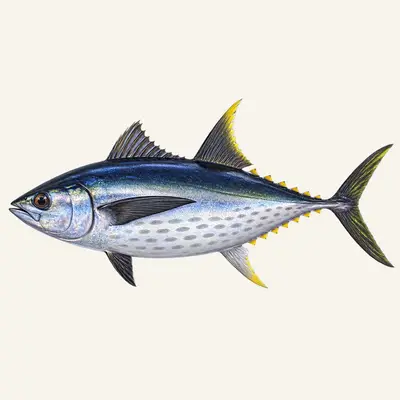
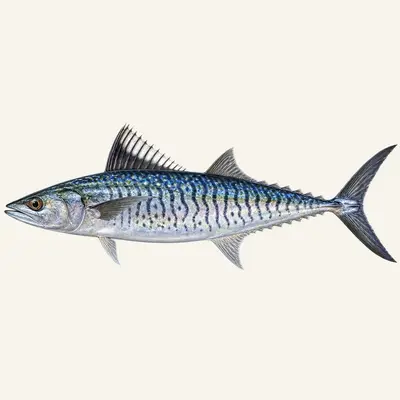
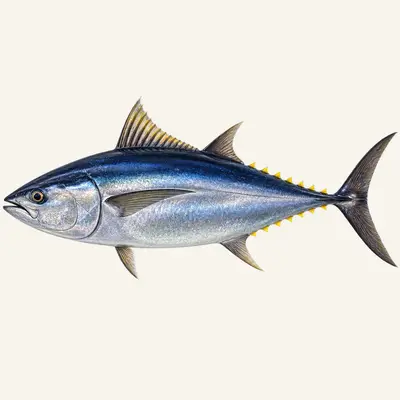
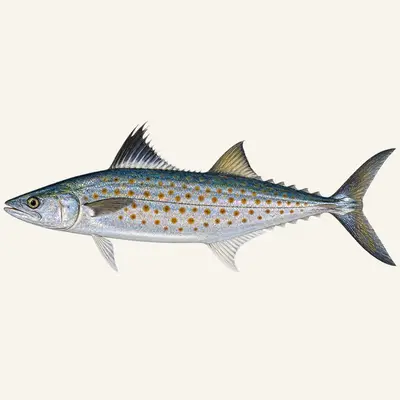
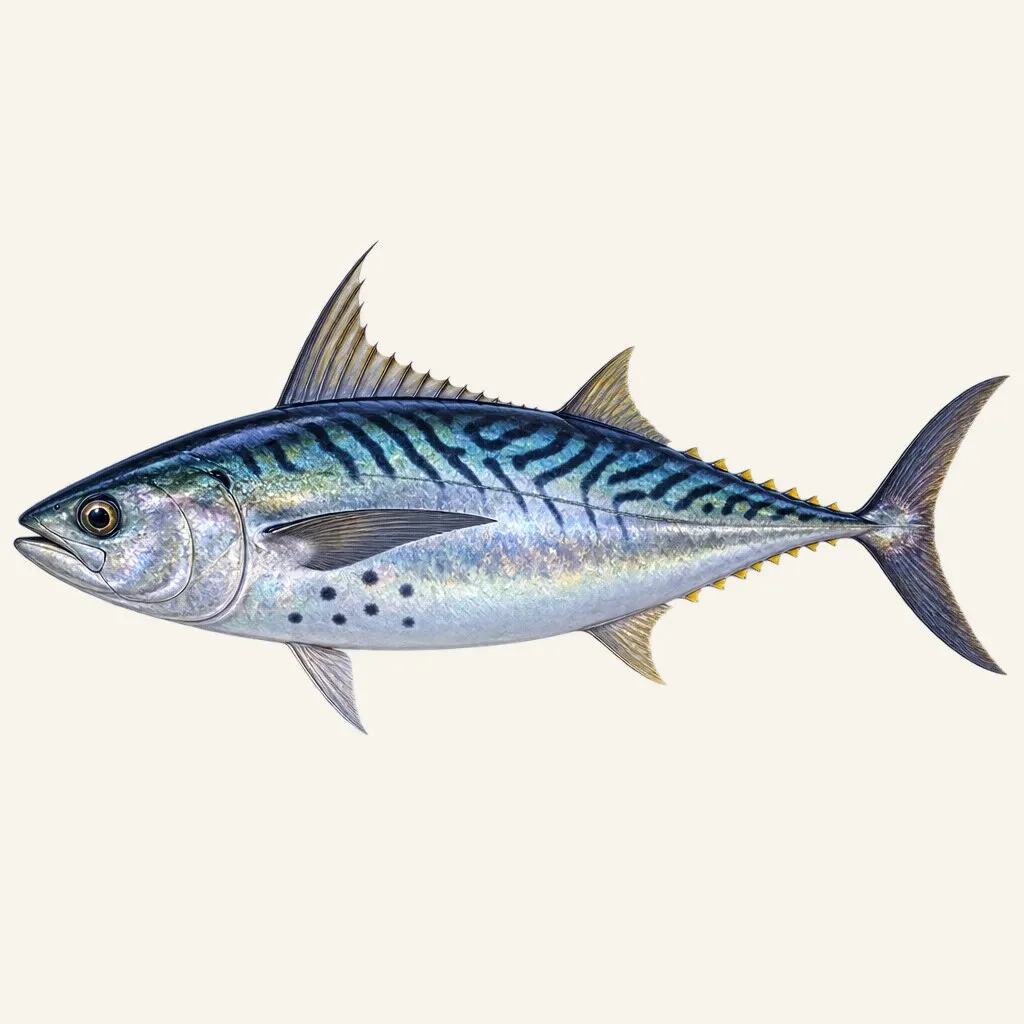
The little tunny is a small, fast-moving tuna with a streamlined body, sickle-shaped fins, and distinctive dark wavy markings on the back with dark spots below. A coastal pelagic species, it hunts in tight schools near the surface.
Calendar
Recorded in 31 countries
Albania · Algeria · Angola · Belize · Brazil · Cameroon · Canada · Colombia · Congo - Brazzaville · Côte d’Ivoire · Croatia · France · French Southern Territories · Gabon · Greece · Guinea · Guinea-Bissau · Israel · Italy · Lebanon · Liberia · Mexico · Puerto Rico · São Tomé & Príncipe · Senegal · Seychelles · Sierra Leone · Spain · Tunisia · Türkiye · United States
GBIF occurrence records — native and introduced populations combined.
Its range
Tropical and subtropical Atlantic, from 56 degrees north to 30 south, taking in the Mediterranean, the Black Sea, the Caribbean and the Gulf of Mexico. The recorded depth band runs from 1 to 150 m and brackish water is tolerated.
The eastern end of that range is unlike anything on the western side. Two enclosed basins, connected to the open ocean through narrow straits, hold populations of a fish otherwise described as highly migratory — which puts part of the species inside water bodies where the exchange with the rest of it is constrained by geography rather than by behaviour.
Identifying it
The front of the first dorsal fin stands much taller than its middle, so the upper edge of the fin sweeps down in a deep hollow. That outline is what names the fish at a distance, before any marking can be made out, and it is the profile to fix in mind.
Ocean settles the rest. This is the Atlantic member of its genus and its Indo-Pacific counterpart does not share water with it, so a fish in its own range needs no further argument. For a specimen out of context there are two checks. The first dorsal carries 15 or 16 spines, where the diagnosis of the kawakawa gives 11 to 14 in the same fin. And between the pelvic fins sits a small forked process, against the two separate flaps its congener's description records.
The body is bare apart from the corselet and the lateral line. There is no swim bladder at all.
One osteological detail deserves quoting for its precision: incipient protuberances form on the 33rd and 34th vertebrae, out of 39.
The back carries broken oblique stripes, and between the pelvic and pectoral fins sit three to seven dark spots. Behind the second dorsal and the anal run seven or eight finlets. Counts: 11 to 13 soft rays in the second dorsal, 11 to 15 in the anal.
Breeding
The eggs go out in several batches, and the timing is given not by a month but by a condition — they are shed when the water is at its warmest.
That distinction is worth holding on to, because it means the reproductive season of this species is a thermal event rather than a date. A warm year and a cool one do not put spawning in the same weeks, and a fixed calendar written from one season's observations describes that season rather than the animal.
Maturity comes at around 42 cm, with figures reported as high as 60. Recorded longevity reaches 10 years, which for a scombrid of this format is generous.
The water it needs
Neritic water, close inshore. That single line is the most consequential fact about the species, because it is what separates it from the tunas of the open ocean and puts a genuine scombrid within reach of a rod fished from a jetty, a beach or a small boat.
Areas
- Coastal pelagic waters
- Surface feeding areas
- Around submerged structures
- Under seabird aggregations
Techniques
- Cast-and-retrieve with metal lures
- Feather fishing
- Surface trolling
- Live bait drift fishing
Baits
- Bright metal lures
- Coloured feathers
- Live sardines
- Small squid
What it eats
An opportunist that feeds, as the sources put it, on virtually everything available to it: crustaceans, fishes and chiefly clupeoids, squid, heteropods and tunicates.
The tunicates are the entry that shows how far the opportunism goes. They are gelatinous animals of very low energy content, and a predator that swallows them is not selecting food so much as accepting what the water hands it. Everything else on the list follows from the same habit.
How to catch it
Two facts are enough to organise a session. The fish lives in schools close to the coast, and flocks of diving birds mark the large ones. That makes this about the most visual fishing available anywhere, and none of it requires going offshore.
Total opportunism then opens the tackle box rather than narrowing it. Surface lure, sinking lure, natural bait: on a school that is actively feeding, everything gets a response, and the problem is placement and speed rather than selection.
The missing swim bladder is the point that changes what happens after the fight. A fish without one suffers none of the pressure injury that condemns species lifted from depth, so a release here has a real chance of working — which is not something that can be said of most of what comes over the side on the same grounds.
Specialised fixed traps, the madragues, are used for this species in Tunisia and Morocco. They are an old technology and an exact one: a stationary gear only makes sense against a fish whose inshore passage is predictable, and this one's is.
Ciguatera poisoning has been reported from the species. Since the toxin is built at the base of coral food chains and this fish ranges as far north as the Bay of Biscay, the question is regional rather than general, and it is answered where the fish was taken.
Conservation
The thermal trigger is the part that will move. If spawning happens when the water is warmest and the eggs go out in batches while that lasts, then the reproductive window of this species is set by a variable that is currently shifting, and it will move without reference to any fixed season.
The individual outcome is more encouraging than in most of the group, and it is worth stating precisely because it depends on one anatomical detail. Having no swim bladder, a fish of this species can be brought up and put back without the internal injury that makes release futile in a great many marine fish. What a captor commits to is therefore real: careful handling here changes the outcome instead of merely appearing to.
Size structure helps as well. Maturity at around 42 cm against an ordinary capture near 80 cm means most fish encountered have already spawned, and spawned repeatedly.
What is genuinely hard to see is the total. This is a fish taken along entire coastlines by shore anglers and small craft, used as bait as well as eaten, across a range that includes two enclosed seas and both sides of an ocean. No single record adds that up.
Regulations
Check the local regulations in force (legal size limits, closed seasons, bag limits).
For guidance only. Legal sizes, quotas and open seasons vary by location and season: always check the local regulations in force before fishing.
Other names
Little tunny is the standard English name. Little tuna is the same fish, and false albacore is the working name along much of the United States seaboard.
False albacore is a poor name for a specific reason: albacore is a genuine and different species, a true Thunnus of the open ocean sold at a different price, so the phrase asserts a relationship that does not exist. Fat albert circulates among American anglers for the same fish and at least misleads nobody.
There is a regional collision as well. On the Florida coast this species is habitually called bonito, a word that properly belongs to Sarda, and a catch report from that coast using it may mean either animal.
Spanish bacoreta, Italian tonnetto, French thonine commune.
Sources: fishbase.se · api.gbif.org