Milkfish
Chanos chanos · Chanidae
- Saltwater
- Coastal
- Hard
- Size
100–180 cm
- Weight
11–14 kg
- Lifespan
15 years
- Water temp.
15–43 °C
- Depth
1–30 m
Where to fish
- Estuary
- Reef
- Beach
Habitat icons: Flaticon
A sleek, powerful silvery fish of tropical waters, prized in aquaculture and a strong fighter on the line.
Calendar
Recorded in 15 countries
Australia · Ecuador · French Polynesia · India · Indonesia · Japan · Mexico · New Caledonia · Panama · Philippines · Singapore · South Africa · Taiwan · Thailand · United States
GBIF occurrence records — native and introduced populations combined.
Its range
The Indo-West Pacific from South Africa and the Red Sea to Hawaii and the Marquesas, north to Japan and south to Victoria in Australia; in the eastern Pacific from San Pedro in California to the Galápagos. Between 46 degrees north and 52 south.
The extremes of that are not the working range. Adults are found where the water exceeds 20 degrees, and the recorded thermal envelope for the species runs from 15 to 43 degrees. The top of it is the remarkable half: the fish is on record as thriving and growing in water as warm as 32 degrees, which is where a great many marine fish of its size stop feeding, and that tolerance is the reason it can be raised in shallow tropical ponds at all.
Identifying it
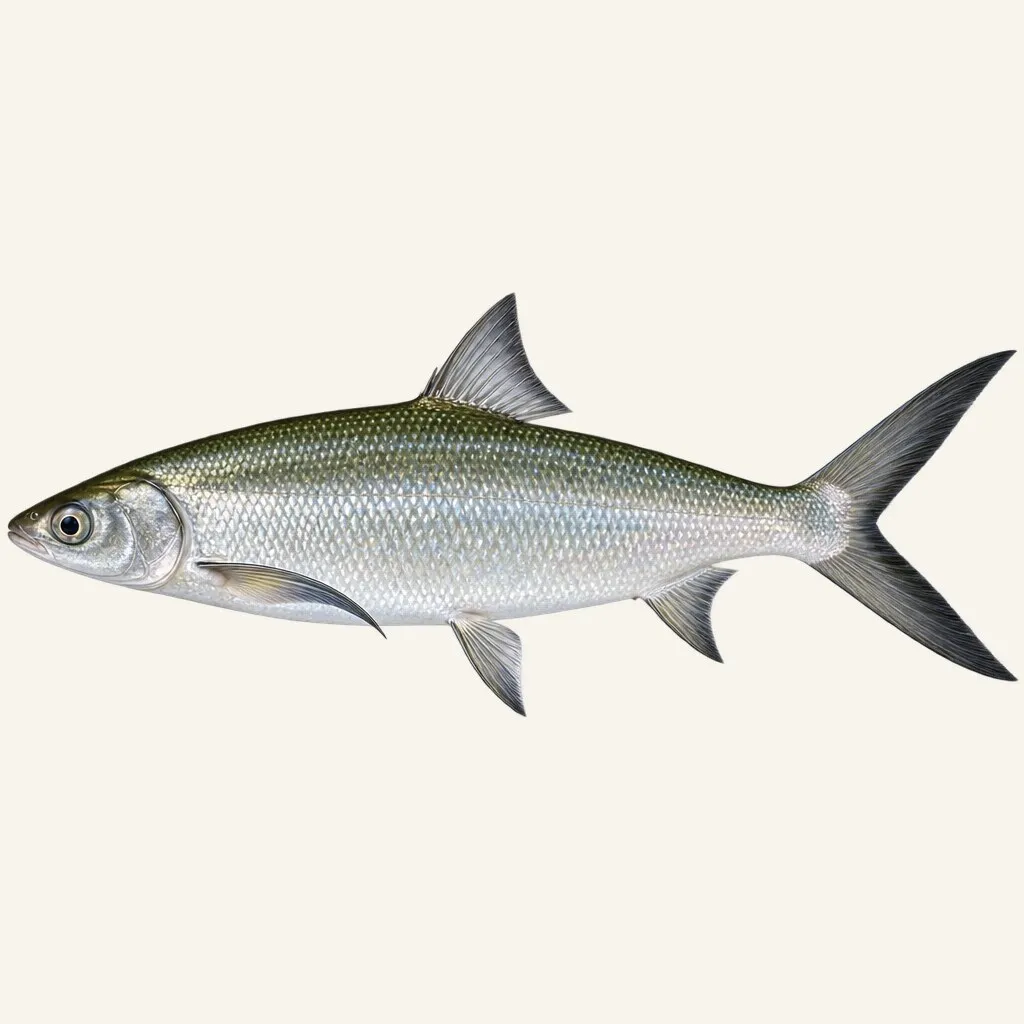
A small toothless mouth on a fish more than a metre long. That mismatch is the identification, and it rules out every predator of comparable size at a glance.
The body is elongate and somewhat compressed, olive green above, silver along the flanks, with dark margins on the unpaired fins. A single dorsal fin sits at mid-body, the pectorals are falcate, and the tail is large and deeply forked. There are no scutes on the belly — the herrings and shads that share this outline carry a keel of them, and this fish has none. Four branchiostegal rays, 46 vertebrae. Two dorsal spines with 13 to 17 soft rays behind them; two anal spines with eight to 10.
Breeding
Spawning happens at night, in clear shallow water, over sand or coral, and never more than 30 km from the shore. A female sheds up to five million eggs, and they hatch in about 24 hours.
One requirement governs the rest of the cycle: mature adults spawn only in fully saline water. Eggs and larvae then drift for two to three weeks, the older larvae move inshore, and the juvenile stage is spent in coastal wetlands — mangrove, estuary, occasionally a freshwater lake. Juveniles and sub-adults return to the sea to mature there.
What the larvae need is recorded with unusual precision: clear coastal or estuarine water above 23 degrees, a salinity between 10 and 32, and abundant phytoplankton. Those three conditions define exactly where this species recruits, and there is no fourth option.
First maturity is given at about 86 cm, with a range recorded at 68 to 70. The two entries do not sit easily together, which is a reason not to build an argument on either figure by itself. The maximum reported age is 15 years.
The water it needs
Adults use offshore marine water and shallow coastal embayments, enter estuaries frequently, and go up freshwater streams occasionally, along continental shelves and around islands. They move in schools, small to large, near coasts and around islands with well-developed reefs, ordinarily in the upper 15 m and on record between 1 and 30.
The juvenile stage happens somewhere else: in coastal wetlands, at sea level, flat and shallow. That is the part of the cycle with no alternative address, and it is the part a chart of the adult range does not show.
Areas
- Tropical lagoons
- Sandy flats
- Estuaries and mangroves
- Indo-Pacific coasts
Techniques
- Fly fishing
- Light spinning in shallows
- Float fishing
- Sight fishing on flats
Baits
- Green algae imitations
- Algae flies
- Small soft plastics
- Vegetable dough baits
- Bread fly
What it eats
Larvae live on zooplankton. Juveniles and adults eat cyanobacteria, soft algae, small benthic invertebrates, and pelagic fish eggs and larvae.
Cyanobacteria at the head of that list is the interesting entry. A fish of this size living substantially on blue-green mats has a food supply that no predator competes for and that grows back in days, which is the entire basis of the pond industry built on the species.
The eggs and larvae at the other end of the list are taken without any dentition being involved. A toothless mouth crossing a cloud of another species' spawn takes it in along with the water, and no hunting is required.
How to catch it
Nothing that imitates prey has any purpose here, and the mouth settles that before tackle is discussed. What works is what matches a grazer: algae imitations, flies dressed to pass for weed, vegetable dough baits, a bread fly, all of it fished fine.
The marks are the shallow flats, lagoons, estuary margins and reef fringes where the schools work, in water above 20 degrees. Much of it is visual fishing — a school grazing across a sand flat is visible, and it can be cast to rather than searched for.
The reputation of the fish rests on power and not on aggression. Common length is 100 cm, the tail is large and deeply forked, and there is nothing in the mouth to cut a leader: what has to be held is a big, fast, herbivorous animal that has never in its life had to catch anything.
The species is also used as bait itself, which is worth knowing when the name turns up in the account of somebody else's fishery.
Conservation
The pressure specific to this fish is the way its farming has traditionally been supplied. The larvae are collected from rivers and grown on in culture ponds — a harvest aimed at a year class that has reproduced nothing, and one whose volume follows the demand for pond stock rather than the condition of the wild population.
The record also carries the way out, and it belongs beside the problem. Brood stock can be raised and spawned in captivity, and larvae produced in a hatchery. The dependence on wild fry is a practice, not a necessity.
Recruitment otherwise rests on the state of estuarine water, because of what the larvae require: clarity, more than 23 degrees, a salinity of 10 to 32, phytoplankton in quantity. Sediment released by coastal works acts on the first of those conditions directly, and the wetlands that hold the juveniles are the ground being worked.
A structural point closes it. Mature adults spawn only in fully saline water, so a population shut inside a pond, a lagoon or a lake feeds, grows and matures without producing anything. Everything harvested from such a place was imported into it.
Regulations
Check the local regulations in force (legal size limits, closed seasons, bag limits).
For guidance only. Legal sizes, quotas and open seasons vary by location and season: always check the local regulations in force before fishing.
Other names
Milkfish in English, and German Milchfisch says the same thing. French, Italian and Portuguese take the genus name unchanged — chano — which is what tends to happen to a fish a language has had no occasion to name. Spanish sabalote is the exception, and it points at the shads, where the outline would put it.
The names that carry weight are the ones from the places the fish is eaten. Bangus in the Philippines and bandeng in Indonesia belong to two of the largest pond industries anywhere, and either word identifies the animal more reliably than any European name does.
Chanos chanos is a tautonym, genus and species spelled identically. The species is also the only living member of its family, which is the taxonomic version of the same observation: there is nothing close enough to it to need distinguishing.
Sources: fishbase.se · api.gbif.org