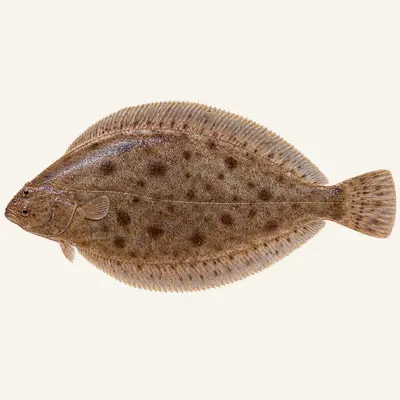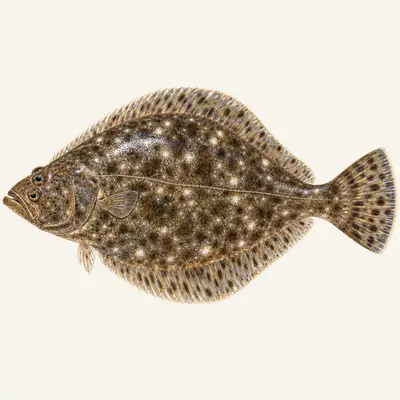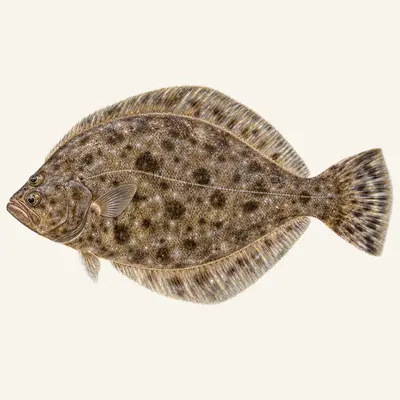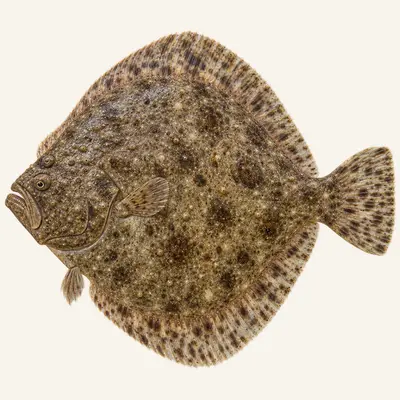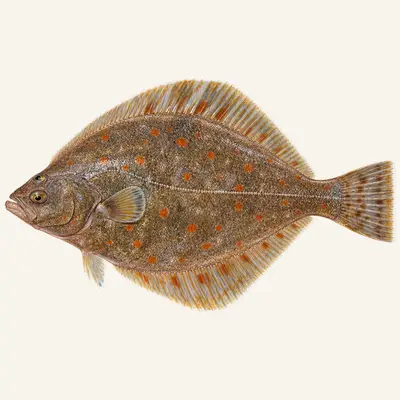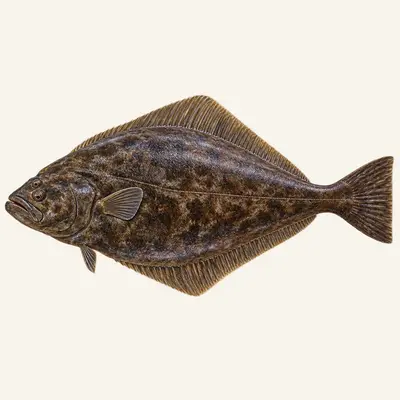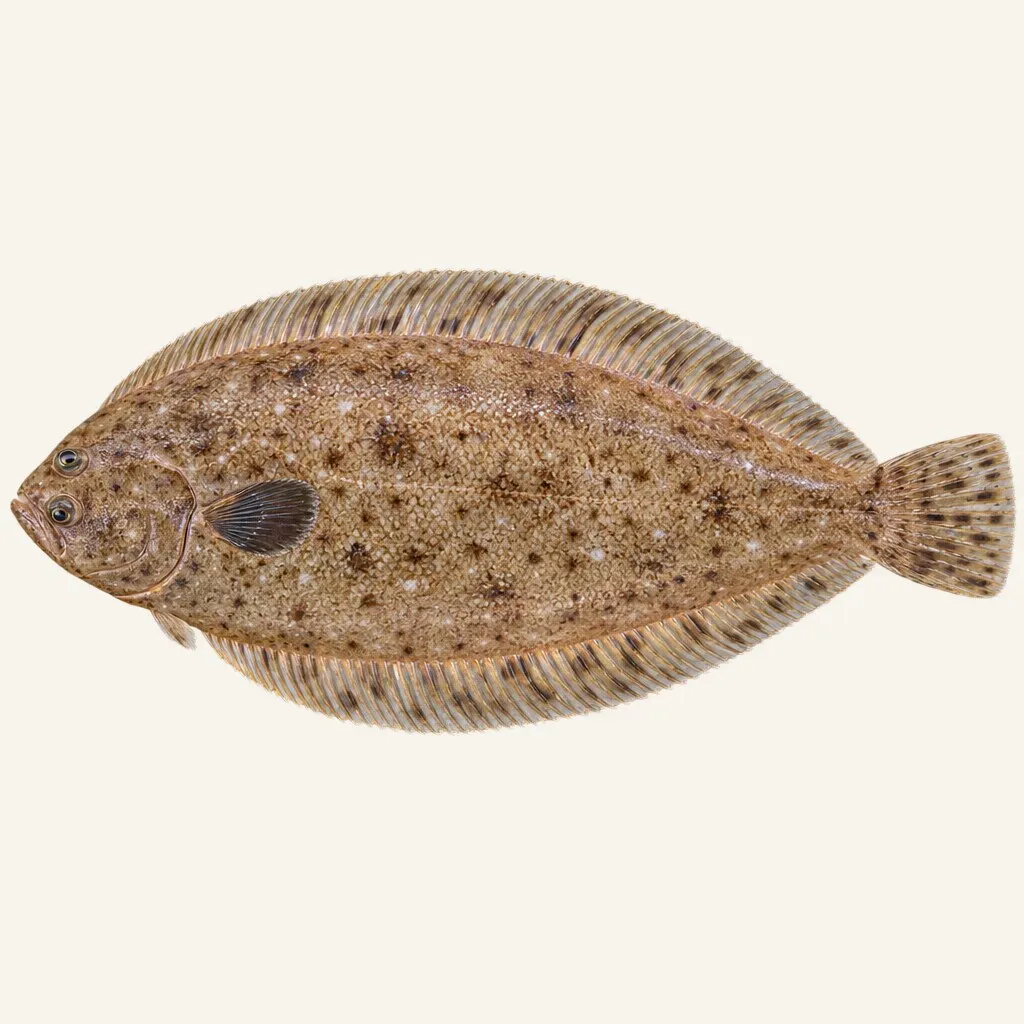
Senegalese sole
Solea senegalensis · Soleidae
- Saltwater
- Flatfish
- Medium
- Size
45–60 cm
- Weight
0.9 kg
- Depth
12–100 m
Where to fish
- Estuary
- Beach
Habitat icons: Flaticon
The Senegalese sole closely resembles the common sole but has a more uniformly brown coloration and a slightly more rounded outline. It inhabits shallow sandy bottoms along the Atlantic coasts of southern Europe and West Africa.
Calendar
Its range
This is a tropical-affinity sole in an otherwise temperate genus. Its centre of gravity is the central Atlantic, from France to Angola, and its presence in the western Mediterranean has a documented history: it entered through Gibraltar, by the route authors label Herculean after the pillars flanking the strait.
The practical consequence is the shape of the overlap. Going north, the species thins out exactly where the common sole becomes abundant. The two are therefore genuinely mixed on the Iberian and Moroccan coasts and in the western Mediterranean, and elsewhere one replaces the other rather than doubling it.
Identifying it
Everything hangs on one fin. On the eyed side, the pectoral of this species is black across its whole middle and distal part, interradial membranes included, from the centre out to the edge. On the common sole the black reduces to a compact patch confined to the rear of that fin. The blind-side pectoral stays whitish in both. Where the two species share a coast, this is the only character legible at a glance on a fish lying on the deck.
The rest wants a lens. The anterior nostril of the blind side measures about half the diameter of the eye and sits close to the front margin of the head, its distance from that margin slightly exceeding its distance from the mouth cleft, in a ratio of 1 to 1.4. The supratemporal branch of the lateral line forms a clear arch. On the eyed side, the scales above the nasal tube are much shorter than the tube itself. The gill rakers of the first arch are reduced to short knobs.
On an intact fish the counts decide without argument: 72 to 95 dorsal rays, 60 to 75 anal rays, and above all 44 to 46 vertebrae against 46 to 52 in the common sole. That is the one place where the two ranges barely touch.
Breeding
Sexual maturity arrives near 30 cm. Spawning occupies March to June, in coastal water. Development follows the soleid pattern, by way of a symmetrical larva that swims upright in open water before it lies down on one flank and settles.
The water it needs
A littoral species before anything else, benthic, on sand and mud off the coast. The recorded depth range starts at 12 m and reaches 100. It also uses brackish lagoons and coastal ponds, a habitat its northern relative frequents far less readily.
Areas
- Coastal sandy bottoms
- Estuaries
- Sheltered lagoons and bays
- Surf-casting beaches
Techniques
- Bottom fishing
- Surf casting
- Running ledger
- Coastal drift fishing
Baits
- Lugworm
- Shrimp
- Sandworm
- Squid strip
What it eats
Bottom invertebrates: polychaete larvae, bivalve molluscs, small crustaceans. The list is what an inferior mouth can collect from soft ground, and it holds nothing that has to be run down.
How to catch it
It is caught in the same places, over the same ground and often on the same tide as the common sole, which makes identifying it more useful than any technique peculiar to it. A logbook that lumps the two together mixes species whose ranges, preferred temperatures and spawning months all differ.
This is also the sole on which the Iberian aquaculture work is concentrated, still at an experimental stage. Fish from those installations share the coastline where the wild ones are taken.
Conservation
Nothing separable is known about its numbers, and the reason is that pectoral fin. Two species that occur together, are caught together and are sold under one market name get landed as one figure. No global verdict has been reached on its abundance, and none will be while the returns do not tell the two apart.
That weighs more here than on the common sole, because this is the species sitting at the northern edge of its range in the very waters where the confusion happens.
Regulations
Check the local regulations in force (legal size limits, closed seasons, bag limits).
For guidance only. Legal sizes, quotas and open seasons vary by location and season: always check the local regulations in force before fishing.
Other names
English has no fishery name for this fish. Senegalese sole is a book name built straight off the epithet, which is what happens to a species that never reaches the coasts where the language is spoken commercially.
Iberian usage, which does land it, went the other way. Linguado in Portuguese and lenguado in Spanish are generic, cover several soles at once and separate none of them, so the counter name settles nothing; lenguado senegalés exists for when precision is wanted, and French says sole sénégalaise. The epithet itself points at a stretch of the African coast rather than at the centre of the range, which reaches Biscay.
Sources: fishbase.se · api.gbif.org