Summer flounder
Paralichthys dentatus · Paralichthyidae
- Saltwater
- Flatfish
- Medium
- Size
94 cm
- Weight
12 kg
- Lifespan
9 years
- Depth
10–183 m
Where to fish
- Estuary
- Beach
Habitat icons: Flaticon
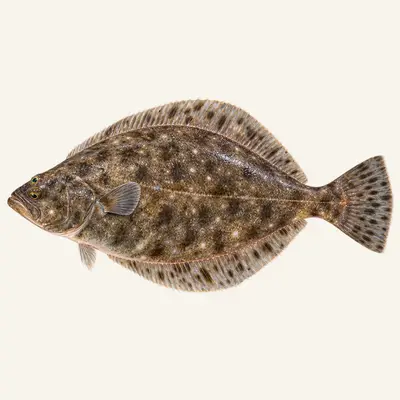
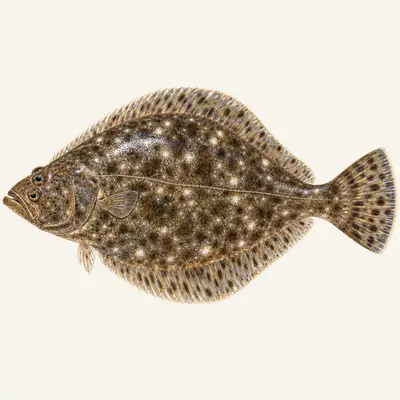
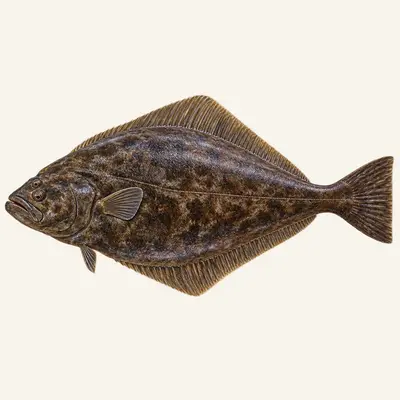
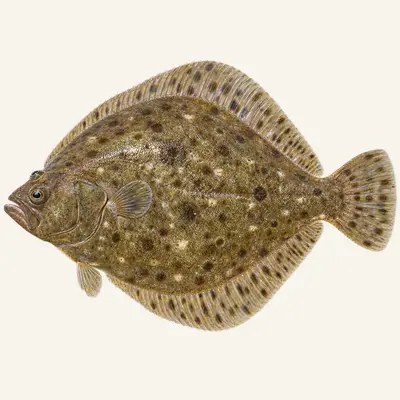
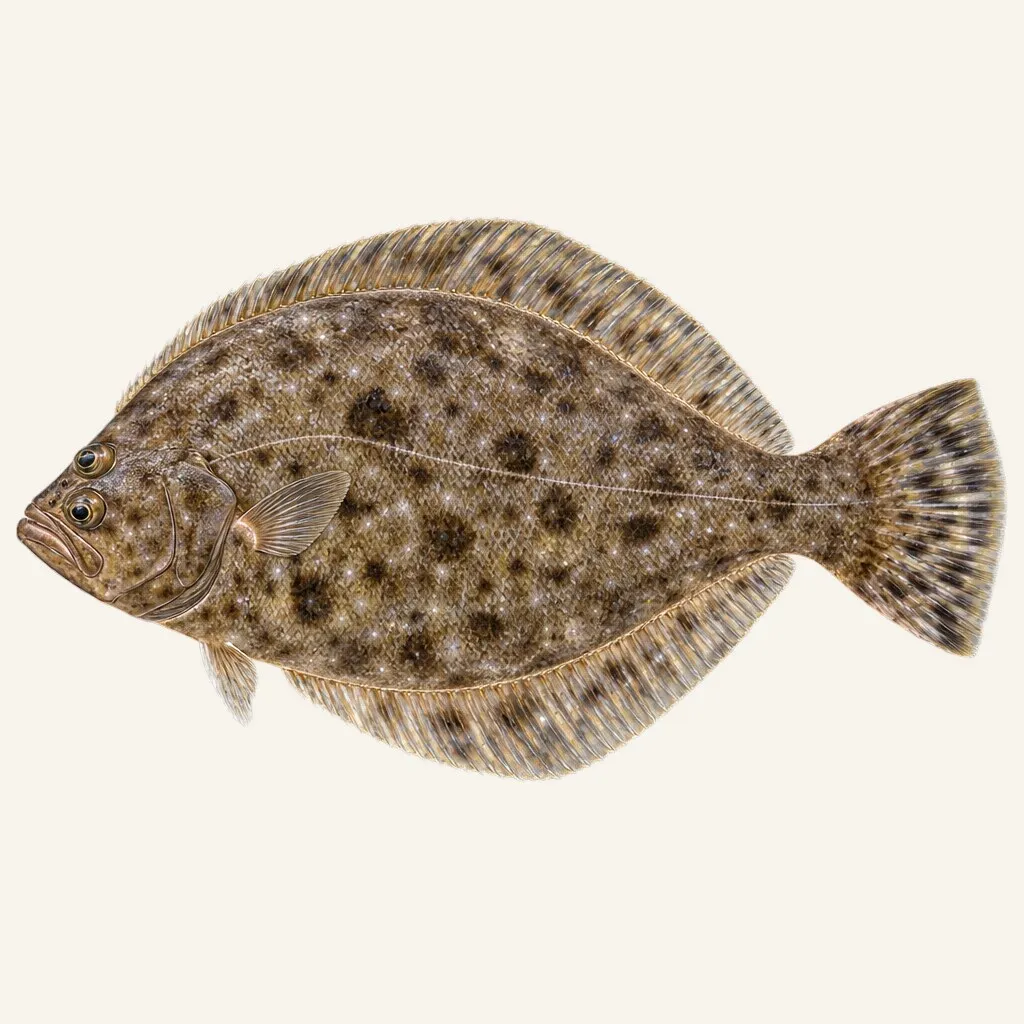
The summer flounder is a large flatfish of the Paralichthyidae family found along the east coast of North America. Its oval body displays numerous ocellated spots on the upper side, and its large toothy mouth reveals its active predatory nature.
Calendar
Recorded in 2 countries
GBIF occurrence records — native and introduced populations combined.
Its range
Maine to southern Florida, with rare records as far as Nova Scotia. The range holds a single seaboard and never leaves the north-west Atlantic shelf.
The latitude band runs from 45° to 25°N, and the northern end of it is a limit of rarity rather than a frontier: Canadian fish are strays, not a population.
To the south the southern flounder takes over, Virginia to Texas. The two overlap along several hundred kilometres of coast, and where they coexist it is the bottom that divides them rather than the latitude — hard sand and open sea for this one, soft mud and diluted water for the other.
Identifying it
The species name is the character: dentatus, toothed. The mouth is large and armed, and it belongs at the front of an active predator rather than to an animal that sifts sand. Numerous ocellated spots — dark centres inside pale rings — are scattered over the eyed side of an oval body.
Those ocelli matter where the ranges meet. The southern flounder, which shares several hundred kilometres of coast with this species, is described as carrying indistinct pale spots, and its own name records the absence. The two descriptions answer each other, which is a better basis for a determination than either one read alone.
Breeding
Distinct pairing. The documentation retains exactly one word about the reproduction of this species, and that word rules out the commonest arrangement among flatfishes: this is not a broadcast release by a crowd over a piece of ground, it is the business of a formed pair.
The rest comes from the growth schedule. Maturity is reached at 28 cm and the maximum reported age is nine years. The summer flounder matures early and does not live long.
A fish that breeds from 28 cm has therefore done its part well before it reaches the size that interests a rod. Few flatfishes are in that position, and it is the most consequential line on this page.
The water it needs
Hard sandy substrate is the stated preference, and the reason for it is mechanical: it will take a burrow.
The species does not confine itself there. It exploits a broad range of lower and mid-estuary habitats — salt marsh creeks and seagrass beds, whose bottoms are muddy or silty — as well as sand flats, and it occupies bays, lagoons and shallow coastal water besides.
Depth runs from 10 to 183 m, but the bulk of the life happens above 37. The oceanodromous classification supplies the rest: the animal changes sector through the year without ever leaving the sea.
That breadth has a consequence to be accepted rather than solved. This flounder has no type of mark. It can be in a marsh creek under a metre of water or on an offshore sand bank, and those are not the same search.
Areas
- Estuaries and bays
- Sandy shallows
- Gently sloping beaches
- Seagrass flat areas
Techniques
- Drift bottom fishing
- Soft-plastic lure
- Live bait
- Light jigging
Baits
- Live shrimp
- Live baitfish (herring, sprat)
- Squid pieces
- Sandworms
What it eats
The reference consulted here publishes no diet entry for this species at all. What stands in its place is the mouth: a large armed one, and a name built on the teeth in it. The catalogue description of the fish reads the same way, taking the mouth as the mark of an active predator.
That is worth stating plainly rather than filled in from a neighbour. A wide toothed mouth on an ambusher establishes that prey is taken whole and mobile, and it puts this animal well clear of the worm-and-mollusc flatfishes working the same shelf. What it does not establish is a list, and none is on record here.
How to catch it
Burial governs presentation. A fish lying under a film of sand does not chase for twenty metres, so the bait has to arrive within immediate reach and stay in contact with the bottom.
Habitat breadth governs the search. Since the species holds the marsh creek and the offshore bank alike, covering ground beats holding a spot — the opposite of the reasoning that applies to a flatfish tied to one kind of bottom.
The spread of habitats also splits the fishery in two. Salt marshes and seagrass are the shore-accessible half; sand banks and the thirty-metre band belong to the boat.
The vernacular name supplies the season that the biological entry does not: it records when the fish is close inshore.
Conservation
The demographic profile is the inverse of the northern flatfishes: maturity at 28 cm, nine years at the outside. A stock built that way answers a management decision within a few years. It falls quickly and it comes back quickly.
The pressure therefore sits somewhere other than in the demography. The habitats that carry this species through its estuarine phase — salt marsh creeks, seagrass beds — are precisely the ones coastal development consumes: infilling, dredging, hardened banks, turbidity. The adult holds open water, but the estuary is not an optional convenience for the animal.
Demand is not local either. Part of the production leaves fresh for Japan for sashimi, which adds a market pull to the inshore and recreational fisheries working the same fish.
Regulations
Check the local regulations in force (legal size limits, closed seasons, bag limits).
For guidance only. Legal sizes, quotas and open seasons vary by location and season: always check the local regulations in force before fishing.
Other names
Summer flounder is a calendar name, not a biological one: it marks the season when the fish is close in. Its counterpart on the same coast, the winter flounder, is named on the identical principle and belongs to another genus entirely. The pair of names describes two arrival times, not two grades of one animal.
American anglers say fluke, and they use the word for no other flatfish on the eastern seaboard.
Dentatus is toothed, which for once gives a name that describes the fish rather than a season, a resemblance or a market.
Sources: fishbase.se · api.gbif.org