Turbot
Scophthalmus maximus · Scophthalmidae
- Saltwater
- Flatfish
- Medium
- Size
50–100 cm
- Weight
1.8–25 kg
- Lifespan
25 years
- Depth
20–70 m
Where to fish
- Beach
Habitat icons: Flaticon
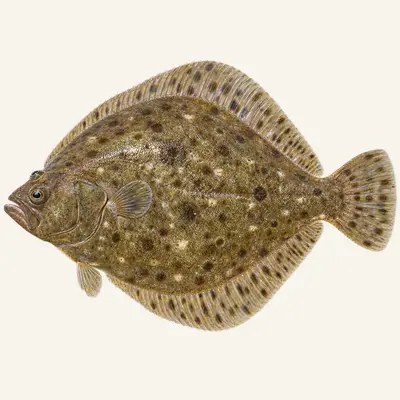
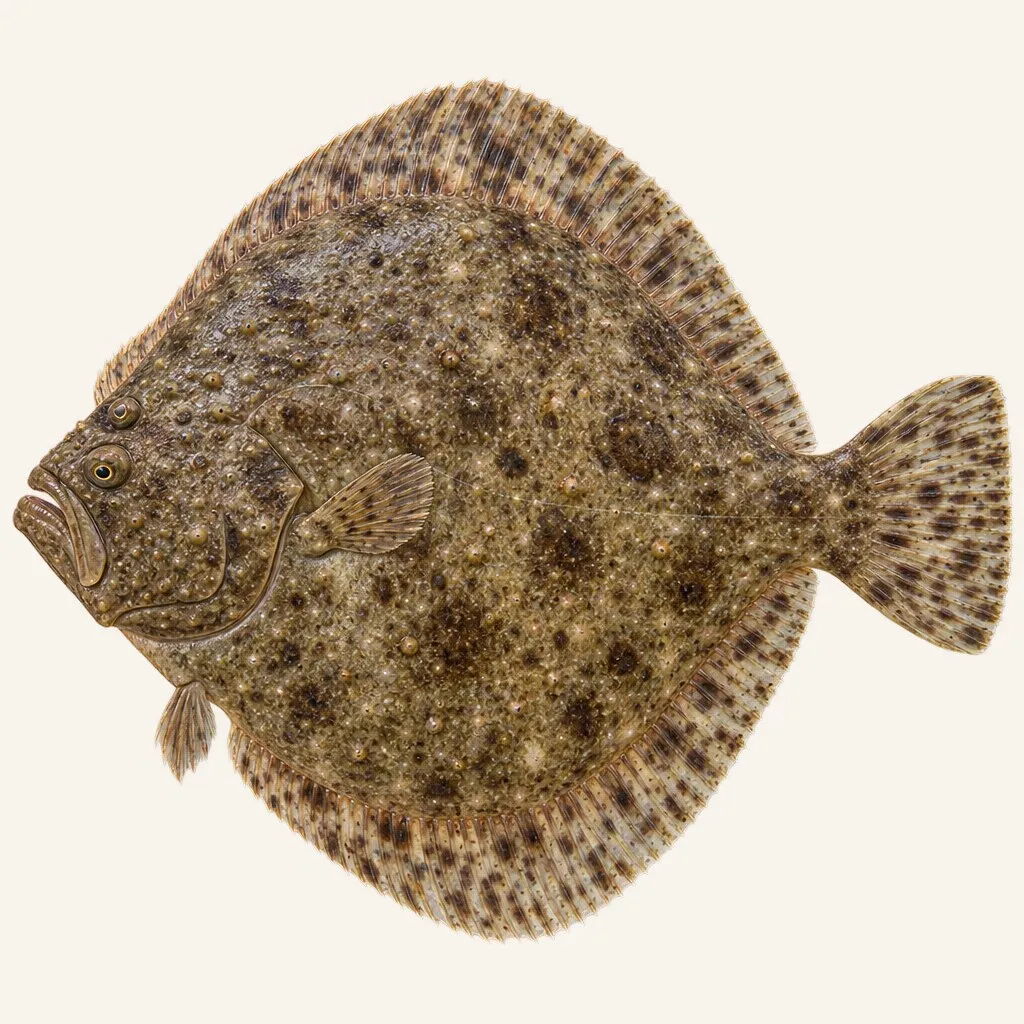
Turbot - a highly prized left-eyed flatfish found on sandy and gravelly seabeds, including the Baltic Sea.
Calendar
Recorded in 10 countries
Belgium · Denmark · France · Germany · Ireland · Netherlands · Norway · Poland · Sweden · United Kingdom
GBIF occurrence records — native and introduced populations combined.
Its range
North-east Atlantic, the entire Mediterranean, and the European coast as far as the Arctic Circle. Also most of the Baltic. A separate subspecies holds the Black Sea.
The Baltic occupation is the entry to stop on. That is a brackish sea, and a marine flatfish holding most of it is one that has stopped treating salinity as a boundary.
Identifying it
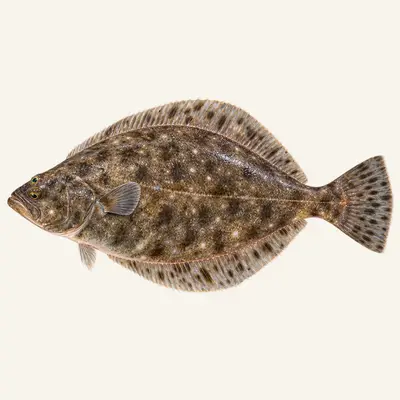
The outline is almost circular — as broad as it is long, a disc rather than an oval — and it carries a determination across a fish market on its own. The brill's diagnosis, written expressly against this species, calls that fish thinner and more slender; the dab is described as oval. This one is not.
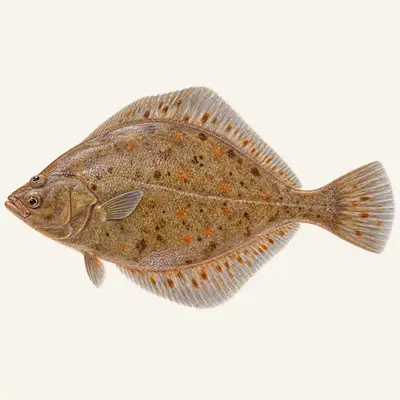
The eyed side has no scales whatever. What it has instead is large bony tubercles set into the skin, coarse and widely spaced, and they are what a hand meets first. Three flatfishes off the same ground therefore offer three different surfaces: smooth and finely scaled on the plaice, rough in rows on the flounder, naked and studded here.
The eyes are on the left, where the plaice and the flounder carry theirs on the right. The cross section is flattened rather than merely compressed.
Breeding
The season moves with latitude by a wide margin — February to April in the Mediterranean, May to July in the Atlantic, with a broader April-to-August window also on record. A date means nothing here without a sea attached to it.
Spawning is sequenced, in batches every two to four days. The eggs are pelagic, 0.9 to 1.2 mm across, and each one carries a single oil droplet, which is enough to pick them out of a plankton sample without further work. Larvae hatch at 2.7 to 3.1 mm, symmetrical.
The symmetry ends at 25 mm, on the fortieth to fiftieth day, when the right eye passes over to the left side.
That passage is the most fragile stretch of the animal's life. For those ten days the larva no longer swims as it did and does not yet lie as it will, and it spends them in open water with nothing above it. A poor drift or a bad thermal year inside that window costs a whole year class.
First maturity is put at 40.8 cm, with a range of 41 to 54.
The water it needs
Sandy, rocky or mixed bottoms, between 20 and 70 m. By the standards of this family that is a narrow band, and it keeps the species on the shelf rather than letting it work down the slope.
Brackish water is described as ordinary for it, not exceptional. Combined with a tolerance for hard ground as well as soft, that widens the search well past the clean sand where flatfishes are usually looked for.
Areas
- Coastal sandy shallows
- Sandbanks
- Surf-casting breaker zones
- Shallow gravelly bottoms
Techniques
- Boat live bait fishing
- Coastal lure drift
- Slow bottom trolling
- Heavy surf casting
Baits
- Small live mackerel
- Sand eel
- Fish imitation soft lure
- Ragworm
What it eats
This one eats fish. Sand-eels, gobies and other bottom-living species make the bulk of the diet, with larger crustaceans and bivalves behind them.
Set that beside the plaice and the flounder, which live on worms and thin-shelled molluscs, and the difference stops being one of degree. It is a different trade. Taking sand-eels means catching something that swims, and the method is ambush: the fish lies still under a film of sediment on ground that shoals of small fish cross, and does nothing at all until one comes inside reach.
How to catch it
Piscivory changes the tackle from end to end, and it is the sharpest practical division among the European flatfishes. Where worm on the bottom accounts for plaice and flounder, this species answers to a fish — a live bait, a strip of fish, a soft lure worked slowly and kept in contact with the sediment.
Ambush changes the search as well. A buried predator will not cross open ground to find what is on offer, so the offering has to pass close to it. Ground near sand-eel concentrations, and the edges where sand meets harder bottom, are worth more than an hour spent anchored over one spot.
The tolerance for brackish water opens sectors that nobody prospects for a fish with this reputation.
Sex shows in the size. Common length is about 50 cm for males and 70 for females.
Conservation
That difference between the sexes has a consequence nobody intends. Any selection by size — a fishery's mesh, an angler's own rule — takes females first, and the largest females carry most of the spawning effort. Nobody has to mean it: the size structure of the two sexes does the sorting by itself.
The larval window is the second exposure, and being unfishable does not make it safe. Ten days in open water in a half-finished body is where a year class is decided, and nothing at sea protects it.
The species is farmed at commercial scale. That takes some weight off the wild stock and raises the usual second question, about escapes and about what farmed fish do to the population they escape into.
Regulations
Check the local regulations in force (legal size limits, closed seasons, bag limits).
For guidance only. Legal sizes, quotas and open seasons vary by location and season: always check the local regulations in force before fishing.
Other names
Turbot in English and in French alike, one of the few fish names that needs no translation between the two.
The genus has been unstable. Both Psetta maxima and Scophthalmus maximus are current in the literature, and a reader will meet this animal under either combination depending on the age and the allegiance of the text.
Three languages name the same feature, and none of them names the colour. Italian rombo chiodato is the nailed rhombus; German Steinbutt is the stone butt; Portuguese pregado says nailed and stops there. The tubercles evidently made a stronger impression in the kitchen than anything else about the fish.
The English name has also been borrowed outward. In Canada, turbot on a label commonly means Greenland halibut, a deep-water species of another family entirely — a market grade rather than a determination.
Sources: fishbase.se · api.gbif.org