Southern flounder
Paralichthys lethostigma · Paralichthyidae
- Saltwater
- Flatfish
- Medium
- Size
50–83 cm
- Weight
1.5–9.3 kg
- Lifespan
8 years
- Depth
1–43 m
Where to fish
- Estuary
- Beach
Habitat icons: Flaticon
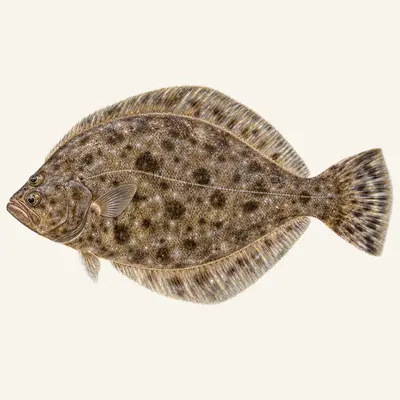
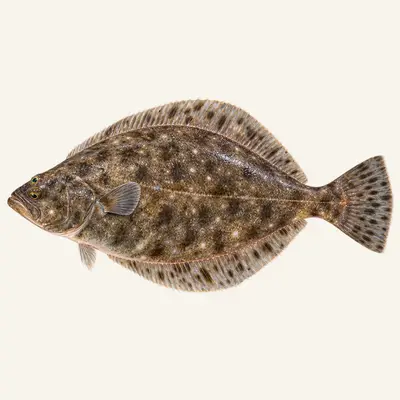
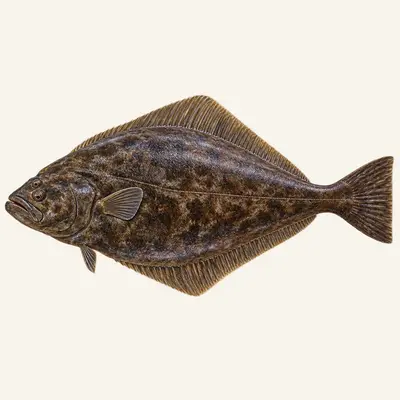
The southern flounder is a flatfish of the Paralichthyidae family found in the warm coastal waters of the south-eastern United States and the Gulf of Mexico. Its brownish-grey oval body bears indistinct pale spots, and its large mouth allows it to capture fish and crustaceans.
Calendar
Recorded in 2 countries
GBIF occurrence records — native and introduced populations combined.
Its range
Virginia to Texas, then northern Mexico, and south as far as Trinidad and Tobago — 37°N down to 9°N.
The southern half of that is easy to overlook. This fish is habitually filed as a Gulf and south-eastern species, and it does hold that coast, but the recorded range runs on past the Gulf into the tropics, several thousand kilometres beyond where most accounts leave it.
The northern boundary is the interesting one all the same, because it is not a boundary at all. It laps over the southern end of the summer flounder's range, and along that shared coast the two are not sorted by latitude. This one takes the soft bottoms and the diluted water; the other takes hard sand and open sea.
Identifying it
Lethostigma is the forgotten mark — that is, unmarked — and the description matches the name. A brownish-grey oval body carries indistinct pale blotches and nothing that resolves into a pattern. The mouth is large enough to take fish.
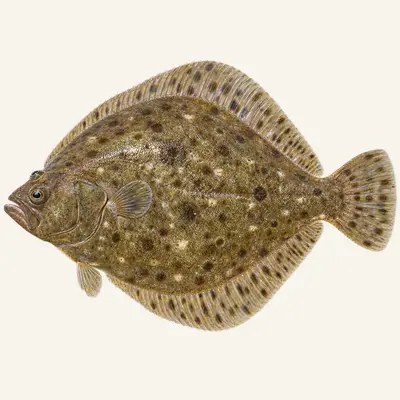
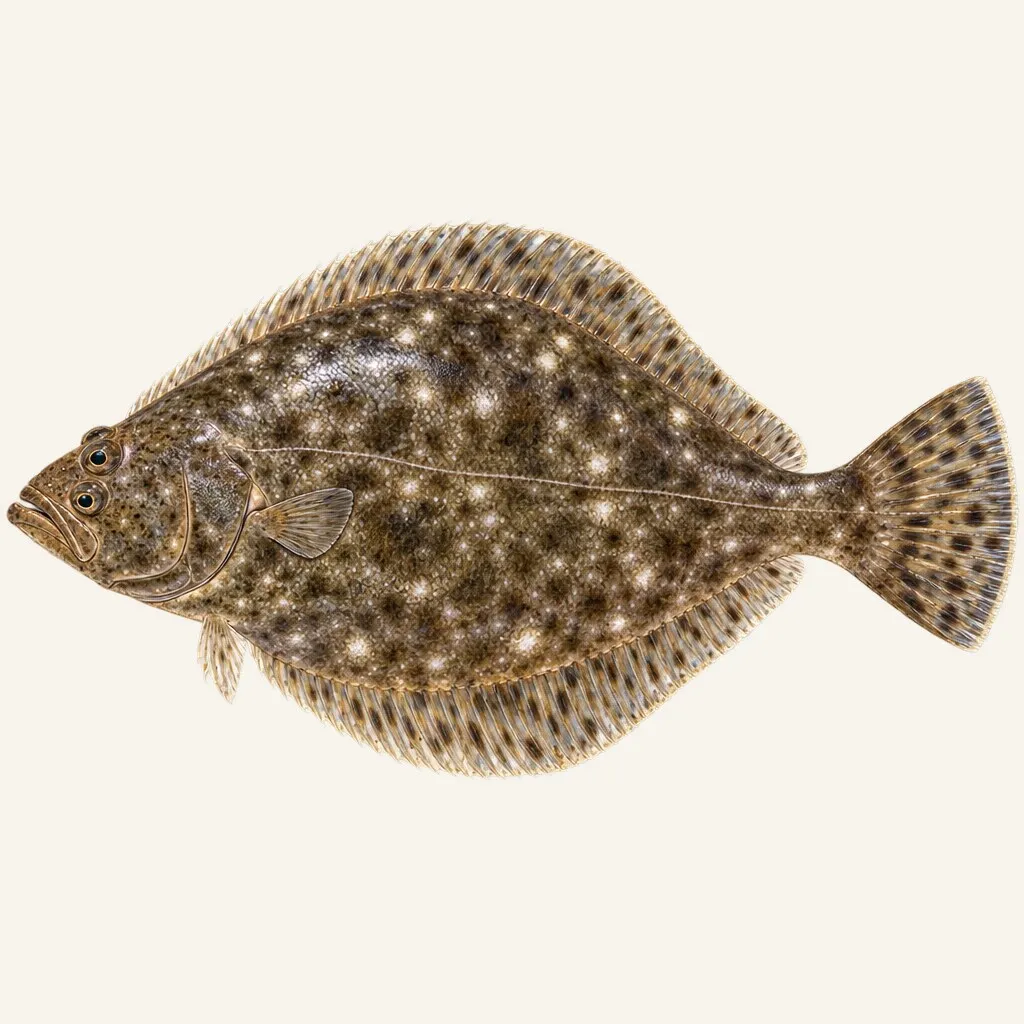
The name was chosen against something, and the something is on the next page of the same catalogue. Along the several hundred kilometres of coast this species shares with the summer flounder, that fish is described with numerous ocellated spots. Where the two ranges overlap, the spotting is the comparison to make, and it is made in the two descriptions themselves rather than deduced from a silence in either.
The water it needs
Cryptic, on mud, in diluted water: three traits that belong together and hold together.
Salinity tolerance is the governing one. The species turns up routinely in brackish bays and estuaries, and on occasion in genuinely fresh water. The minimum recorded depth is 0.7 m.
A flatfish of this size under seventy centimetres of brackish water has an obvious consequence, and the documentation states it outright: the fish is taken from bridges, jetties and small boats. For most of the year no vessel is required at all.
Winter moves it down without moving it away — it goes deeper and stays easily accessible. Beyond that fringe, adults hold mud in estuaries and coastal water out to about forty metres.
Areas
- Coastal bays and lagoons
- Shallow estuaries
- Sandy shallows
- Channel edges
Techniques
- Sandy bottom drift
- Live bait
- Crawfish soft-plastic lure
- Kayak fishing
Baits
- Live shrimp
- Mudminnows
- Squid
- Small live mullet
What it eats
Adults eat mostly fish, with crabs and shrimps behind them. Juveniles live on small bottom-living invertebrates.
The switch matters more than the list does. A southern flounder begins life as a sediment forager and ends it as a predator of fish without changing bottom or even sector: one mud flat carries both diets, at two different levels of the food chain, and often in the same season.
How to catch it
The spot is nearly always artificial. Bridges, jetties, quays — the documentation names these structures as places of capture, and what they have in common is a piece of hard footing dropped into the middle of a mud basin.
Turbidity rules out sight fishing. This is an animal prospected in contact with the bottom, with baits that announce themselves by something other than their silhouette: scent, vibration, contrast against a dark ground.
The adult diet points at live fish and at soft lures worked slowly. The juvenile diet explains the incidental catches on worm and shrimp, in the same sectors and sometimes off the same piling.
Two markers close the case. Winter does not suspend the fishing, it lowers the fish by a few metres. And with maturity reached by 35 cm at the latest against a commonly encountered length of 50, most of what is landed has already bred — which is less often true than anglers assume.
Conservation · Near Threatened (IUCN) — This species is in decline. Release your catch quickly and handle it with care — wet hands, as little time out of the water as possible.
Conservation
Everything happens in the estuary, and that is precisely the difficulty.
The species completes most of its cycle there. It tolerates the diluted water, it holds the mud, it stays within reach through the winter. Taken one at a time those are advantages. Taken together they describe an animal permanently exposed, in the most heavily modified coastal environment anywhere in its range.
Fishing from bridges and jetties adds a pressure that depends neither on a season nor on access to a boat. A species that can be caught on foot twelve months of the year has no refuge in the calendar.
Eight years of life leave no margin either. A population of this flounder is a handful of year classes and nothing behind them, so two poor years in succession show up in it immediately, without any lag to soften the reading.
Regulations
Check the local regulations in force (legal size limits, closed seasons, bag limits).
For guidance only. Legal sizes, quotas and open seasons vary by location and season: always check the local regulations in force before fishing.
Other names
Southern flounder places the species relative to its northern neighbour, and that is how it is generally read on the Atlantic coast.
On the Gulf coast the epithet gets dropped and anglers say flounder, full stop. There it is the flatfish, the default, and the bare word needs no qualifier because no other candidate is locally in play — the exact reverse of the situation further up the seaboard, where the same word is ambiguous between at least three species.
Lethostigma translates as forgotten mark, meaning unmarked. A name defined by an absence is unusual, and in this genus it happens to be useful.
Sources: fishbase.se · api.gbif.org