Oilfish
Ruvettus pretiosus · Gempylidae
- Saltwater
- Big pelagics
- Hard
- Size
150–300 cm
- Weight
20–64 kg
- Depth
100–975 m
Where to fish
- Rocky shore
- Offshore
Habitat icons: Flaticon
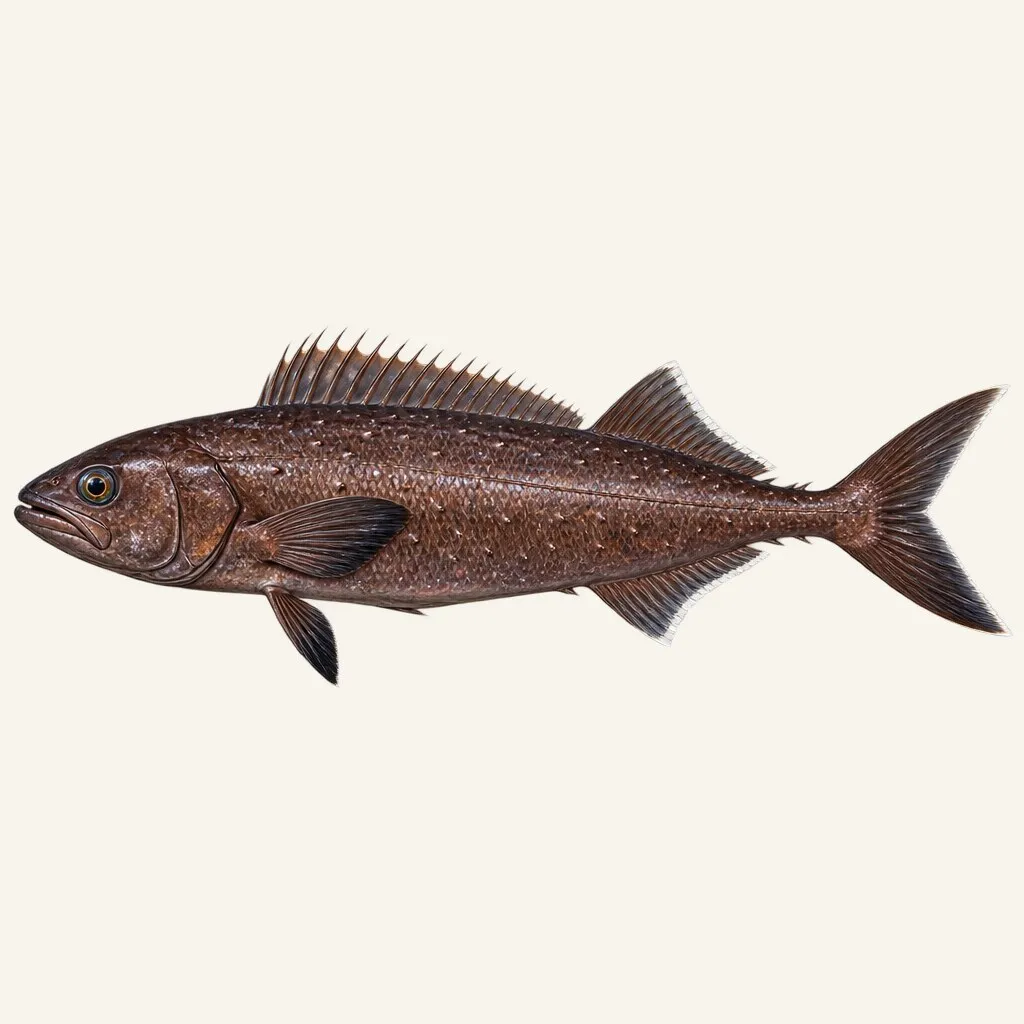
Oilfish (escolar) - deep-sea species found worldwide.
Calendar
Recorded in 24 countries
Australia · Brazil · Cameroon · Chile · Congo - Brazzaville · Côte d’Ivoire · Equatorial Guinea · Gabon · Ghana · Guinea · Guinea-Bissau · Japan · Liberia · Mexico · New Zealand · Nigeria · Portugal · Senegal · Sierra Leone · South Africa · Spain · Taiwan · United Kingdom · United States
GBIF occurrence records — native and introduced populations combined.
Identifying it
The identification is done by hand. The skin is very rough: the scales have spinous bony tubercles set among them, so the surface works like a rasp rather than like a fish, and the character is in the first line of the published description.
A mid-ventral keel runs along the contour of the belly.
The colour is uniform brown to dark brown, with black tips to the pectoral and pelvic fins. In young specimens the margins of the second dorsal and the anal fin are white; that mark is given for the young and not for the adult.
The counts: 13 to 15 dorsal spines, 15 to 18 soft rays behind them, 15 to 18 in the anal fin with no spines at all, and 32 vertebrae. The body is elongate and compressed.
The water it needs
Deep, and near the bottom. The recorded range is 100 to 975 m, usually 200 to 400, over the continental shelf and sometimes out in oceanic water — where the biology entry puts the working limit at 800 m.
It is usually solitary or in pairs, close to the bottom, and it migrates far offshore. Benthopelagic in the water column, oceanic in its movements: the two together describe a fish that is neither a bottom resident nor a surface traveller.
Areas
- Deep offshore trenches
- Bathyal rocky drop-offs
- Underwater canyons
- Deep open water
Techniques
- Night fishing in deep water
- Bottom longline
- Heavy deep jigging
- Bottom live bait line
Baits
- Whole squid
- Pelagic live bait
- Bright heavy jig
- Mackerel strip
What it eats
Fish, crustaceans and squid.
That is a mesopelagic predator's list, taken a few hundred metres down in cold water. The record does not connect the diet to what the flesh contains, and the flesh is what this species is known for.
How to catch it
One piece of gear was designed for this animal and nothing else: the wooden palu hook, also called the Ruvettus hook, used to take the species in the south central Pacific. A purpose-built hook for a single deep-water fish says something about how long and how deliberately it has been fished.
The fishing follows the animal. Deep, on or near the bottom, for a fish that is alone or in a pair — there is no school to intercept and no surface sign to read.
Then the part that decides what happens to the catch, and it is explicit in the source. The flesh is very oily and has purgative properties if much of it is eaten, and the file's hazard line for the species reads: poisonous to eat. This is not a rare reaction or an allergy; it is a property of the flesh, and it follows a large enough portion. Where the species is landed it is sold fresh, made into fish cakes in Japan and processed into fishmeal, so the problem is quantity rather than possibility. What may be sold, and under what name, varies from country to country and is a question for the competent authority rather than for this page.
A last entry belongs to the record rather than the fish. The file carries a note reporting the maximum length as far lower than the published figure printed beside it. Where a reference contradicts itself about how large an animal grows, the useful thing to know is that it does, not which of the two numbers to repeat.
Regulations
Check the local regulations in force (legal size limits, closed seasons, bag limits).
For guidance only. Legal sizes, quotas and open seasons vary by location and season: always check the local regulations in force before fishing.
Other names
Oilfish in English, and the name is the warning.
The confusion is commercial, which is why the warning gets missed. The catalogue's Spanish name for this fish is escolar, and the same word is used in the trade for another member of the same family; Brazilian Portuguese has escolar-preto. German went for Buttermakrele, butter mackerel, which is worse than uninformative — it sells the very property that causes the trouble as a virtue. French keeps rouvet, straight off the genus, and asserts nothing.
The epithet pretiosus means precious, which is a valuation the flesh only partly supports, and the only word in the whole set of names that a buyer would be wise to distrust.
Sources: fishbase.se · api.gbif.org