Nursehound
Scyliorhinus stellaris · Scyliorhinidae
- Saltwater
- Sharks & rays
- Medium
- Size
125–170 cm
- Weight
8.7 kg
- Lifespan
19 years
- Depth
1–400 m
Where to fish
- Rocky shore
Habitat icons: Flaticon
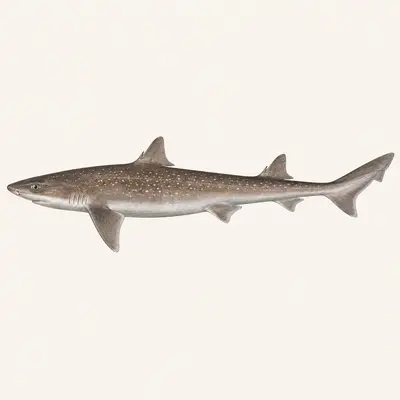
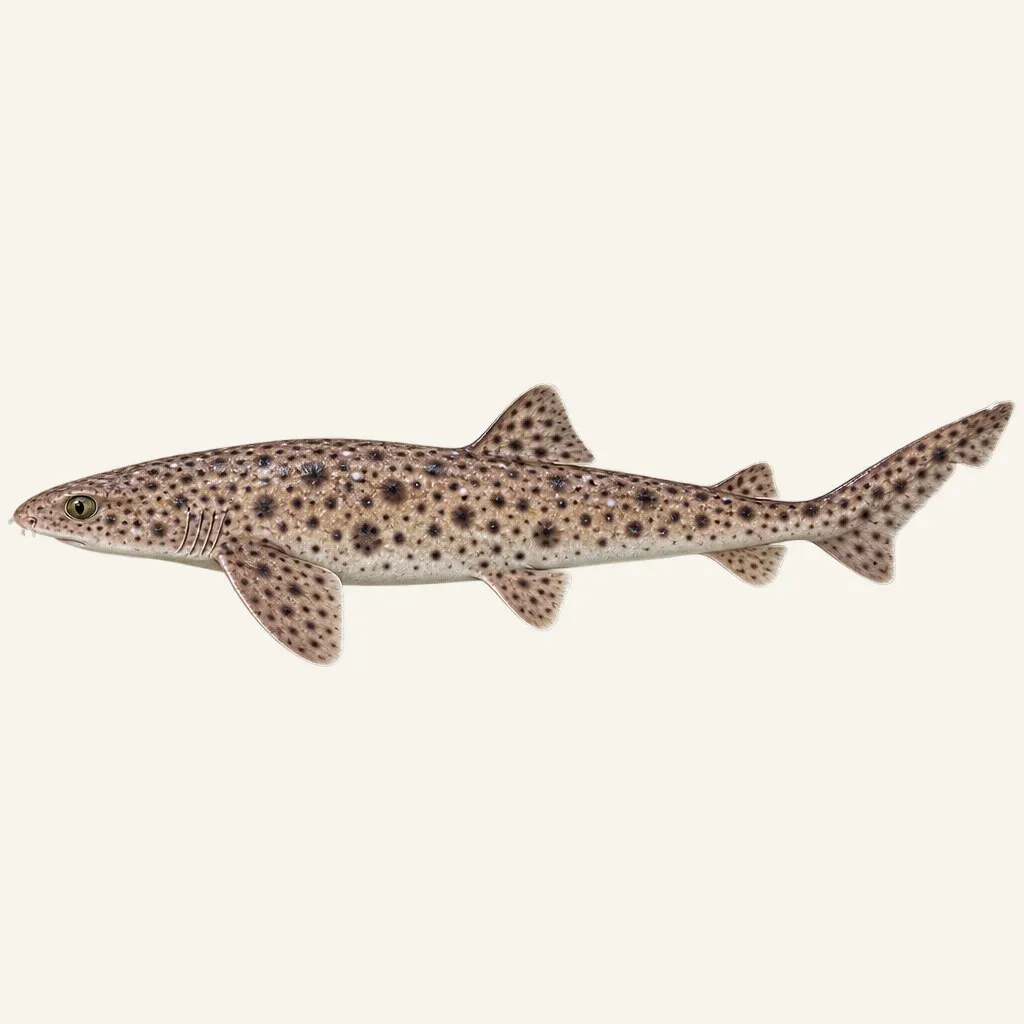
The nursehound is a robust coastal catshark exceeding one metre, with a brown-reddish back covered in large and small dark spots on a pale background. It lives on rocky and sandy bottoms and seagrass meadows in the Mediterranean and North-East Atlantic.
Calendar
Recorded in 24 countries
Angola · Belgium · Cameroon · Congo - Brazzaville · Côte d’Ivoire · Croatia · Equatorial Guinea · France · Gabon · Ghana · Guernsey · Guinea · Guinea-Bissau · Ireland · Isle of Man · Italy · Jersey · Liberia · Netherlands · Nigeria · Senegal · Sierra Leone · Spain · United Kingdom
GBIF occurrence records — native and introduced populations combined.
Its range
Because the animal is tied to hard bottom, its range is a chain of rocky sectors inside a broad band rather than a continuous coastal ribbon. The band runs from southern Scandinavia through the Mediterranean and on past Morocco and Mauritania to Senegal, between 63°N and 12°N.
The southern end of that is not secure. Records further south, to the Gulf of Guinea and the mouth of the Congo, are considered likely misidentifications of Scyliorhinus cervigoni, a very close west African species. A range that is wrong at the bottom corrupts everything calculated from it afterwards, starting with abundance estimates for an animal that is losing ground.
Identifying it
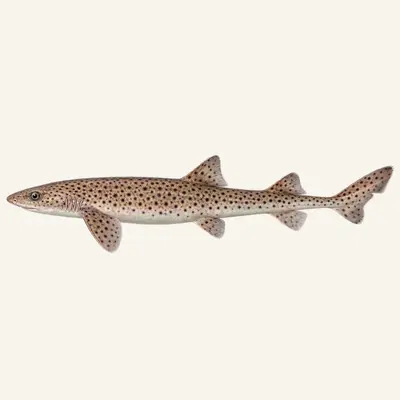
No nasoral grooves. Where the small-spotted catshark has shallow channels running from nostril towards mouth, this species has none at all, and its anterior nasal flaps are small and stop short of the mouth. Labial furrows exist on the lower jaw only. That trio finishes the determination against the only catshark it can be mistaken for.
The spots do the same job from further off. Large black markings mixed with small ones cover the back, sometimes with white spots among them, and the dark saddles that several members of the genus carry are obsolete here. On the smaller species the markings stay below the size of the spiracle; on this one they pass it.
Two more characters close it out. The second dorsal fin is much smaller than the first. And the body is compressed from side to side, where the small-spotted catshark's is oval in section — a difference that can be felt before it is seen.
This is a stocky, thickset shark, and a grown one is getting on for twice the length of the other. Size works on an adult and misleads on a juvenile, which is exactly when the nostrils are needed.
Breeding
Maturity arrives at 77 to 79 cm. Common length is 125, and the maximum reported age is 19 years: the animal spends several years inside the range of sizes that gear takes before it lays a single capsule.
What is known of the laying itself is thin, and that is worth stating for a shark this common. One egg to each oviduct, no more, and the published record adds very little to it.
The arithmetic of the capsule is the interesting part. The embryo receives nothing once the box is deposited — yolk and nothing else — and it emerges at about 16 cm, twice the hatching length of its smaller relative. Everything the young shark is at hatching was sealed in months earlier, which means the case has to be proportionally far larger, and has to survive proportionally longer wherever the female left it.
The water it needs
It comes into one or two metres of water. A shark of this size in water shallow enough to wade is unusual, and it puts the species within range of a rod worked from the rocks — which is where it has to be fished, because rock is what it wants.
The ground is hard throughout: rock, broken bottom, coralline gravel, algal cover. That is the exact inverse of the sand and mud its congener lives on. The two share every sea in the range and almost no seabed.
Depth runs from that first metre to at least 125 m, with 400 as the recorded maximum and the bulk of records between 20 and 63. The species is described as reef-associated, and on these coasts a reef means rock.
Areas
- Rocky coastal bottoms
- Posidonia meadows
- Deep bays and rocky drop-offs
Techniques
- Bottom fishing with paternoster rig
- Bottom longline
- Surf casting
Baits
- Squid
- Cuttlefish
- Crab
- Fresh fish pieces
What it eats
This catshark eats other sharks, and one of them is the small-spotted catshark living on the sand beside it.
The rest is bottom invertebrates — molluscs and crustaceans — together with demersal fishes. But the shark on the menu reorganises everything else. The two species are not merely separated by the size of their spots and the nature of their substrate: one preys on the other, and the border between rock and sand is a feeding border as much as a habitat one. The larger animal holds the hard ground and forages out onto the soft ground next to it.
For bait that means a whole fish rather than a piece of one. A predator that swallows a catshark is not troubled by a mouthful of 30 cm.
How to catch it
Rock dictates the rig. Fishing static over rock costs leads and hooks, and the line wants checking after every snag as much as after every fish; the denticles on the animal's skin then finish whatever the rock started.
Bait follows the diet, and a whole small fish — a bottom-dwelling one for preference — outperforms a chunk.
Access is the opportunity here. The species uses water one or two metres deep over rock, so it can be reached from the shore in a way that few sharks of its size can, and the usual requirement for a boat does not apply.
Handling is the obligation. An animal of a metre and more is heavy enough to be mishandled: it is supported under the belly, never lifted by the gill slits or by the tail alone, and time out of the water is counted in seconds. Any fish of this size on these coasts has spent years getting there.
Conservation · Vulnerable (IUCN) — This species is threatened with extinction. Always release it (no-kill), handle it with the utmost care and check local rules — fishing for it may be prohibited.
Conservation
Rough ground is a partial refuge, and it is the reason this species has lasted as long as it has on fished coasts. Rock that cannot be trawled is still fished with static gear, and a shark that lies motionless on the bottom at night is precisely what a set net or a bottom longline is built to catch. The protection is against one method, not against fishing.
The retreat is established two ways that agree — indices of abundance, and the levels of exploitation on record — in an assessment dated August 2020.
The demography accounts for the rest. First laying at 77 to 79 cm, up to 19 years of life, and one egg per oviduct at a time: a female's total output across her life is small, and she is catchable for years before any of it begins.
Uses are modest — flesh fresh or salt-dried, fishmeal, a few animals in public aquariums — and that is a problem rather than a reassurance. Nobody targets it, so nobody counts it, and a species can lose ground for a long time without anything registering the loss.
Regulations
Check the local regulations in force (legal size limits, closed seasons, bag limits).
For guidance only. Legal sizes, quotas and open seasons vary by location and season: always check the local regulations in force before fishing.
Other names
Nursehound, bull huss and greater spotted dogfish all name this fish in English, and not one of the three contains the word catshark, which is what the scientific literature calls it. Three vernaculars and a book name for one animal, on one set of coasts.
On the slab it disappears into the same two words as its congener — huss and flake, skinned and beheaded, the spots gone along with the skin.
Stellaris means starry, and it is the second star in the European shark list without pointing at the same family: the starry smoothhound, Mustelus asterias, is a houndshark of another order of business entirely. A star names two unrelated fish here and locates neither.
French says grande roussette, German Großgefleckter Katzenhai, the large-spotted catshark, and Spanish alitán.
Sources: fishbase.se · api.gbif.org