Sandbar shark
Carcharhinus plumbeus · Carcharhinidae
- Saltwater
- Sharks & rays
- Medium
- Regulated
- Dangerous
- Size
200–300 cm
- Weight
56–118 kg
- Lifespan
34 years
- Water temp.
23–27 °C
- Depth
0–500 m
Where to fish
- Estuary
- Rocky shore
Habitat icons: Flaticon
Sandbar shark - coastal sea fish, worldwide
Calendar
Recorded in 8 countries
Australia · Brazil · Faroe Islands · France · Puerto Rico · Svalbard & Jan Mayen · United Kingdom · United States
GBIF occurrence records — native and introduced populations combined.
Its range
The range reaches from 45°N to 41°S, but it is a thermal envelope that draws it rather than any geography: the preference recorded for the species sits between 23 and 27 degrees.
That requirement explains the movement. Extended seasonal migrations are known in several parts of the range, and they follow the displacement of that band of warm water rather than any fixed route. Populations are also segregated by age, which means a given area does not hold a sample of the species but a slice of year classes.
Identifying it
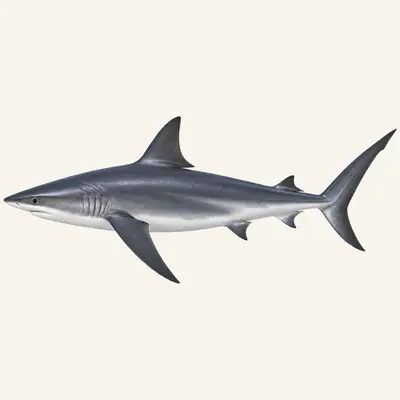
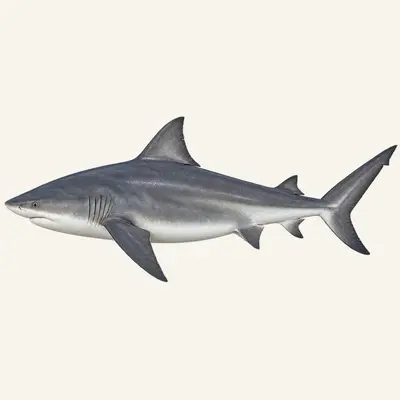
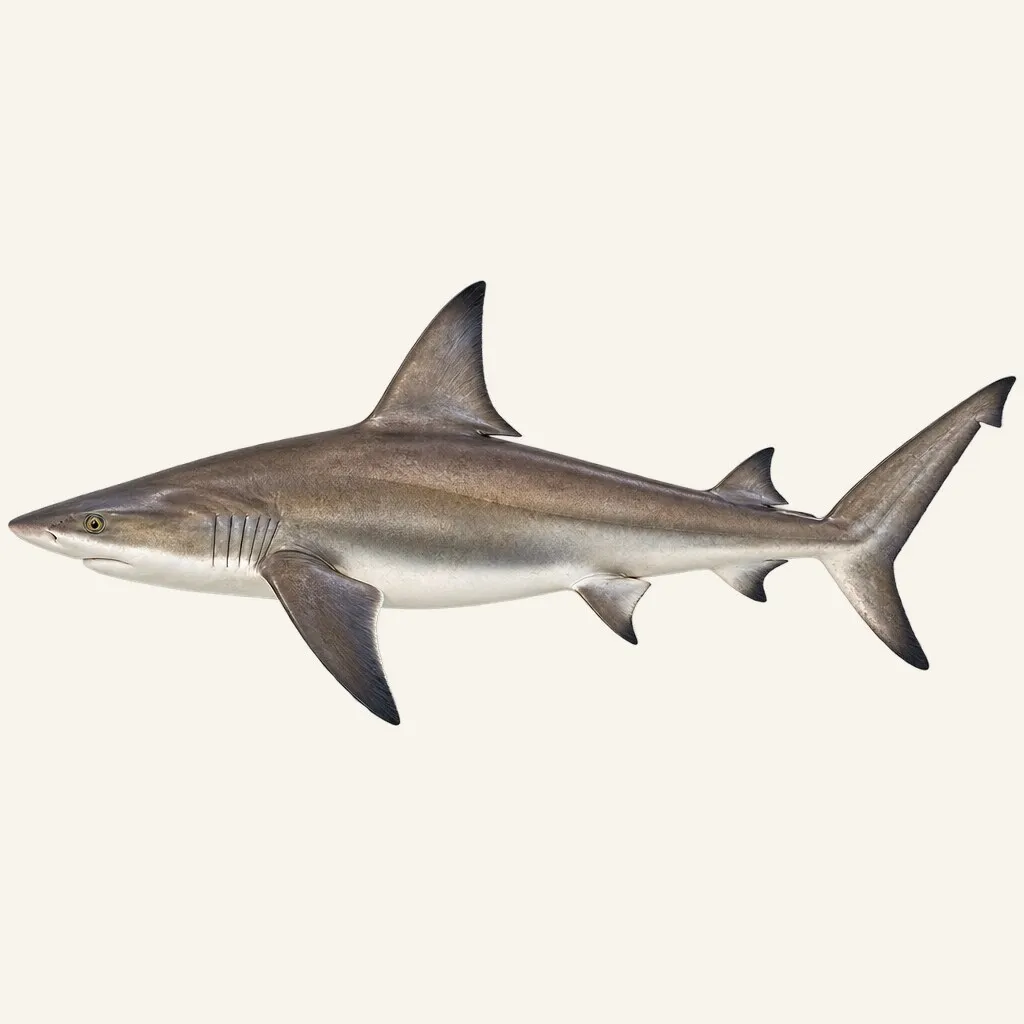
The first dorsal is out of proportion. Very high, held erect, it dominates an otherwise unremarkable body, and it is what registers first when the animal passes under the boat. No other requiem shark of this size carries such a ratio between the fin and the rest of it.
A fleshy ridge runs along the midline between the two dorsals. That relief eliminates the bull shark and the blacktip in one movement, since neither has one, and leaves only the offshore species in contention.
The snout decides next. It is of moderate length and rounded at the end, neither truncated like the bull's nor drawn out like the blacktip's. The upper teeth are high, triangular, with sawing edges. The colour gives nothing away: uniform grey-brown or bronze, white below, fins plain or at most slightly dusky at the tip. There is no marking to remember, and that in itself is information.
Two ridged neighbours remain. The silky shark separates on the position of its first dorsal, which begins behind the free rear tip of the pectorals, where here it is set well forward of it. The dusky shark separates on size and on the absence of any exception in its profile: that species passes four metres without a single fin drawing attention. Here the common length is 2 m, and records to 3 m are held to be uncertain.
Breeding
The secondary sexual character of this species is neither a colour nor a fin: it is the thickness of the skin. In maturing and adult females the cutaneous layer is markedly thicker than in males. Two explanations are offered together — it absorbs the bites the male delivers before copulation, and it resists abrasion on the rock and coral bottoms the species lives over.
The rest follows the pattern of the genus. One to fourteen pups per litter, 56 to 75 cm at birth, twelve months of gestation, mating by distinct pairing with embrace. Off north-eastern Taiwan pups are dropped from February to April.
Maturity comes between 1.26 and 1.83 m, averaging about 1.66 — which is roughly the length of an ordinary fish of the species. Put another way, a good share of the animals encountered have not yet begun to breed.
The water it needs
This shark is defined above all by what it refuses, and the list is unusually specific. It avoids sandy beaches and the surf zone, coral reefs and rough bottom, and surface water. Four exclusions that write off half the coastline before anything else is considered.
What it occupies is the complement: bays, river mouths and harbours, even ground, continental and insular shelves and the deep water bordering them. Recorded depth goes down to 500 m, but ordinary use falls between 20 and 65, with bottom association between 1 and 280. It passes into oceanic water on occasion.
Areas
- Shallow coastal bays
- Sandy and muddy bottoms
- Estuaries
- Coastal drop-offs
Techniques
- Drifting live bait
- Slow-worked dead bait on bottom
- Coastal trolling
- Anchored chumming
Baits
- Whole fish
- Squid
- Sardines
- Mackerel
- Tuna chunks
What it eats
The adult menu is dominated by bony fishes, filled out with small sharks, cephalopods, shrimps, rays and gastropods. The juvenile menu is another matter: young fish feed heavily on crustaceans, blue crabs and mantis shrimps at the head of the list.
That switch during growth has a direct translation. On ground held by juveniles, a crustacean bait matches what the fish actually eat; on ground held by adults it matches nothing. The segregation of age classes and the change of diet combine, and each tells you something about the other.
How to catch it
FishBase describes it in two words that amount to a programme: an inshore fish, and a good light-tackle fighter. It is also the only one of these grey sharks classed harmless to humans, which changes the nature of the encounter — unhooking remains a matter of care, it is not a matter of safety.
Its aversions dictate where to look. Since it shuns the surf and the coral, fishing off a beach or over a reef flat does not concern it. Harbour channels, deep holes in bays and river mouths over mud or even sand are its ground, and the bait is worked near the bottom rather than at the surface, which it avoids equally.
Age segregation supplies one simple rule for reading a session. On a given sector the fish come out at the same size; two very different captures on the same mark are the exception, and changing the size of the catch means changing the place or the season.
Regulated — Often governed by quotas, size limits, seasons, or reporting rules.
Dangerous — Risky handling: gear, release, and safety practices must be adapted.
Conservation · Endangered (IUCN) — This species is threatened with extinction. Always release it (no-kill), handle it with the utmost care and check local rules — fishing for it may be prohibited.
Conservation
Everything about this species is slow. Maturity is reached between 1.26 and 1.83 m, gestation occupies a full year, and the litter rarely passes ten. The longevity figures do not agree with each other: 34 years as the published maximum, but 21 years for females and 15 for males in the populations that have been followed. Whichever value is taken, a female's litters can be counted on the fingers.
Age segregation makes the effect of fishing worse than the raw tonnage suggests. A fishery working one sector does not remove an even fraction of the population: it removes an entire year class, and the hole it digs climbs the age pyramid for the next ten or fifteen years before it shows up as missing litters. Nothing in the landings warns of this while it is happening, because the other year classes are elsewhere and still being caught.
The thermal band adds a second effect. A stock that follows 23 to 27 degrees moves when that water moves, so the ground a fishery has worked for decades can hold fish one season and none the next without a single animal having been lost.
Regulations
Check the local regulations in force (legal size limits, closed seasons, bag limits).
For guidance only. Legal sizes, quotas and open seasons vary by location and season: always check the local regulations in force before fishing.
Other names
Sandbar shark is the standard English name, taken from the ground rather than the colour, and German follows with Sandbankhai. The name is precise enough to be useful, which is not common in this genus.
The other names are less helpful. French says requin gris, Italian squalo grigio: several species of the same genus would answer to grey just as well, and commercial usage does not settle it either. The epithet plumbeus means lead-coloured, which returns to the same difficulty. The trap for an English speaker lies elsewhere, in Spanish: the dusky shark is tiburón arenero, the sandy one, so the sand belongs to one species in English and to its close relative in Spanish. Where determination matters, the scientific name is the only one that holds.
Sources: fishbase.se · api.gbif.org