Shortfin mako
Isurus oxyrinchus · Lamnidae
- Saltwater
- Sharks & rays
- Medium
- Protected
- Regulated
- Dangerous
- Size
270–445 cm
- Weight
150–506 kg
- Lifespan
32 years
- Depth
0–888 m
Where to fish
- Offshore
Habitat icons: Flaticon
Shortfin mako shark - pelagic sea fish, worldwide
Calendar
Recorded in 24 countries
Australia · Austria · Brazil · Chile · Denmark · Faroe Islands · Fiji · Finland · France · Germany · Greece · Indonesia · Ireland · Italy · Mexico · Mozambique · Netherlands · New Zealand · Norway · Peru · Portugal · Spain · United Kingdom · United States
GBIF occurrence records — native and introduced populations combined.
Its range
The mako holds the temperate and tropical seas of the world, from 65°N to 54°S, the Mediterranean included. That apparent continuity covers something more divided.
Mitochondrial DNA shows differentiation between populations at a global scale. The reading taken from it is that dispersal is carried by the males, the females staying faithful to the area where they were born. Added to that is a marked sexual segregation in population structure: males and females are not distributed the same way.
A local stock is therefore not fed by the rest of the world. An area emptied of its females does not repopulate from the neighbouring ocean, however freely the males move through it. Tagging carried out in New Zealand shows seasonal migrations besides.
Identifying it
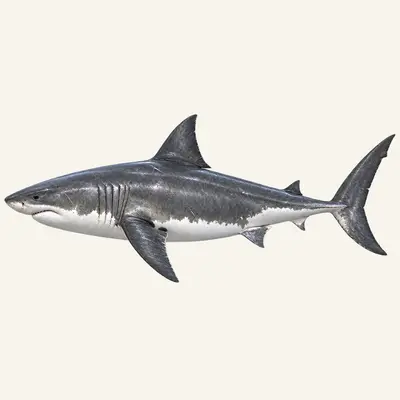
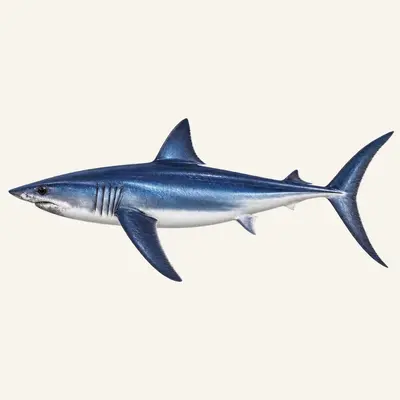
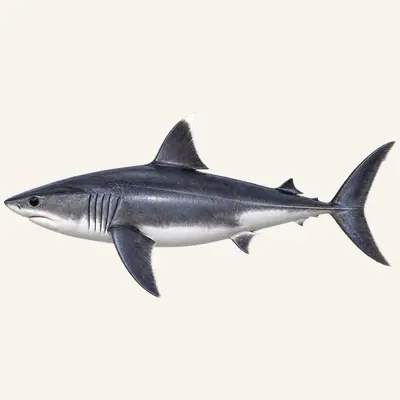
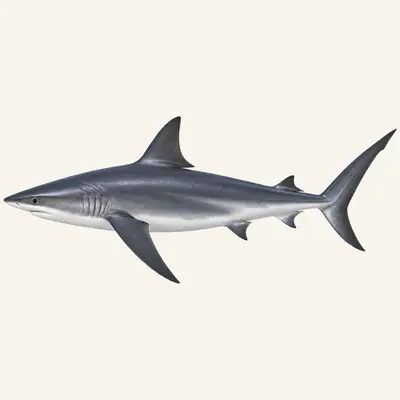
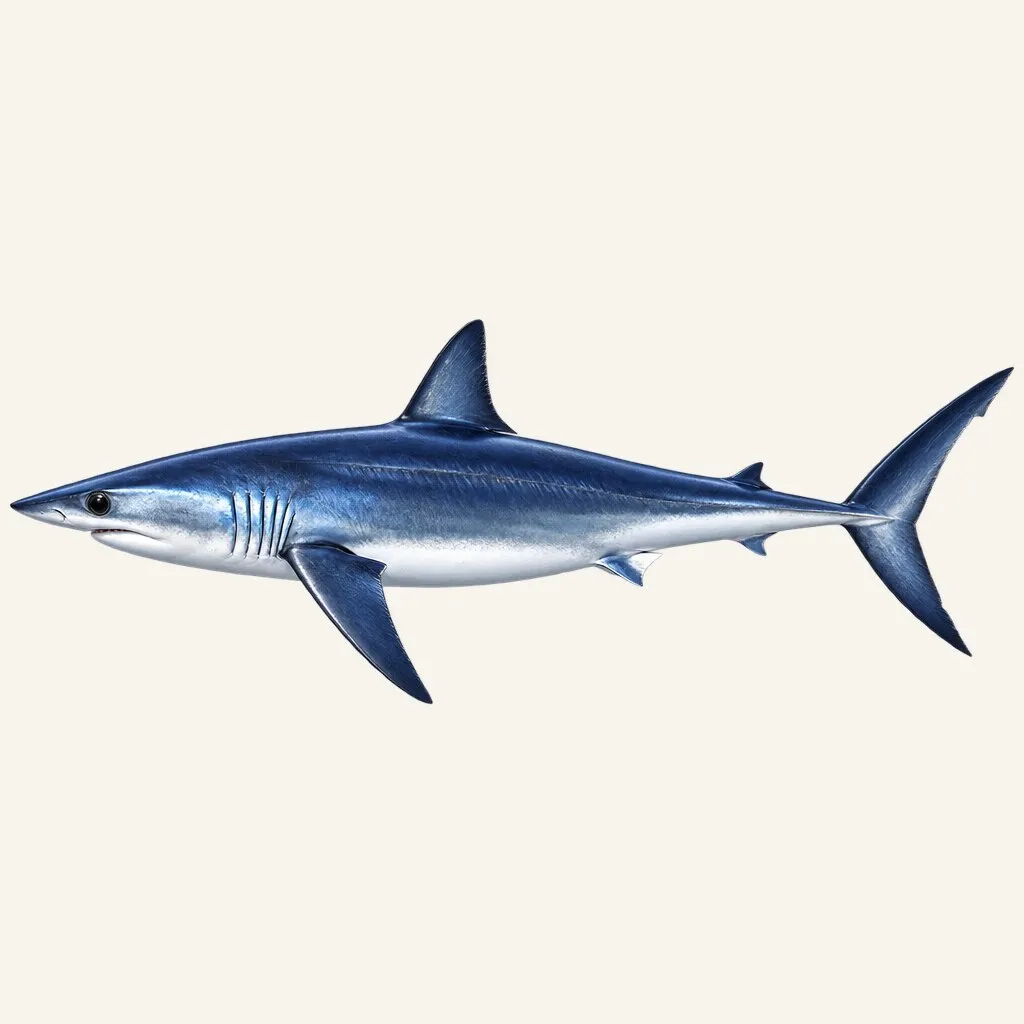
The body is a pure spindle with nothing sticking out of it: the second dorsal and the anal are tiny, the tail is lunate and its lower lobe almost as developed as the upper. That near-symmetrical tail belongs to an open-water swimmer, not to a shark that works the bottom.
The snout is sharp, drawn to a fine point, and the eye is large and completely black. The back is a deep blue that cuts hard against a white belly, with no mottling or blotching under the snout.
The teeth decide. They are long, narrow, hooked, smooth-edged, without serrations or basal cusplets. No other high-seas shark of this size carries that dentition of curved needles.
The pectoral separates the mako from the only fish it can be confused with. In this species it is shorter than the head; in the longfin mako it equals or exceeds the head, and its tip is broad rather than tapered.
The sizes are considerable, with 2.7 m for an ordinary individual. The upper end is not settled: a historical specimen taken off Turkey was estimated from photographs at 5.85 m, a figure the published records do not support.
Breeding
The embryos eat, and what they eat is what the mother goes on producing. Once the yolk sac has been resorbed they feed on the unfertilised ova she releases into the uterus. That is oophagy, and it turns out newborns of 60 to 70 cm, ready to hunt.
Gestation lasts fifteen to eighteen months. The complete cycle comes round every three years. The litter runs from four to twenty-five pups, most often ten to eighteen. Mating involves a distinct pairing with embrace.
Maturity arrives around 2.78 m on average, within a narrow bracket of 2.75 to 2.85 m. Longevity reaches 32 years.
Those three numbers hold the fate of the species between them. A female spends a decade and a half reaching breeding size and then gives birth only one year in three. The renewal rate is closer to a marine mammal's than to a fish's.
The water it needs
An oceanic shark that comes inshore at times. It usually holds surface water down to about 150 m, though records reach 888. It does not enter water below 16 degrees.
Areas
- Offshore pelagic waters
- Warm current zones
- Offshore thermal fronts
- Open sea beyond the continental shelf
Techniques
- Fast offshore trolling
- Pelagic live bait fishing
- Offshore chumming and drifting
- Offshore surface lures
Baits
- Mackerel
- Bonito
- Squid
- Whole tunas
- Sardines
What it eats
Isotope analysis puts it at the top: in the oceanic water off eastern Australia it is the highest-level fish predator measured. Nothing sits above it.
The menu follows size. Bony fishes, other sharks and cephalopods for ordinary purposes; the large individuals take prey on their own scale, billfish and small cetaceans.
How to catch it
It jumps. A hooked mako leaves the water, and it is the only large shark for which that is ordinary behaviour rather than an accident. It is also probably the fastest of all sharks, which gives those jumps a height out of all proportion to the animal's mass.
The combination has two practical consequences. The first is a tackle one: something that accelerates like that requires drags set at the outset rather than during the fight, and line to spare. The second concerns safety, and it is serious. The species is classed as traumatogenic, responsible for unprovoked attacks on swimmers and on boats, and a fish that jumps can arrive on board.
The third point belongs to handling. The teeth are hooked needles with smooth edges, made to pierce and to hold, and they stay effective for as long as the animal is within reach. Striking, unhooking and release are worked out before leaving the dock, not at the moment they are needed.
Protected — Sensitive or protected species depending on area: check local rules before taking action.
Regulated — Often governed by quotas, size limits, seasons, or reporting rules.
Dangerous — Risky handling: gear, release, and safety practices must be adapted.
Conservation · Endangered (IUCN) — This species is threatened with extinction. Always release it (no-kill), handle it with the utmost care and check local rules — fishing for it may be prohibited.
Conservation
A methodological error long concealed how serious its case was. Several authors assumed the species laid down two growth rings a year in its vertebrae, which halved the age read off every individual. The resulting estimates of longevity, of age at maturity and of capacity to rebuild all came out too favourable. Those data have been withdrawn and replaced by verified estimates, and the portrait that emerges is of an animal twice as slow as the earlier publications said.
The consequence is not only historical. Quotas, rebuilding plans and stock assessments written on the old figures were built on a fish that recovers twice as fast as this one does, and the deficit they created is still being carried.
Pressure, meanwhile, is constant and falls on the whole animal. The flesh is of good quality, the fins and skin are valued, oil is extracted for vitamins, and the jaws and teeth sell as objects. Few parts are left without a market, which makes the species profitable even as an incidental catch.
Regulations
Check the local regulations in force (legal size limits, closed seasons, bag limits).
For guidance only. Legal sizes, quotas and open seasons vary by location and season: always check the local regulations in force before fishing.
Other names
Shortfin mako in English, where the adjective only takes on meaning by contrast with the longfin. Mako itself is borrowed from Maori and has become international; the French requin-taupe bleu and the Spanish marrajo are the local alternatives. The genus name Isurus refers to the equal lobes of the tail, oxyrinchus to the pointed snout: both characters of the outline are in the scientific name.
Sources: fishbase.se · api.gbif.org