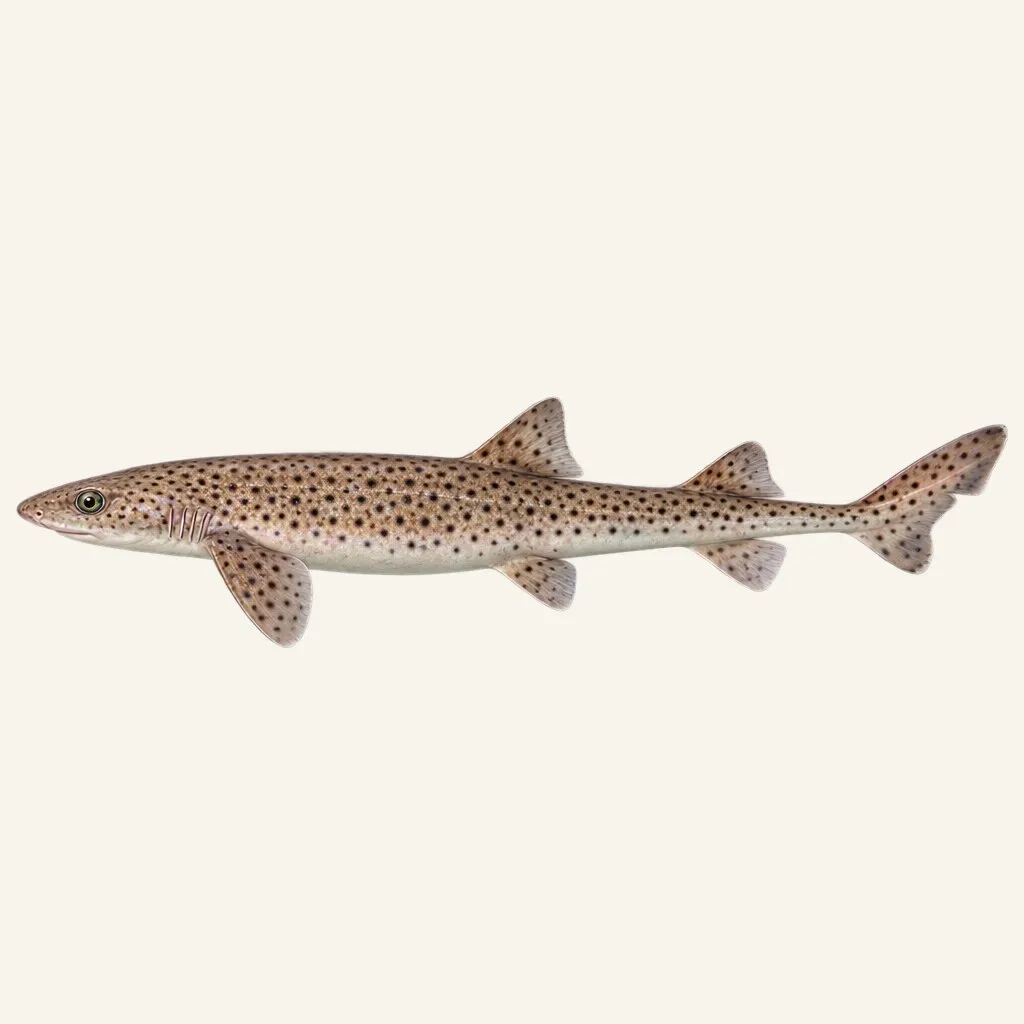
Lesser spotted dogfish
Scyliorhinus canicula · Scyliorhinidae
- Saltwater
- Sharks & rays
- Medium
- Regulated
- Size
60–100 cm
- Weight
0.7–3.7 kg
- Lifespan
12 years
- Depth
10–780 m
Where to fish
- Beach
- Rocky shore
Habitat icons: Flaticon
Small-spotted catshark - coastal sea fish, Eastern Atlantic/Mediterranean. Lives over continental shelves and uppermost slopes, on sandy, coralline, algal, gravel or muddy bottoms
Calendar
Recorded in 31 countries
Albania · Algeria · Belgium · Cameroon · Congo - Brazzaville · Côte d’Ivoire · Croatia · Denmark · France · Gabon · Germany · Ghana · Greece · Guernsey · Guinea · Guinea-Bissau · Ireland · Isle of Man · Italy · Jersey · Liberia · Morocco · Netherlands · Nigeria · Norway · Portugal · Senegal · Sierra Leone · Spain · Sweden · United Kingdom
GBIF occurrence records — native and introduced populations combined.
Its range
The eastern limit is a doorway the animal declines to use. The range pushes into the North Sea as far as the south-west coast of Sweden and Copenhagen, and stops at the Danish straits — the entrance to the Baltic. What lies beyond is brackish, and this species does not follow the coast into it.
Everything else is a ribbon rather than an area: the Norwegian Sea, the Atlantic front from Ireland to Portugal, the whole Mediterranean, then the African coast down to northern Mauritania at 20°30′N. An animal that spends its life lying on the shelf does not cross deep water, so the outline traces the shelf itself and nothing more.
Because this is the commonest catshark in European coastal waters, those limits are established rather than merely under-sampled. The line at Copenhagen and the line at twenty degrees north are both real edges, not the edge of the sampling.
Identifying it
Turn the fish over. This is the one European catshark with grooves running from the nostrils towards the mouth — shallow nasoral grooves, with the posterior nasal flaps set out at the sides rather than along the rear border of the openings. Every congener but one lacks them, and that exception, S. duhamelii, is separated on other proportions taken from the same underside.
Those proportions are worth having while the fish is upside down. The gap between the anterior nasal flaps is 6 to 7.5 times smaller than the width of one flap; through most of the genus that ratio is nearer two. The lower labial furrow measures a little under half the width of the mouth, where in the others it stays under a third.
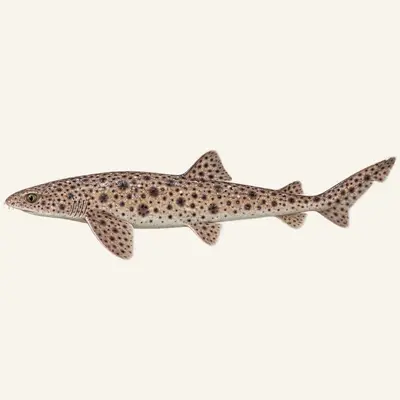
Then the spots, which are the character everybody actually uses, and which need a reference to work at all. The dark markings on the back are well defined, close-set and mostly smaller than the spiracle — the small respiratory opening behind the eye. On the nursehound they exceed it. The comparison is taken on the animal itself, with nothing brought in from outside, and that is what makes it usable at the waterline in the dark.
The body is elongated and oval in section, and the skin is rough under a hand run forward along it. Sex reads at a glance: males carry a pair of claspers at the base of the pelvic fins, and in this species the clasper tip has a rough dermal covering. The detail earns its place, because the two sexes do not spend the day in the same kind of ground.
Breeding
The only parental care in this species is the choice of somewhere to tie the egg. Each corner of the capsule carries a long tendril that winds around whatever it meets — a macroalga, a seagrass, a sponge, a bryozoan, an erect hydroid. Without that purchase the case rolls and ends buried, so laying requires structured ground in a few metres of water; some capsules have even been found in the lower part of the intertidal zone.
The capsule is a horny box, 4.9 to 7.0 cm long by 1.5 to 3.0 wide, its dimensions varying with locality and with the size of the female. One is laid per oviduct at a time, never two, and the operation repeats through the year with a peak in June and July.
After that the mother contributes nothing. The embryo has its yolk and no other supply, and it stays in the box for 5 to 11 months depending on temperature — a spread wide enough that pups conceived together hatch months apart. The hatchling measures 8 to 10 cm and already looks like the adult.
Annual fecundity for north-east Atlantic females is estimated at 29 to 62 pups. That is a poor figure beside a bony fish and a remarkable one beside a shark, and it is the single reason this animal is common.
The water it needs
The depth this species occupies changes with latitude, and the pattern is instructive. In the north-east Atlantic it holds 10 to 100 m. In the Mediterranean it goes down to 400. In the eastern Ionian Sea it has been recorded between 288 and 780. It is not a different fish in each place — it is the same fish looking for the same cool water, and that water lies deeper where the surface is warmer.
The ground is soft or mixed: sand, gravel, mud, coralline bottoms, algal mats, over the shelf and the top of the slope. It swims in midwater from time to time; almost all of its life is spent lying down.
Daytime separates the sexes, and this is the most useful line on its record. Males rest directly on the substrate. Females conceal themselves in caves and crevices under half a metre to a metre and a half of water. Males forage over prey-rich soft sediment and beneath mats of filamentous algae. A rock mark worked in daylight yields females and a sandy bottom yields males: the sex ratio of a session says mostly where it was fished.
The animal is nocturnal. Daylight is for resting, and activity begins as the light goes.
Areas
- Rocky and sandy coastal bottoms
- Seagrass beds and underwater algae
- Rocky bays and coves
Techniques
- Bottom fishing with paternoster rig
- Surf casting
- Bottom longline
Baits
- Ragworm
- Crab
- Squid
- Mussel
What it eats
The diet is sex-structured, which is unusual enough to lead with. Males are recorded foraging over soft prey-rich sediment and under filamentous algae — two specific habitats, worked by one sex, while the other spends the day in rock.
What both take is small and slow: molluscs, crustaceans, small cephalopods, polychaete worms, and a few small bony fishes. Nothing on the list is fast and a good deal of it is buried.
Buried prey is the problem this animal solves electrically. It detects the weak fields generated by other organisms, so a worm inside its burrow — invisible, and poorly scented through sediment — is still broadcasting. That sense is what makes a nocturnal soft-bottom forager viable in the first place.
How to catch it
On sand, at night, this is what finds the bait first. It is caught more often by accident than on purpose, and the accident is close to a certainty.
The bite is not a bite. The animal arrives, turns, closes on the bait and moves off pulling gently, so the signal at the rod resembles a snag giving way rather than a take.
Two things cost tackle. The hide, covered in denticles, wears through a fine leader in a few seconds of the fish rolling against it. And the defence: it coils around whatever is available — line, forearm, landing-net frame — and a catshark knotted around itself does not come undone without being handled roughly. A wet cloth and a hand under the belly beat a firm grip.
It is harmless. The dentition is made for shells and worms rather than for biting, and abrasion is the only hazard in handling one.
Bait and presentation follow the diet: pieces that leak scent, laid on sand or gravel, and time. Nothing about this fish can be hurried, and it cannot be drawn in from a distance by movement.
Regulated — Often governed by quotas, size limits, seasons, or reporting rules.
Conservation
This species takes a level of fishing that its larger relative cannot, and the demography accounts for the entire difference. It matures at about 50 cm — 35 to 64 depending on the population — lives around 12 years, and a female produces 29 to 62 pups a year. The nursehound, in the same seas, matures near 78 cm and reaches 19 years. Small, early and prolific against large, late and few: the first absorbs removals and the second does not.
One thing does press, and it presses on the egg rather than on the fish. A horny capsule needs a standing structure to hold onto, and swept ground offers none. What goes missing is not missing to the adult; it is missing to an embryo, months before it hatches, in water shallow enough that the whole business happens within sight of the beach.
Landings are modest — flesh sold fresh or salt-dried, oil, fishmeal. Most of what is taken was not being looked for, and that is where the future of the species is decided rather than on a market stall.
Regulations
Check the local regulations in force (legal size limits, closed seasons, bag limits).
For guidance only. Legal sizes, quotas and open seasons vary by location and season: always check the local regulations in force before fishing.
Other names
Small-spotted catshark is the current book name. Lesser spotted dogfish is what most British anglers still say, and rough hound is older usage for the same fish.
The fish counter erases all of it. Skinned and beheaded, this species and several other small sharks are sold as rock salmon, huss or flake, names that identify nothing — and the skinning removes precisely the characters the determination depended on.
Dogfish is the deeper problem. In Britain it means this animal; in North America it usually means the spiny dogfish, an unrelated shark of another order entirely. Elsewhere the cat won: Kleingefleckter Katzenhai in German, gattuccio in Italian, pintarroja in Spanish, petite roussette in French.
The egg case has a name of its own, out of beachcombing rather than fishing: mermaid's purse. Tangled in the strand line, it is more familiar to walkers than to anglers.
Sources: fishbase.se · api.gbif.org