Scalloped hammerhead
Sphyrna lewini · Sphyrnidae
- Saltwater
- Sharks & rays
- Medium
- Protected
- Regulated
- Dangerous
- Size
360–430 cm
- Weight
292–152 kg
- Lifespan
35 years
- Depth
0–1,043 m
Where to fish
- Reef
- Offshore
Habitat icons: Flaticon
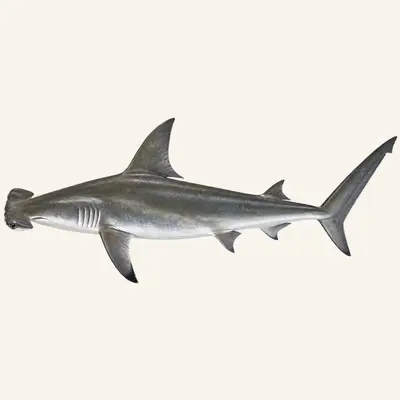
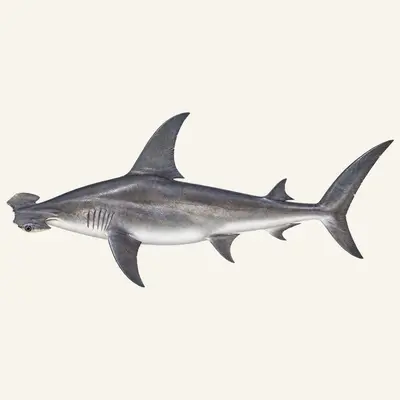
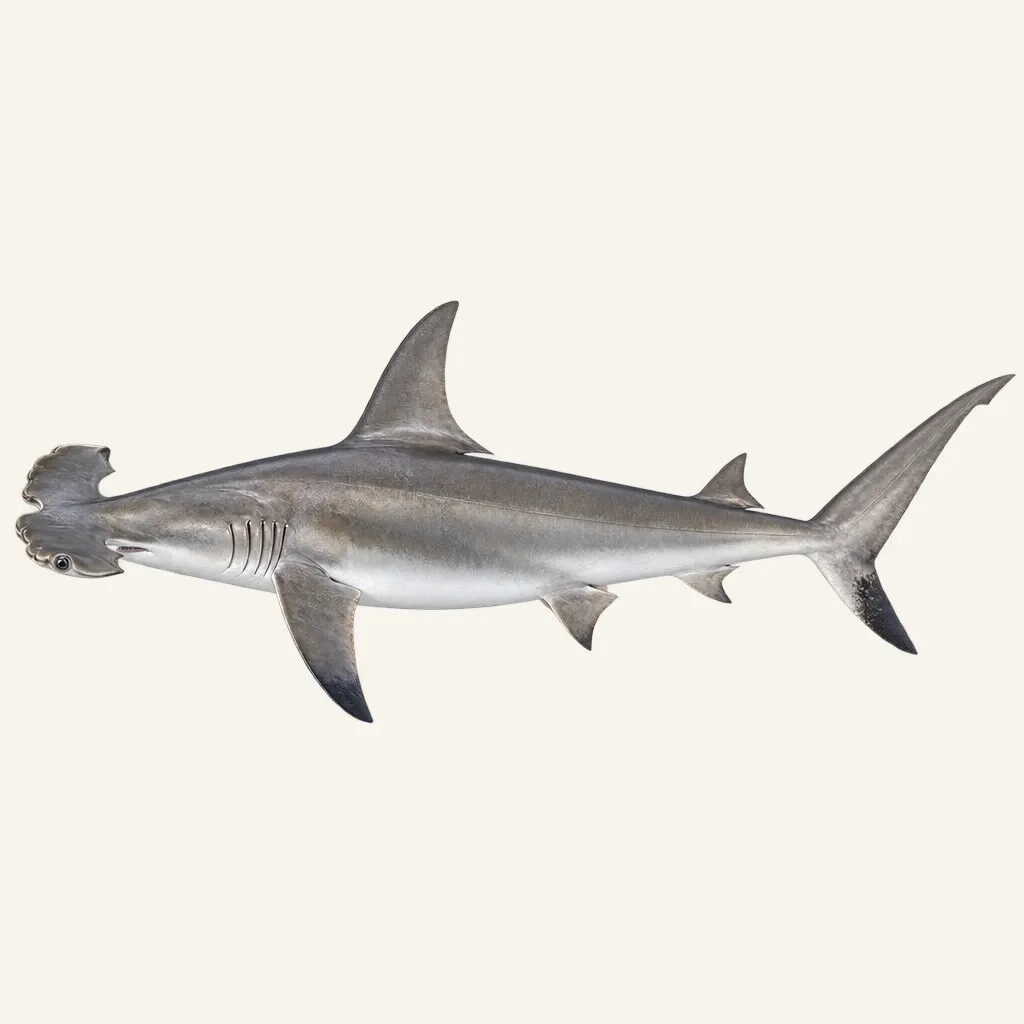
The scalloped hammerhead is distinguished from other hammerhead sharks by the wavy, scalloped front edge of its head, including a visible central notch. It often forms large, dense schools during the day in coastal waters and around oceanic islands.
Calendar
Recorded in 30 countries
Australia · Bangladesh · Brazil · Cameroon · China · Colombia · Costa Rica · Côte d’Ivoire · Ecuador · Egypt · Faroe Islands · Fiji · French Polynesia · Gabon · Ghana · Guinea · India · Indonesia · Japan · Liberia · Malaysia · Mexico · Mozambique · Nigeria · Papua New Guinea · Puerto Rico · Sierra Leone · Taiwan · United Kingdom · United States
GBIF occurrence records — native and introduced populations combined.
Its range
The range circles the globe between 46°N and 39°S, and that limit is thermal: it is warm and temperate water that fixes it, not the continents.
Its shape, on the other hand, comes from the depth the animal actually uses. The recorded maximum reaches 1,043 m, but the ordinary band lies between the surface and 25. The range is therefore not a filled ocean: it is a ribbon of continental and insular shelves, doubled by the deep water immediately bordering them. An isolated island in mid-Pacific counts for as much as a thousand kilometres of mainland coast, because it supplies the same relief.
Summer widens the ribbon. Huge schools of small individuals move poleward in several sectors at that season before dropping back. Elsewhere, resident populations stay put all year.
Identifying it
The front edge of the head is scalloped. A well-marked median indentation cuts into the middle of the brow, two lateral indentations take it up on either side, and the profile undulates instead of running clean across. This is the character to check before any other, because it is what divides this shark from the two others of comparable size: one has a brow that is nearly straight once adult, the other a continuous curve with nothing cut into its centre.
The head itself is wide and thin, blade-like. The nostrils carry strong prenarial grooves. The rear margin of the eye falls roughly level with the front of the mouth, sometimes slightly behind it.
Two markings confirm the identification. The undersides of the pectoral tips are dusky, and the lower caudal lobe carries a dark blotch. Those smudges are enough to rule out the great hammerhead, whose fins are uniform. The first dorsal stays moderately high; the second dorsal and the pectorals are low.
The teeth are triangular, deeply notched on their rear edge, with smooth or very finely serrated margins. The upper precaudal pit forms a transverse crescent.
Breeding
A litter runs to thirteen or twenty-three pups, forty-one at the highest count recorded, and the young are born between 39 and 57 cm, most often around 45. Gestation lasts nine to ten months, with a placenta joining each embryo to the uterine wall.
The maturity figures carry the rest of the meaning. A female breeds on average at 2.1 m, in a bracket running from 1.4 to 2.73, in an animal that reaches 4.3 m and lives thirty-five years. Half the possible length is behind her before the first litter, and the bulk of the reproductive life belongs to fish that are already large.
The water it needs
The fish lives above relief. Seamount flanks, island drop-offs, passes, places where current lifts cold water: these are where prey concentrates, and it holds there in midwater rather than pinned to the bottom.
It comes very close in all the same. Enclosed bays and estuaries are part of its ground, and it tolerates brackish water. That coastal penetration is not incidental, because the young stay there: the nurseries are inshore while the adults work the island edges.
Grouping follows age. Adults are met singly, in pairs or in schools; the young form very large aggregations. A dense school crossed in daylight is therefore first of all a school of small fish, and its density measures an entire year class in one place.
Areas
- Around seamounts
- Insular semi-pelagic waters
- Tropical upwelling zones
- Reef passes
Techniques
- Offshore trolling
- Live bait mid-water
- Chumming and drifting
- Offshore float fishing
Baits
- Small tunas
- Mackerel
- Squid
- Bonito
- Sardines
What it eats
Bony fishes and cephalopods make up the bulk of it. Lobsters, shrimps and crabs are added, along with other sharks and rays in smaller proportion.
That is a midwater menu, consistent with a fish holding station above relief: it takes what the current gathers, and it has none of the bottom specialisation of its larger relative.
How to catch it
The school governs everything. An encounter is almost never a single animal, and that fact cuts two ways. For finding fish, locating the right piece of relief means locating dozens of them at once, which is why prospecting is done on the sounder over seamounts and drop-offs rather than at random offshore. For pressure, one successful set removes a whole fraction of a gathering, and that is exactly why restraint matters more here than elsewhere.
The working depth simplifies presentation. Despite the thousand metres on record, the animal hunts in the top 25, and a live bait drifting under a float or a lure imitating a small tuna works in that band.
The risk exists but is misplaced in most people's imagination. The species is held to be potentially dangerous, yet it is often unaggressive towards divers who approach it. The danger is not in the water; it is alongside the hull, on a hooked animal that is exhausted and out of its element.
The fish is also fragile relative to its population. An individual fought at length, lifted and then released does not have the toughness of a coastal shark, and the only gesture that counts is unhooking in the water, cutting the line close to the hook if need be.
Protected — Sensitive or protected species depending on area: check local rules before taking action.
Regulated — Often governed by quotas, size limits, seasons, or reporting rules.
Dangerous — Risky handling: gear, release, and safety practices must be adapted.
Conservation · Critically Endangered (IUCN) — This species is threatened with extinction. Always release it (no-kill), handle it with the utmost care and check local rules — fishing for it may be prohibited.
Conservation
The central problem is accessibility, and it works from both ends at once. The young grow up in bays and estuaries, within reach of the smallest artisanal boat; the adults frequent seamounts that distant-water fleets know how to find. Few species lay themselves open to both extremities of world fishing this way, and neither depth nor remoteness offers this one a refuge.
Schooling then turns a capture into a mass removal. A school is not a sum of scattered individuals to be taken one at a time: it is a single target, and one operation is enough to take a considerable share of it out.
The two effects compound. A fishery that finds a nursery removes a year class before it has bred; a fishery that finds an aggregation of adults removes the fish that were breeding. Neither event is visible from the other's grounds, and the stock is assessed as one animal across both.
Regulations
Check the local regulations in force (legal size limits, closed seasons, bag limits).
For guidance only. Legal sizes, quotas and open seasons vary by location and season: always check the local regulations in force before fishing.
Other names
Scalloped hammerhead in English, where the adjective describes the notched front margin of the head. French says requin marteau halicorne. The two languages name the same peculiarity, each in its own way, which is unusual for a shark.
The genus name Sphyrna comes from the Greek sphyra, a hammer, and hammerhead has passed into most fishing languages unchanged. That is precisely what makes identification confused: three species answer to the same nickname, and only the detail of the leading edge separates them by eye.
Sources: fishbase.se · api.gbif.org