Piked dogfish
Squalus acanthias · Squalidae
- Saltwater
- Sharks & rays
- Medium
- Regulated
- Size
100–160 cm
- Weight
4.0–9.1 kg
- Lifespan
75 years
- Water temp.
7–15 °C
- Depth
0–1,978 m
Where to fish
- Rocky shore
Habitat icons: Flaticon
Spiny dogfish - coastal sea fish, worldwide
Calendar
Recorded in 31 countries
Argentina · Australia · Cameroon · Canada · Chile · Congo - Brazzaville · Côte d’Ivoire · Croatia · Denmark · Equatorial Guinea · France · Gabon · Ghana · Guinea · Guinea-Bissau · Ireland · Isle of Man · Italy · Liberia · Namibia · Netherlands · New Zealand · Nigeria · Norway · Senegal · Sierra Leone · South Africa · St. Pierre & Miquelon · Sweden · United Kingdom · United States
GBIF occurrence records — native and introduced populations combined.
Its range
Boreal and temperate water in both hemispheres, which puts this shark on nearly every continental shelf on the planet — with one exception that changes how the whole literature has to be read.
The North Pacific is not part of it. Every record from there refers to Squalus suckleyi, resurrected and redescribed as a separate species in 2010.
The consequence is practical rather than nomenclatural. Growth rates, longevity figures and management parameters published from the North American Pacific coast do not describe the animal on this page, and carrying them across means transposing demographic values between two stocks that do not share them. Anything written before 2010 needs checking for which fish it was measuring.
Identifying it
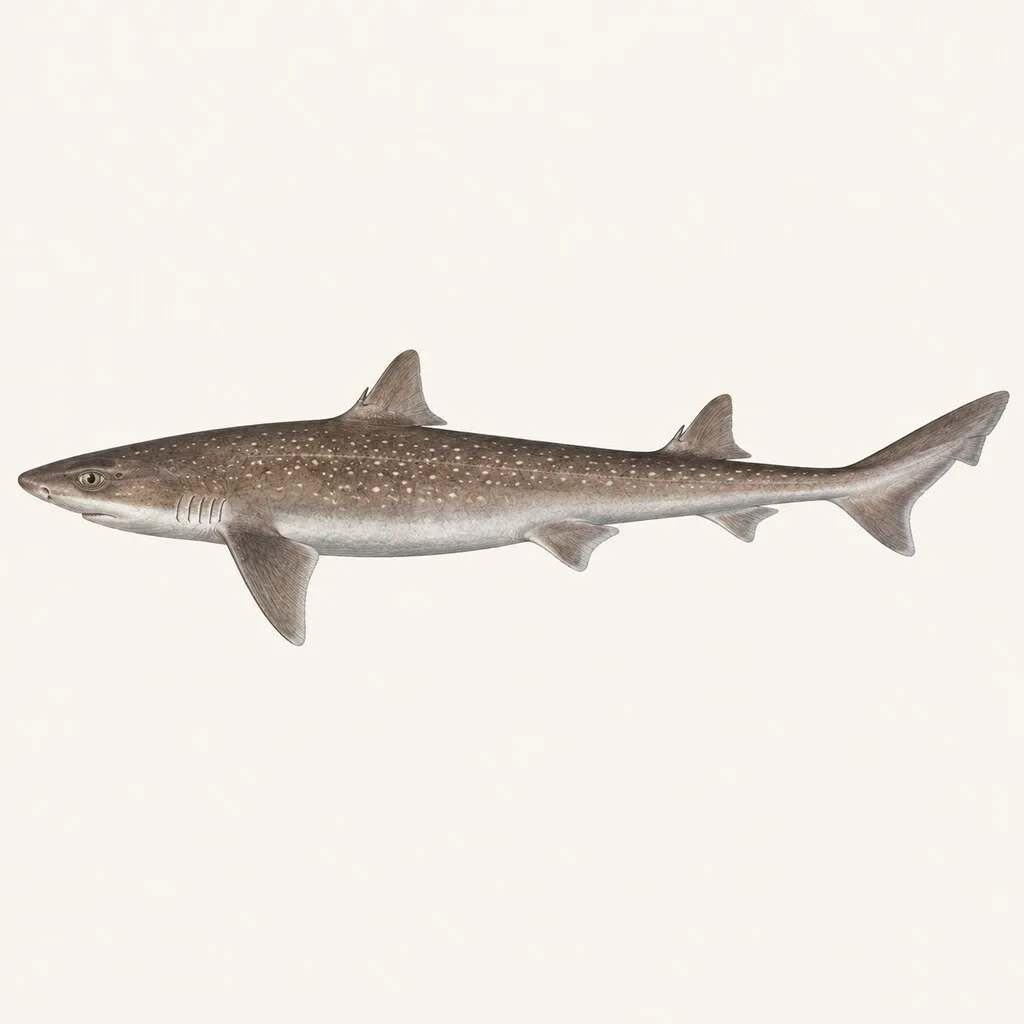
Two dorsal spines, one set into the leading edge of each dorsal fin, and no anal fin at all. Those two characters together settle the order before any measuring starts. The exposed part of the first spine is short, 1.7 to 2.7 per cent of total length, on a narrow exposed base.
After that the published diagnosis becomes almost entirely a set of ratios, which is itself informative: this animal had to be separated from something that looks the same, and proportions were what did it. The body is very slender, the abdomen 7.2 to 9.2 per cent of total length. The head is narrow, 7.9 to 10.2 per cent across at the mouth. The snout is moderately long. The anterior nasal flap has a single lobe. The first dorsal begins just behind the free rear tips of the pectorals, further back than in most of the neighbouring dogfishes.
The livery finishes it and is the part usable at arm's length. Back and flanks bluish grey, scattered with an irregular array of moderately large white spots; whitish underneath. The caudal is pale with a poorly demarcated whitish margin and a blackish blotch at the apex of its upper lobe, and there is no dark caudal bar; in juveniles the anterior margins of both lobes are whitish. The flank denticles carry three points. The vertebral count runs from 101 to 109.
Breeding
Gestation runs 18 to 24 months — the longest known of any cartilaginous fish, and long enough that a female is pregnant for most of her adult life without producing very much.
What she produces is one to twenty-one pups, born at 18 to 30 cm, and 26 to 28 in the north-east Atlantic. The sex ratio at birth is even. Development is aplacental: the embryos live on yolk, so the two years are spent carrying rather than supplying.
Birth is closer to a mammal's than to a spawning. Pregnant females gather in enclosed shallow bays to give it, the mother goes through a series of rhythmic contractions, and the pups are delivered head first.
One fact governs everything downstream of this section. The size of the mother sets the size of the brood: a female of 100 cm carries on average four times as many embryos as one of 70, and her pups survive at a higher rate. Large females are not simply older breeders. They are where the reproduction of the population actually happens, and the biggest of them are carried in exactly the aggregations that fisheries have historically preferred.
Males mature at 60 to 70 cm, females at 75 to 90. Mating probably takes place in winter and begins with a pairing and an embrace.
The water it needs
Temperature places this shark far more precisely than depth does. It lives between 7 and 15 degrees, and both its north-south movements and its runs out towards deeper water are that band being followed round the year. It has been recorded from the surface to nearly 2,000 m, but ordinarily holds 50 to 300, with adults mostly between 10 and 200.
The habit is demersal without being exclusive. It hunts near the bottom, and it is also met in midwater and at the surface. It tolerates brackish conditions, enters enclosed bays and estuaries, and will go into fresh water, where it cannot survive more than a few hours.
Gregariousness shapes every encounter. The species used to be seen in foraging schools of several thousand, sorted by size or by sex: males and pregnant females in the shallower water, non-pregnant females further out. A school met is therefore not a sample of the population but one class of it. Tagging has shown movements on a large scale — fish from the northern North Sea and north-west Scotland winter off Norway and return to Scotland in summer — while ocean crossings occur and stay rare.
Areas
- Temperate to cold coastal bottoms
- Continental shelves
- Deep bays
Techniques
- Bottom fishing with paternoster rig
- Bottom longline
- Surf casting
Baits
- Herring
- Mackerel pieces
- Squid
- Ragworm
What it eats
The diet is unusually broad for a shark this size. It runs from comb jellies and squid through mackerel and herring to a whole series of bottom fishes, shrimps, crabs and even sea cucumbers.
Very little available at its working depth escapes it, and that absence of specialisation is why the species stays abundant in sectors where the forage fish have changed. It also detects the weak electric fields prey animals generate, which is what lets it work a dark bottom for buried and slow-moving things rather than only chasing what it can see.
How to catch it
The spine comes before everything else. Its venom is why the species is flagged as dangerous to handle, and the danger is not confined to putting a hand on the shark's back: the record singles it out as the one horned shark able to deliver its toxin with a blow of the tail. The animal folds itself sideways and strikes, which brings a dorsal spine onto whatever is holding it. A spurdog is therefore controlled along the body and never gripped level with the dorsal fins, and a sting stays painful long after the fish is back in the water.
The second point is that this is rarely a one-fish fishery. Electroreception explains why a bait lying on a dark bottom is found at all, and the schooling explains what happens next: a mark that produces one produces ten, all of much the same size because the schools are sorted, and the takes keep coming for as long as the school is passing.
The third is a matter of scale. A 15-year-old fish is not an old fish in a species that reaches 75, and two years of gestation mean a female does not breed every season. What is taken is worth reckoning against that clock and not against the length of an outing.
Regulated — Often governed by quotas, size limits, seasons, or reporting rules.
Conservation · Vulnerable (IUCN) — This species is threatened with extinction. Always release it (no-kill), handle it with the utmost care and check local rules — fishing for it may be prohibited.
Conservation
Every trait of the biology argues against the way the species has been used. Growth is slow. Longevity reaches 75 years, 35 to 50 in the north Atlantic, with most individuals living only 20 to 24. Gestation occupies two years. Litters are counted in single figures. A population that is drawn down does not come back within a decade.
Selectivity makes it worse. The schools of large pregnant females were precisely the ones the fisheries went for — that is, the individuals carrying the most embryos and producing the pups that survive best. Taking that fraction costs several times what the same tonnage would cost taken anywhere else in the population. The decline that followed is why the convention on migratory species brought the species onto its Appendix II, which organises conservation through agreements between states.
The paradox is worth stating at the end rather than the beginning. This is possibly the most abundant living shark, and abundance has protected it from nothing. Numbers were never the same thing as resilience.
Regulations
Check the local regulations in force (legal size limits, closed seasons, bag limits).
For guidance only. Legal sizes, quotas and open seasons vary by location and season: always check the local regulations in force before fishing.
Other names
The commonest English name spans two species, which is the naming problem here. Spiny dogfish is what most North American usage says, and on the North American Pacific coast the fish carrying that name is Squalus suckleyi, separated from this one in 2010. Piked dogfish and spurdog are the alternatives, and both name the spine rather than the region, which makes them the safer choices in writing.
Almost everyone else named the weapon too. German Dornhai is thorn-shark, Italian spinarolo is built on the spine, French aiguillat is a diminutive of needle, and Brazilian Portuguese galhudo-malhado manages both characters at once, the horns and the spotting. Spanish mielga is the one outlier. The epithet acanthias is the Greek for a thorn, which makes the scientific name one more entry on the same list.
Spurdog is the safest word an English speaker can use for this animal. Dogfish unqualified is the one to avoid: it is claimed by several unrelated small sharks, and the reader has no way of knowing which was meant.
Sources: fishbase.se · api.gbif.org