Porbeagle
Lamna nasus · Lamnidae
- Saltwater
- Sharks & rays
- Medium
- Protected
- Regulated
- Dangerous
- Size
244–350 cm
- Weight
179–230 kg
- Lifespan
65 years
- Water temp.
1–23 °C
- Depth
0–1,360 m
Where to fish
- Offshore
Habitat icons: Flaticon
Porbeagle - pelagic sea fish, North Atlantic
Calendar
Recorded in 13 countries
Argentina · Australia · Brazil · Canada · Chile · France · Guernsey · Ireland · Netherlands · New Zealand · Norway · United Kingdom · United States
GBIF occurrence records — native and introduced populations combined.
Its range
Circumglobal and amphitemperate: one concentration in the North Atlantic, another in the temperate water of the southern hemisphere, and nothing joining them. The equatorial seas are empty. The Mediterranean holds the species.
That tropical gap is the most instructive line on the map, because it is the consequence of the 23-degree ceiling. The warm belt is not a region this shark passes through slowly — it is a barrier as solid as a continent, and the northern and southern populations do not exchange across it.
Inside each half, the movement is enormous. A fish tagged off southern England was recovered in northern Norway, 2,370 km away; others turned up in Denmark and Spain, and trans-Atlantic crossings are on record. The north-west Atlantic stock winters off Newfoundland and runs down to Massachusetts in summer.
Identifying it
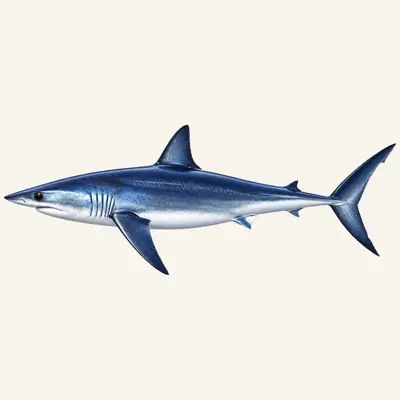
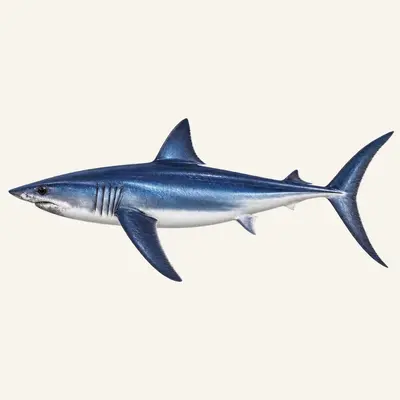
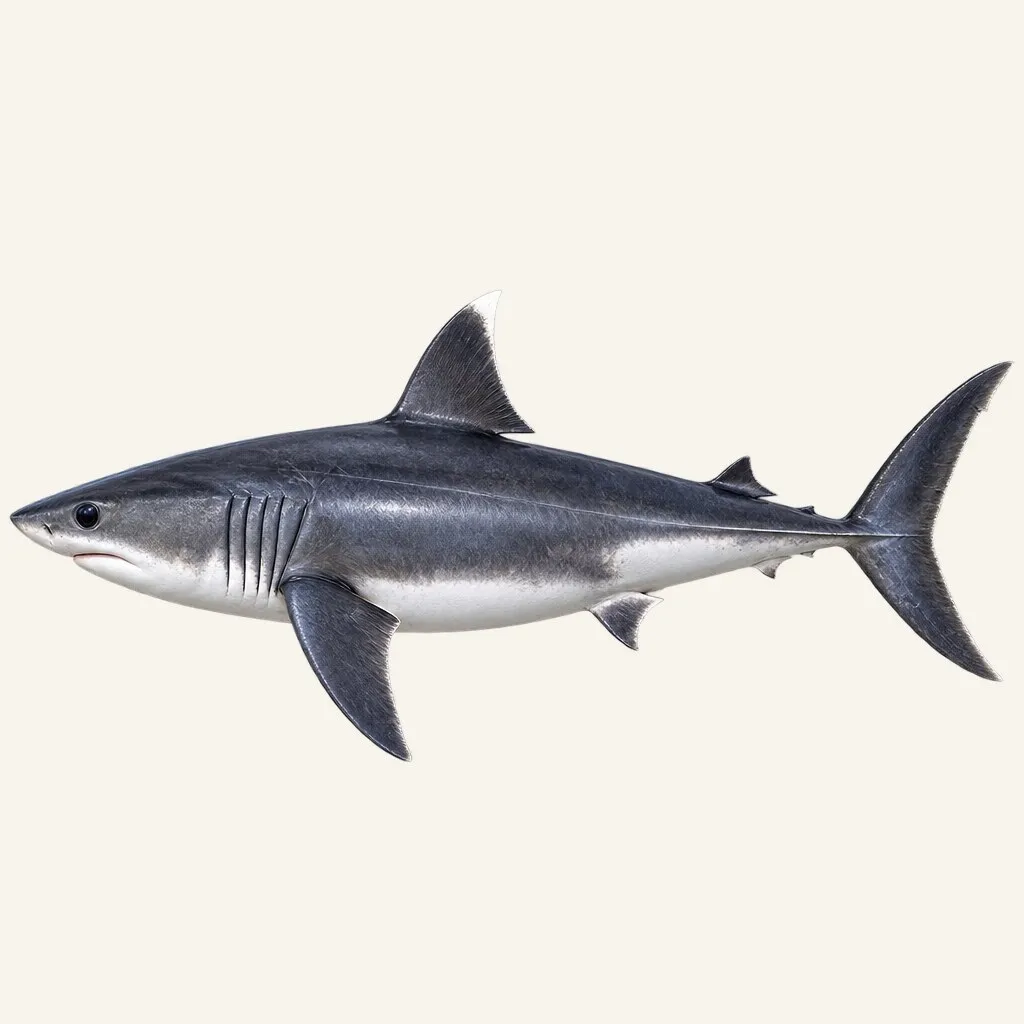
Look at the tail root, and then look again a little further back. There are strong keels along the caudal peduncle, which several fast open-water sharks have, and there are short secondary keels on the base of the caudal fin itself, which is a second storey to the same structure. That two-tier arrangement belongs to the genus, and it is visible on a dead fish at the rail.
The rear tip of the first dorsal is abruptly white, as though the fin had been dipped. The edge of the mark is hard rather than graded, it survives handling and it reads at a distance.
The teeth confirm what the keels suggest. They are small, narrow and smooth-edged, and each blade carries a little cusp on either side of its base. Those lateral cusplets are what to check against a mako, whose published description gives long, narrow, hooked teeth with smooth edges and records no cusp at their base.
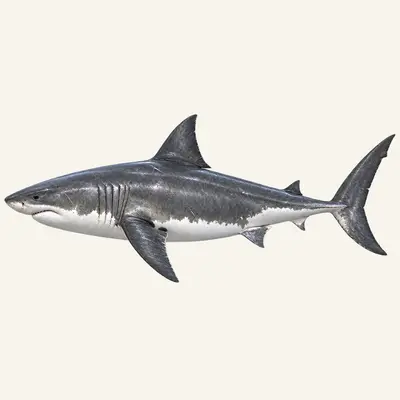
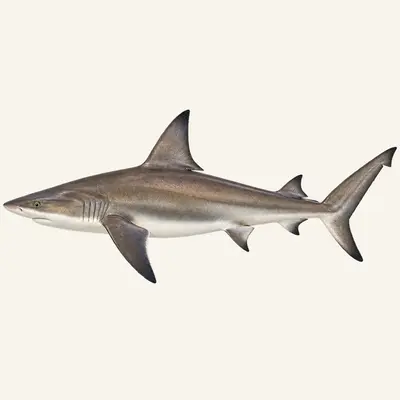
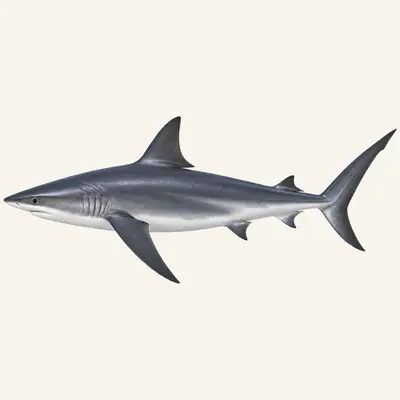
The rest is a heavy spindle: sharp conical snout, long gill slits, large wholly black eyes. Dark grey above and white below, unmarked, with no blotching anywhere. The second dorsal is small and its insertion sits over the insertion of the anal, so the two answer each other across the body.
Maturity averages 186.5 cm, within a bracket of 170 to 219.
Breeding
Four pups a year, every year, for decades. That is the whole demographic argument of this species, and each part of it is doing work.
Development is aplacental. The embryos absorb their yolk sac and then eat — specifically, they consume the ova the mother continues to release into the uterus, a supply she manufactures for the purpose. Litters run from one to five and are usually four, and the pups come out at 60 to 80 cm, which is a functional shark rather than a larva.
The calendar is tight. Mating happens in late summer, gestation runs eight to nine months, and birth falls in the spring following. Embryos are found in mature females in every month except July, August and September, which is the same statement read from the other side: there is no long fallow period in the cycle, and reproduction is probably annual.
In the north-east Atlantic the breeding grounds lie off the coast of Europe and the British Isles.
Four a year for decades beats what most large sharks manage, and it is why this animal is not in the same demographic category as the species that breed once in three years. The qualification is where the sequence starts: nothing happens until a female passes something like 186 cm, and reaching that takes years she has to survive first.
The water it needs
Cold is not what stops this shark. It has been taken in water at minus one degree, it holds mostly between 5 and 10 in the north-west Atlantic, and it is among the most cold-tolerant sharks there are. Its upper limit is 23 degrees, and that is the wall.
It is one of the few sharks that keeps its swimming muscle, its viscera and its eyes above the temperature of the surrounding water, which is what makes a fast predator viable at seven degrees. The equipment costs nothing at the bottom of the range and everything at the top.
It works the offshore fishing banks of the continental shelves, coming inshore and to the surface through summer and wintering further out and deeper. The ordinary working depth stops around 300 m against an extreme record of 1,360. It will temporarily tolerate salinity as low as 10 in order to follow prey, which brings it into estuarine plumes. It turns up singly, in schools, and in feeding aggregations.
Areas
- Open sea and continental shelves
- Temperate coastal waters
- Upwelling zones
Techniques
- Drifting with live bait
- Deep trolling
- Rod fishing with mackerel
Baits
- Whole mackerel
- Herring
- Squid
- Fresh fish fillet
What it eats
Two levels, and it works both. In midwater, the small and medium-sized pelagic schooling fishes. On the bottom of the banks, cod, white hake, red hake, haddock and cusk. Squid and other sharks fill in around them.
A predator taking demersal fish off a bank and schooling fish above it is not committed to any layer, and the warm muscle is what makes that flexibility affordable in seven-degree water: the acceleration stays available, and a warmed eye goes on resolving fast movement where an eye at ambient temperature would not.
How to catch it
The banks concentrate the fish, and the season decides which part of them. Inshore and near the surface in summer, further out and deeper in winter. Desalinated plumes are worth considering as well, since the shark will follow prey into them.
One fact changes how a good season should be read. In the north-east Atlantic, catch records and studies show segregation by sex and by size. What comes off a given sector is not a sample of the population but one particular class of it, and the impression a fishing year leaves about the state of the stock is distorted by exactly that much.
The species is classed as traumatogenic and is taken by some as a sport fish, and those two entries belong together. It has never or very seldom been implicated in an attack on a person or a boat. The hazard is not intent but mass and speed at close range, and two and a half metres of very active shark against a gunwale is a problem regardless of what it means by it.
Protected — Sensitive or protected species depending on area: check local rules before taking action.
Regulated — Often governed by quotas, size limits, seasons, or reporting rules.
Dangerous — Risky handling: gear, release, and safety practices must be adapted.
Conservation · Vulnerable (IUCN) — This species is threatened with extinction. Always release it (no-kill), handle it with the utmost care and check local rules — fishing for it may be prohibited.
Conservation
Two ages are on record and the gap between them is the most useful thing on this page. Fish in the North Atlantic reach at least 26 years. In the southern hemisphere they probably reach 65.
There are two ways to read that, and both matter. It may be two genuinely different growth regimes in two hemispheres. It may equally be that a stock fished hard for a century no longer contains old animals for anyone to examine, in which case the northern figure is not a lifespan at all but a measurement of what survived. The number is a floor, not a ceiling.
Underneath it sits the reproductive arithmetic. A female must approach 190 cm before she breeds, then produces four pups a year. That is slow rebuilding, but it is rebuilding — this is not one of the species whose recovery time runs past a human career.
What obstructs it is geography. A shark tagged in England and recovered in Norway crosses the waters of several states in a single season. The stock is one thing and the rules governing it are not, and effort withdrawn on one coast can be taken up on another with no benefit to the fish. That is the reasoning behind its listing on Appendix II of the migratory species convention, which exists to make range states coordinate, and behind the monitoring of its trade under CITES Appendix II.
Sex and size segregation sharpens it. A fishery working one sector removes one class, so landed tonnage can hold steady while the population is hollowed out in a particular place.
Finally, no part of the animal is without a buyer. The flesh is of good quality and is said to eat like swordfish; it sells fresh, dried, salted and frozen, and the rest goes to fins, oil and fishmeal. Nothing is left on deck for want of a market, which removes the usual economic brake on incidental catch.
Regulations
Check the local regulations in force (legal size limits, closed seasons, bag limits).
For guidance only. Legal sizes, quotas and open seasons vary by location and season: always check the local regulations in force before fishing.
Other names
Porbeagle, of uncertain origin and possibly Cornish. It is one of the few English fish names that explains nothing about the animal, which is probably why it has survived unchanged.
Several northern European languages went instead to what the shark follows. German Heringshai and Spanish marrajo sardinero both attach it to the herring and sardine shoals; Italian says smeriglio. English speakers should be careful with mackerel shark, which names the whole family and not this member of it, and with the French requin-taupe, where the unqualified word covers the group and the qualified requin-taupe bleu is the shortfin mako, a different genus.
Lamna comes from lamia, the devourer of Greek myth. Nasus is the nose, for the conical snout.
Sources: fishbase.se · api.gbif.org