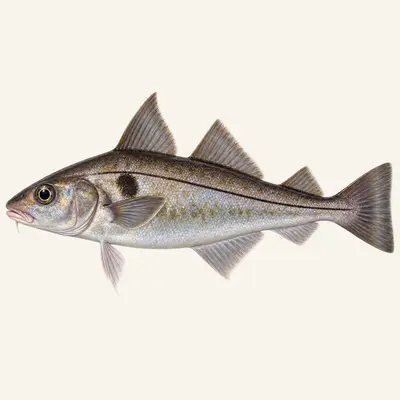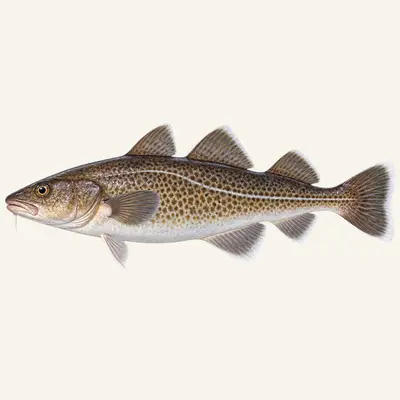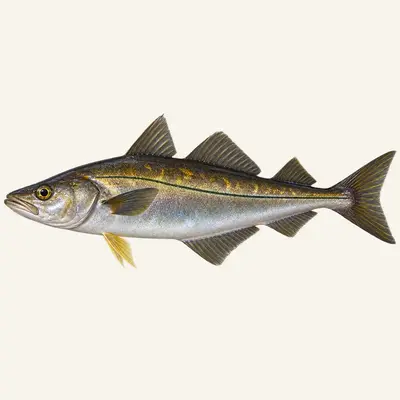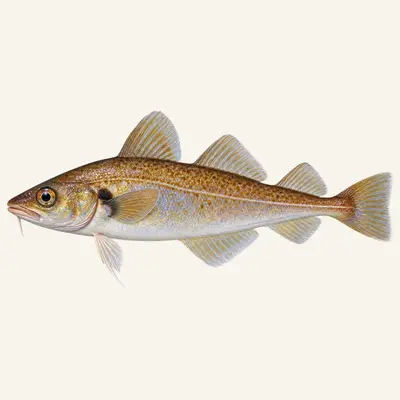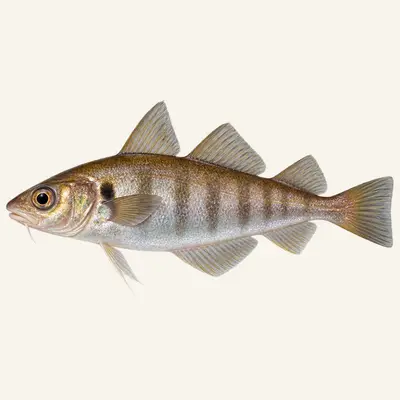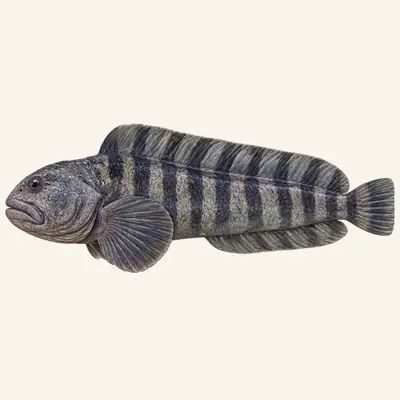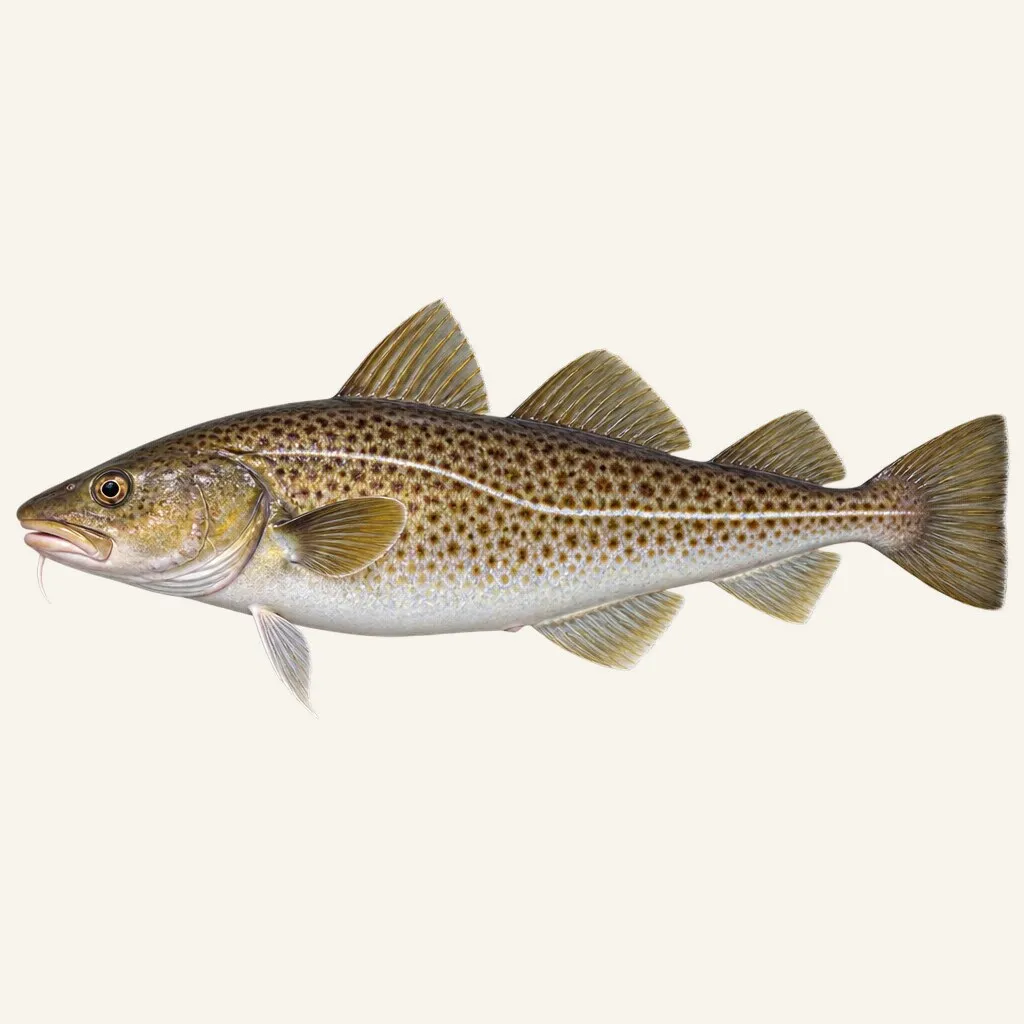
Atlantic cod
Gadus morhua · Gadidae
- Saltwater
- Bottom fish
- Medium
- Size
100–200 cm
- Weight
9.8–96 kg
- Lifespan
25 years
- Water temp.
0–15 °C
- Depth
0–600 m
Where to fish
- Reef
- Rocky shore
Habitat icons: Flaticon
Robust bottom-dwelling fish of the cold North Atlantic, recognizable by its three dorsal fins, chin barbel and pale, well-marked lateral line.
Calendar
Recorded in 30 countries
American Samoa · Australia · Bahamas · Belgium · Canada · Denmark · Estonia · Faroe Islands · Finland · France · Germany · Greenland · Iceland · Ireland · Isle of Man · Italy · Kiribati · Latvia · Lithuania · Netherlands · Norway · Poland · Russia · Spain · St. Pierre & Miquelon · Svalbard & Jan Mayen · Sweden · Tokelau · United Kingdom · United States
GBIF occurrence records — native and introduced populations combined.
Its range
Two limits, one cause: temperature. The species lives between 0 and 15 degrees, which pushes it as far north as Atlantic water penetrates beneath the ice and stops it in the south where the sea warms. Cape Hatteras and the Bay of Biscay are two thermal boundaries, not two accidents of geography.
The most important trait does not show on the map at all. Movements beyond 200 km are rare, and each population stays within the bounds of its own stock. That apparently continuous band is in reality a mosaic of populations that barely mix: one stock can collapse while its neighbour holds, and it does not repopulate from it.
The species has also been introduced to the Mediterranean.
Identifying it
Three dorsal fins and two anals: the gadid signature is counted before anything else. Together they carry 44 to 55 soft rays above and 33 to 45 below, without a single spine.
Two characters then identify the species. The first is the chin barbel, well developed, which rules out the pollacks and the saithe immediately. The second is the lateral line, pale and almost white, curving above the pectorals before running back towards the tail. On a fish laid out on ice, that is what to look for first.
The proportions confirm it. The distance from the snout to the first dorsal is less than a third of the total length, and body depth is about a fifth of it. The upper jaw overhangs the lower. There are 51 to 55 vertebrae.
The colour runs from brown through greenish to grey on the back, pales along the flanks and turns silver beneath; the peritoneum is silvery too. That variability is no help in identification, and counting fins beats judging colour.
Breeding
The worth of a female to her stock is not read in the number of her eggs but in their quality. A cod of 5 kg produces two and a half million, one of 34 kg up to nine million: relative to weight the large fish actually lays slightly fewer. What she contributes lies elsewhere. Her eggs are larger and stay neutrally buoyant at lower salinities, which decides whether they survive where the salt layer is thin — in the Baltic, precisely.
Spawning takes place in winter and early spring, in very dense schools, offshore, at or near the bottom between 50 and 200 m, in water of 0 to 12 degrees with an optimum between 0 and 6. When bottom temperature is unsuitable the fish rise and spawn in the water column rather than give it up.
The species spawns in batches, eight to twenty-two of them depending on the case, but the stock of oocytes is fixed before the season opens: what is not shed that year is not carried over. Spawning grounds change from one winter to the next.
The embryo develops in about a fortnight at six degrees. The larva then stays in open water for close to three months before settling on the bottom. In the Baltic, laying peaks in March below 20 m, and the nursery grounds occupy the inner coastal fringe. Recruitment to the fished stock begins before two years and peaks around three.
The water it needs
From the shoreline to the shelf edge, down to 600 m, with the bulk between 150 and 200. Adults hold the deeper, colder water.
Juveniles do the opposite. They stay between the shore and 10 to 30 m, over complicated ground — seagrass, gravel, rock, boulders — because that ground offers holes to hide in. What they hide from is set out below.
The daily rhythm is the element most anglers underestimate. By day, cod form schools and swim 30 to 80 m above the bottom. At night the school breaks up and the fish drop down to feed. A mark sounded at 180 m at midday may therefore be holding its cod at 100, and a bait dragged across the sand misses them by fifty metres.
The species tolerates brackish water, which opens the Baltic and its particular stock to it.
Areas
- Sandy and muddy bottoms
- Wrecks and rocky reefs
- Deep coastal waters
- Strong tidal current zones
Techniques
- Bottom fishing (ledgering)
- Paternoster rig fishing
- Heavy jigging
- Deep trolling
Baits
- Lugworms
- Whole squid
- Cut deadbait fish
- Large shrimp
- Shore crabs
What it eats
Omnivorous in the broad sense: invertebrates and fish, with two windows of activity at dawn and dusk. The chin barbel is a sensory organ, the tool of a fish that works the sediment and finds as much by touch and taste as by sight.
Young cod are on the menu of the large ones. That is the reason for the complicated ground mentioned above: the juveniles are not hiding from an outside predator, they are hiding from their own species. A stretch of stony coast is therefore worth as much to a stock as a spawning ground.
How to catch it
Two windows, two depths. Dawn and dusk are when the animal feeds; the middle of the day finds it suspended high above the bottom, in a school, and disinclined. A sounder showing marks well off the bottom is not showing fish in transit, it is showing cod at the hour when they do not come down.
The mosaic of stocks changes how a sector should be regarded. A fishery that produces rests on a local and sedentary population, not on a flow passing through. What is taken there will not be replaced by fish from elsewhere, because the fish do not come from elsewhere.
The decision at the moment of capture follows from the reproduction. A large female carries heavier, better-floating eggs than a small one, and replacing her demographically takes several years.
Then there is depth, which limits what can be decided at all. A fish brought up from 150 or 200 m does not re-equalise its swim bladder on the way, and releasing it is not a neutral gesture. On that ground the choice is made before the line goes down, not once the fish is aboard.
Conservation · Vulnerable (IUCN) — This species is threatened with extinction. Always release it (no-kill), handle it with the utmost care and check local rules — fishing for it may be prohibited.
Conservation
The Grand Banks collapse is the precedent every fishery has cited since. Northern cod off Newfoundland had fed five centuries of fleets, European and then Canadian; catches fell away at the end of the 1980s, and Ottawa closed the fishery in July 1992. Tens of thousands of people lost their work, in villages that had never lived on anything else.
The stock did not come back. Three decades after the closure it remains far below what it was, and that is the fact that matters: stopping fishing was not enough.
Three traits described above explain the inertia. Cod barely move beyond their own stock, so an emptied sector is not recolonised from the neighbourhood. Recruitment peaks at three years, so a few consecutive poor year classes dig a hole that cannot be climbed out of in one season. And the removals fell first on the largest fish, which is to say on the females whose eggs held up best.
The ecosystem, for its part, reorganised itself without them. Crustaceans took the place left open by a bottom predator that had become scarce, and that configuration maintains itself. The same continental shelf can sit in two different states; the Newfoundland shelf is no longer in the one it occupied in 1980.
The global assessment of the species, meanwhile, dates from 1 August 1996. It was made while the subject was at its hottest, and nothing has revisited it since — an age to keep in mind when reading it.
Regulations
Check the local regulations in force (legal size limits, closed seasons, bag limits).
For guidance only. Legal sizes, quotas and open seasons vary by location and season: always check the local regulations in force before fishing.
Other names
Cod in English covers the fish in every state, which is where English is poorer than its neighbours. French keeps two words for one animal, and the difference is a matter of preservation rather than biology: cabillaud is the fresh fish, morue the salted or dried one. English has to reach for salt cod and stockfish to say the same, the second being the fish dried without salt.
German says Kabeljau for the North Sea fish and Dorsch for the smaller Baltic one. Norwegian reserves skrei for the Barents Sea migrants that run down to the Lofoten to spawn in winter: a name that designates neither a species nor a size, but a fish on its wedding journey.
Sources: fishbase.se · api.gbif.org