Whiting
Merlangius merlangus · Gadidae
- Saltwater
- Bottom fish
- Medium
- Size
24–92 cm
- Weight
0.1–3.1 kg
- Lifespan
20 years
- Depth
10–200 m
Where to fish
- Estuary
- Beach
Habitat icons: Flaticon
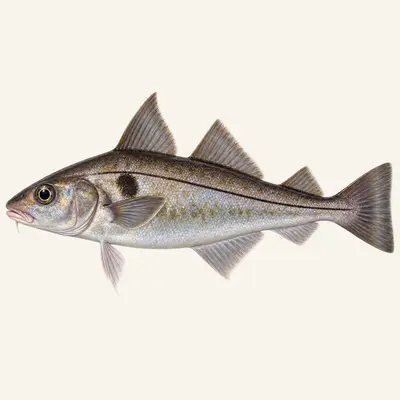
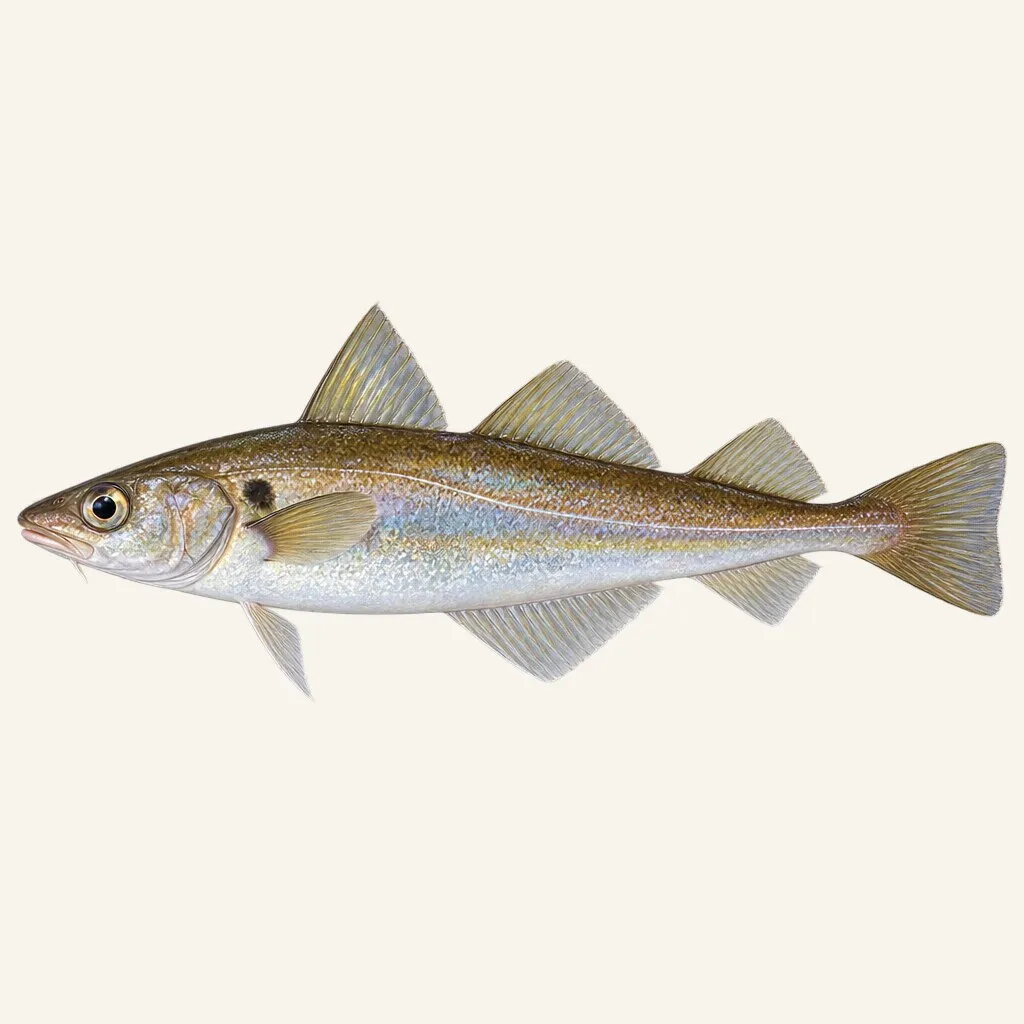
Small slender gadid of sandy bottoms in the north-east Atlantic and Mediterranean, recognizable by the dark blotch at the base of its pectoral fins.
Calendar
Its range
The range covers the north-east Atlantic from the south-eastern Barents Sea and Iceland to Portugal, together with the Black Sea, the Aegean, the Adriatic and their approaches. It is rare in the north-western Mediterranean.
That combination is worth a second look. The species holds the enclosed eastern basins and thins out in the western Mediterranean, so its southern limit is not a straight line drawn by latitude. It is a patchwork of basins that suit it and basins that do not.
Identifying it
This species answers the barbel question twice, and the answer depends on the age of the fish in the hand. The small chin barbel that juveniles carry disappears at maturity. An adult is described as having it small or absent; a young one has it. A key built on presence or absence therefore sorts one species into two places, and the fish has to be aged before that line of the key can be used at all.
The pectoral mark needs the same care. There is often a small dark blotch at the upper base of the pectoral fin. The haddock's own description gives a large dark blotch above the pectoral, sitting just below the lateral line. Different size, different position, and the two descriptions were written to be read side by side.
Everything else is proportion. The body is elongate, the head small, and the lateral-line canals open in pores across the head. Thirty to 40 soft rays in the dorsal, 30 to 35 in the anal, no spines. Colour is variable and settles nothing: yellowish-brown, dark blue or green above, yellowish grey along the sides, white and silver below.
Breeding
Oviparous, separate sexes, spawning in batches, with pelagic eggs. First spawning happens at 28.2 cm, inside a narrow band of 28 to 30 cm.
Narrowness is unusual and useful. Many marine fish mature across a spread of tens of centimetres depending on where they live; here the threshold is nearly the same wherever the fish is, which makes it a reliable figure to reason with.
The water it needs
Ten to 200 m, most commonly 30 to 100, over mud and gravel above all, with sand and rock also used. The species enters brackish water.
The first year is spent inshore. Migration to the open sea happens only after it, which means the juveniles and the adults are two different fisheries in two different places.
Then the fact that has no equivalent among the other gadids on this site: the larvae and juveniles are associated with jellyfish. A fry travelling under a bell is travelling inside a defence it did not have to grow. It also ties the production of young whiting to the abundance of an animal whose own cycles answer to temperature and to the enrichment of the water — and to nothing a fishery does.
Areas
- Sandy coastal bottoms
- Nearshore mudflats
- Moderate current zones
- River mouths at sea
Techniques
- Paternoster rig fishing
- Simple bottom fishing
- Light jigging
- Drift fishing
Baits
- Sandworms
- Lugworms
- Sand eels
- Squid strips
- Shrimp
What it eats
Shrimps, crabs, molluscs, small fish, polychaetes and cephalopods. The list is weighted towards crustaceans, and it is the diet of an animal that works mixed ground rather than open water.
The mouth is small, which is the constraint behind the breadth. A fish that cannot take a large prey item has to take many kinds of small ones, and a bottom of mud and gravel supplies exactly that.
How to catch it
The context is 30 to 100 m over mixed ground: sandy coastal bottoms, nearshore mud, moderate tide and the mouths of rivers at sea. The commercial fishery on the species is a heavy one, and the recreational catch comes off the same ground.
The small mouth and the varied diet call for modest baits presented on the bottom: lugworm and sandworm, sandeel, squid strip, shrimp. Nothing about this fish rewards a large offering. The season runs from autumn into spring, and the calendar on this page is built from it.
Then the figure that ought to sit in front of every catch. The common length is 23.5 cm and first spawning happens at 28. The average fish encountered has therefore not yet bred, and a decision about keeping it is being taken on the wrong side of that threshold unless the fish is measured.
Conservation
The gap between the common length and the length at first spawning — 23.5 cm against 28 — is the central fact, and it points at the whole fishery rather than at any one boat. Most of what is landed has not reproduced, which means the catch is being taken from the year classes that were going to do it.
The jellyfish association adds a dependency that no management measure reaches. If the survival of larvae and juveniles is bound up with the abundance of jellyfish, then a large part of the variation in how many young whiting appear each year is set outside the fishery altogether — and cannot be corrected inside it.
Regulations
Check the local regulations in force (legal size limits, closed seasons, bag limits).
For guidance only. Legal sizes, quotas and open seasons vary by location and season: always check the local regulations in force before fishing.
Other names
Whiting in English is a shape rather than a species, and it travels badly. In North America the word means the silver hake, a fish of another family entirely; in Australia it belongs to the sillaginids. A menu or a freezer cabinet saying whiting outside Europe is almost certainly not this animal, and the scientific name is the only thing that carries across.
Inside Europe the names behave. Merlan in French, Wittling in German, merlano in Italian, merlán in Spanish. Four languages, one fish, no ambiguity — which is exactly what the English word fails to deliver.
Sources: fishbase.se · api.gbif.org