Roosterfish
Nematistius pectoralis · Nematistiidae
- Saltwater
- Coastal
- Hard
- Size
60–163 cm
- Weight
2.5–52 kg
Where to fish
- Estuary
- Beach
Habitat icons: Flaticon
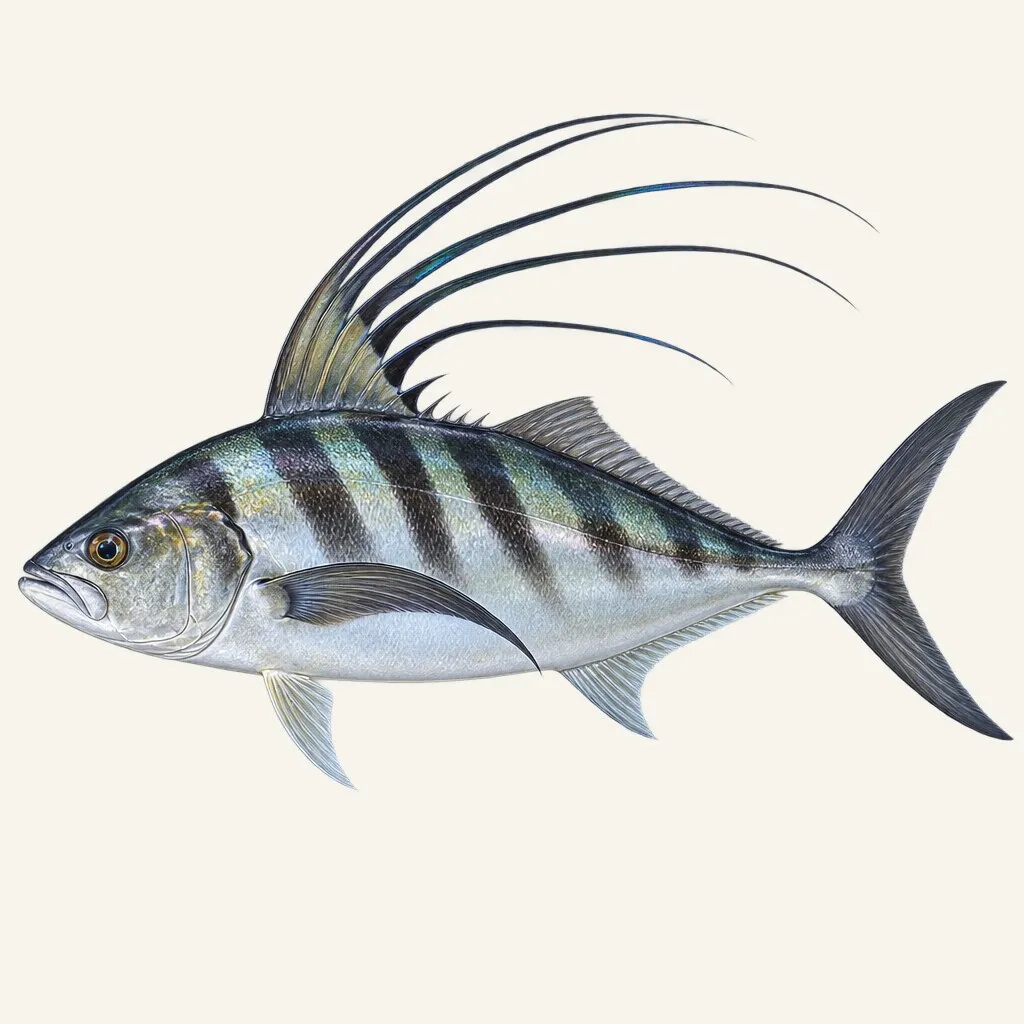
Powerful eastern Pacific inshore predator recognizable by its tall dorsal crest of seven long, comb-like spines resembling a rooster's comb.
Calendar
Its range
The eastern Pacific, from Peru north to Baja California, the Galápagos included, with the northernmost records reaching San Clemente in southern California.
Read that northern end as a gradient rather than as a line. The entry says rare north of Baja California, not absent, which is the signature of a temperature limit rather than of a barrier. Nothing stops the fish going further up the coast; the water simply stops suiting it, and a few go anyway.
Identifying it
Start with the crest, because nothing else is needed. The catalogue description rendered on this page gives seven long comb-like spines standing up from the back like a rooster's comb, and that is the feature every language has named the fish for.
Then the gap. The reference file for this species carries no morphology section at all — no ray counts, no proportions, no scale rows, no colour description. For an animal this recognisable and this heavily fished, the absence is striking, and it is probably explained by the same thing that makes the crest sufficient: a fish nobody mistakes for anything else never needed a tight diagnosis written for it.
The classification says it more formally. This is not a jack. It sits alone in Nematistiidae, its own family, and the catalogue holds no other member of it. There is no key to work through and no congener to eliminate — which is, in the end, the best-established statement anyone can make about this fish.
The water it needs
The whole life happens inside a band a few hundred metres wide. Adults are in shallow inshore water and frequent sandy shores along beaches. Juveniles live in tide pools.
A tide pool is a hard place to be a fish. The volume is tiny, the temperature climbs through an afternoon, the salinity moves with evaporation and rain, and at low water the pool is cut off from everything else. The young of a species that will pass a metre in length begin in a few tens of litres. The adult does not go far either: it works the break on the same beach.
Areas
- Baja California (Mexico)
- Pacific coast of Costa Rica
- Panama
- Ecuador
- Peru
Techniques
- Topwater lure fishing (popper)
- Surf casting from shore
- Live bait fishing
- Fly fishing
- Slow inshore trolling
Baits
- Live mullet
- Live sardine
- Surface poppers
- Stickbaits
- Large streamer flies
How to catch it
It is fished from the shore, and that follows from the biology rather than from any preference for shore fishing. There is no reason to go offshore for an animal that lives in the surf. Sandy beaches and the shallow inshore fringe are the water, and there is no alternative water.
Common length is 60 cm, and the fish that made the species' reputation are far above that. The gap between the ordinary animal and the exceptional one is what the fishery is about.
Two fisheries share the same strip of sand. One is local and takes fish to be sold fresh; the other is a sport fishery. They use different gear and have different intentions, and they work the same beach, the same depth and the same age classes. That is the only documented pressure on the species, and it is concentrated into a few hundred metres of shoreline.
Regulations
Widely managed as catch-and-release in sport fishing; according to local regulations.
For guidance only. Legal sizes, quotas and open seasons vary by location and season: always check the local regulations in force before fishing.
Other names
Six languages looked at this fish and all six saw a farmyard bird: roosterfish in English, poisson coq in French, pez gallo in Spanish, Hahnenbarsch in German, pesce gallo in Italian, peixe-galo in Portuguese. Not one of them mentions a colour, a size or a habitat. Every one describes a raised comb.
The scientific name is the same observation in Greek and Latin: Nematistius is built on nêma, a thread, and pectoralis points at the pectoral fins.
The trouble starts when the name travels. In this catalogue peixe-galo is also the Brazilian Portuguese name of the John Dory, a fish of another order in another ocean; pez gallo de dos manchas belongs to a carangid of the Indo-Pacific; and plain gallo in Spanish names a European flatfish. Each of those is somebody seeing a comb or a cockerel in a different animal. A fishing report that says pez gallo without a coastline attached has not identified anything at all.
Sources: fishbase.se · api.gbif.org