Smooth-hound
Mustelus mustelus · Triakidae
- Saltwater
- Sharks & rays
- Medium
- Size
100–200 cm
- Weight
3.3 kg
- Lifespan
24 years
- Depth
5–624 m
Where to fish
- Estuary
- Beach
Habitat icons: Flaticon
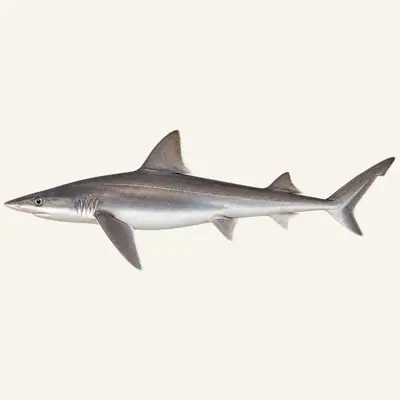
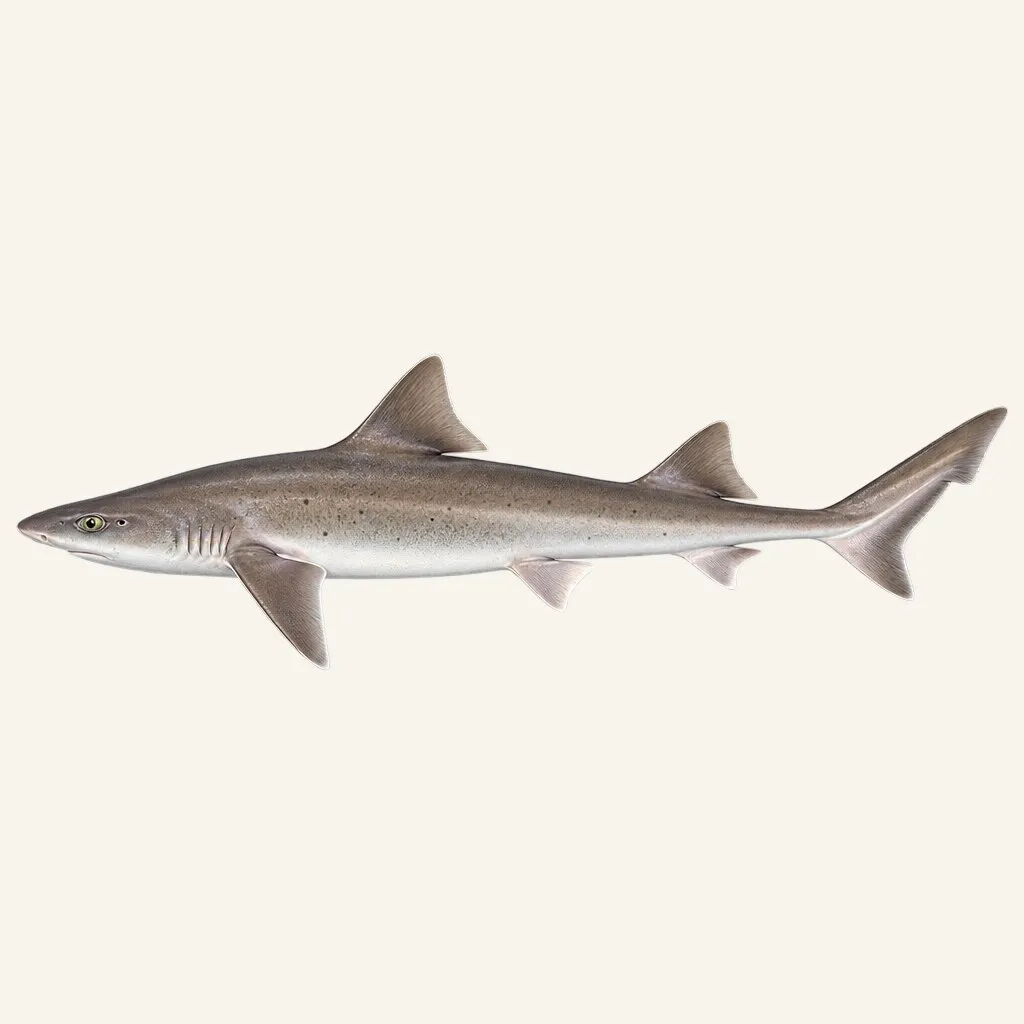
The smooth-hound is a small, slender coastal shark with plain grey, unspotted skin, typical of the Triakidae family. It lives close to sandy and rocky bottoms along European and African coasts, where it forages for crustaceans and small fish.
Calendar
Recorded in 23 countries
Albania · Benin · Cameroon · Congo - Brazzaville · Côte d’Ivoire · Croatia · Equatorial Guinea · France · Gabon · Ghana · Greece · Guinea · Guinea-Bissau · Ireland · Italy · Liberia · Netherlands · Nigeria · Senegal · Sierra Leone · South Africa · Spain · United Kingdom
GBIF occurrence records — native and introduced populations combined.
Its range
No other shark of this size holds a range this long. It runs from the United Kingdom southward down the entire eastern Atlantic margin — Mediterranean, Canary Islands, Morocco, and on down the west African coast to eastern South Africa — spanning 58°N to 34°S.
A single coastal species with both hemispheres inside its range does not meet one fishery. The northern end sits under European management and recreational shore fishing; the middle and southern lengths sit under industrial and artisanal fisheries of quite different kinds. Nothing in the animal's biology varies as much as what is done to it.
Identifying it
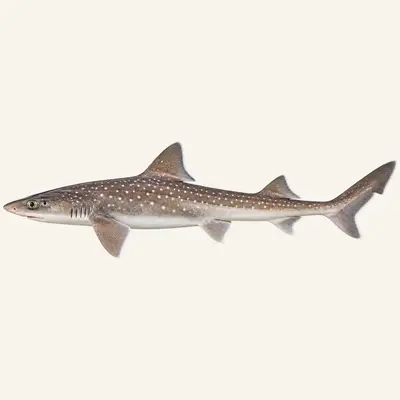
Colour does not settle this species, and the published description says why: a large smoothhound, plain or black-spotted, uniform grey to greyish brown above and white beneath. Plain or spotted. Its congener is the starry smoothhound, named for the white spots on its back — so spotting occurs on both animals and is diagnostic on neither.
What is left is size and proportion, and neither works from a photograph. Common length is 100 cm and maturity falls at 70 to 80, so a large adult smoothhound in European water is more often this species than the other. That is a probability, not a determination. Where the identity matters, it is settled on tooth and denticle detail with the fish in hand.
The genus itself is unmistakable: slender elongated body, two dorsals of similar build, no spines anywhere, and teeth that are low and blunt instead of bladed — which is what the name records.
One historical trap remains. The eastern Atlantic fish was long called Mustelus canis, a name now restricted to the western Atlantic species. Older records, older keys and a good deal of older literature filed under canis refer to this animal, and the two are still confused in print.
Breeding
This shark feeds its young. The embryos attach to a yolk-sac placenta and draw supply from the mother throughout gestation — the least common of the reproductive modes found among the small coastal sharks of these coasts, and the one with the highest cost per pup.
The output is correspondingly small: 4 to 17 young in a litter, born at about 39 cm. Mating involves distinct pairing with embrace.
Thirty-nine centimetres at birth is half the length at first maturity. A newborn here is not a larva to be produced in thousands and written off, but a functional shark, and the female has paid for it directly out of her own intake.
The water it needs
Continental shelves and the uppermost slopes, usually 5 to 50 m, from the intertidal down to at least 350. One specimen came from 624 m in the eastern Ionian Sea, which is a record rather than a habitat.
It swims near the bottom by preference and enters midwater occasionally. The important half of that depth range is the shallow half: a shark living in 5 to 50 m of water is a shark within reach of the shore.
Areas
- Coastal sandy bottoms
- Surf-casting beaches
- Estuaries and sandy bays
Techniques
- Bottom fishing with paternoster rig
- Surf casting
- Bottom longline
Baits
- Crab
- Crustaceans
- Squid
- Ragworm
What it eats
Crustaceans mainly, with cephalopods and bony fishes filling in behind them. That order is not an accident of sampling. The low blunt teeth of the genus crush rather than cut, and a crushing dentition is built for shells.
Bait follows directly, and so does the shape of the fight: an animal that works the seabed for crabs takes a bait lying on the seabed, and does not chase anything through the water above it.
How to catch it
The source records it caught by shore and ski-boat anglers, which places the fishery precisely — from the beach and from small craft, in the shallow part of its depth range.
The dentition removes one usual precaution and leaves another in place. There is no cutting edge in that mouth, so wire is not what this fish demands; the skin is another matter, and denticles will finish a light leader in a few seconds of the animal rolling against it. The species is harmless to people.
Size at maturity is the point worth carrying away. Maturity comes at 70 to 80 cm and common length is a metre, so most of what is caught has already bred at least once. That is the reverse of the situation on many shark pages, and it is why the argument here concerns the female rather than the juvenile. The maximum reported age is 24 years.
Conservation · Endangered (IUCN) — This species is threatened with extinction. Always release it (no-kill), handle it with the utmost care and check local rules — fishing for it may be prohibited.
Conservation
The decline is documented twice over, from abundance indices and from the levels of exploitation on record, and the two agree. The assessment behind that finding dates from August 2020.
The mechanism is the placenta. A species that supplies its embryos directly produces 4 to 17 pups per litter and no more, each one costing a full gestation. There is no reproductive surplus to work with: removals are replaced one pup at a time, at whatever interval a female's cycle allows, and the animal is heavily commercial across most of its range — taken for human consumption, for oil and for fishmeal.
The length of the range makes matters worse rather than better. A species spread from the United Kingdom to South Africa crosses dozens of jurisdictions, and a measure taken at one end does nothing at the other. This is not one stock under one set of rules but a continuous coastal population fished by everyone along it.
Handling a female of this species commits you to more than it appears to. She is not carrying eggs for broadcast but a small number of large young that she is actively supplying.
Regulations
Check the local regulations in force (legal size limits, closed seasons, bag limits).
For guidance only. Legal sizes, quotas and open seasons vary by location and season: always check the local regulations in force before fishing.
Other names
Common smoothhound. Smoothhound names the whole genus in English, and British anglers use it unqualified for whichever of the two they have caught, which on their coasts is usually the other one.
The published trap is the American name. Mustelus canis, the smooth dogfish or dusky smoothhound of the western Atlantic, carried this fish's name through generations of European literature before the two were separated, so canis in an older text may mean either. Dogfish in America, meanwhile, usually means neither, since it most often refers to the spiny dogfish.
Mustelus is the Latin for a weasel, the word behind the martens and the whole mustelid family, applied here to a slim shark that noses along the bottom. French keeps the smoothness in émissole lisse.
Sources: fishbase.se · api.gbif.org