Blacktip shark
Carcharhinus limbatus · Carcharhinidae
- Saltwater
- Sharks & rays
- Medium
- Regulated
- Dangerous
- Size
150–286 cm
- Weight
23–123 kg
- Lifespan
12 years
- Depth
0–140 m
Where to fish
- Estuary
- Reef
- Beach
Habitat icons: Flaticon
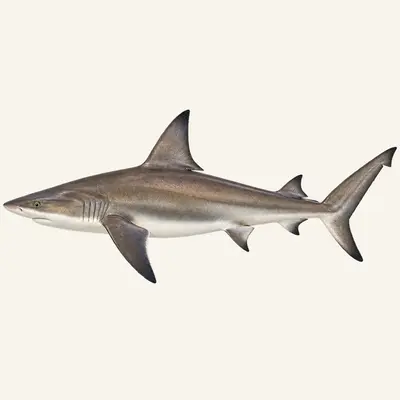
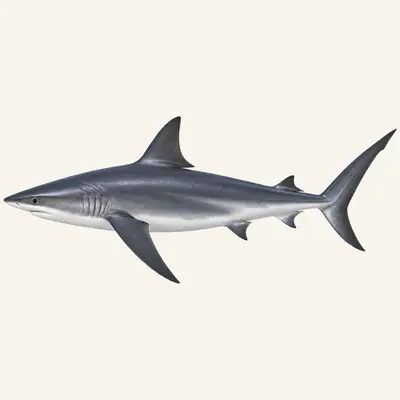
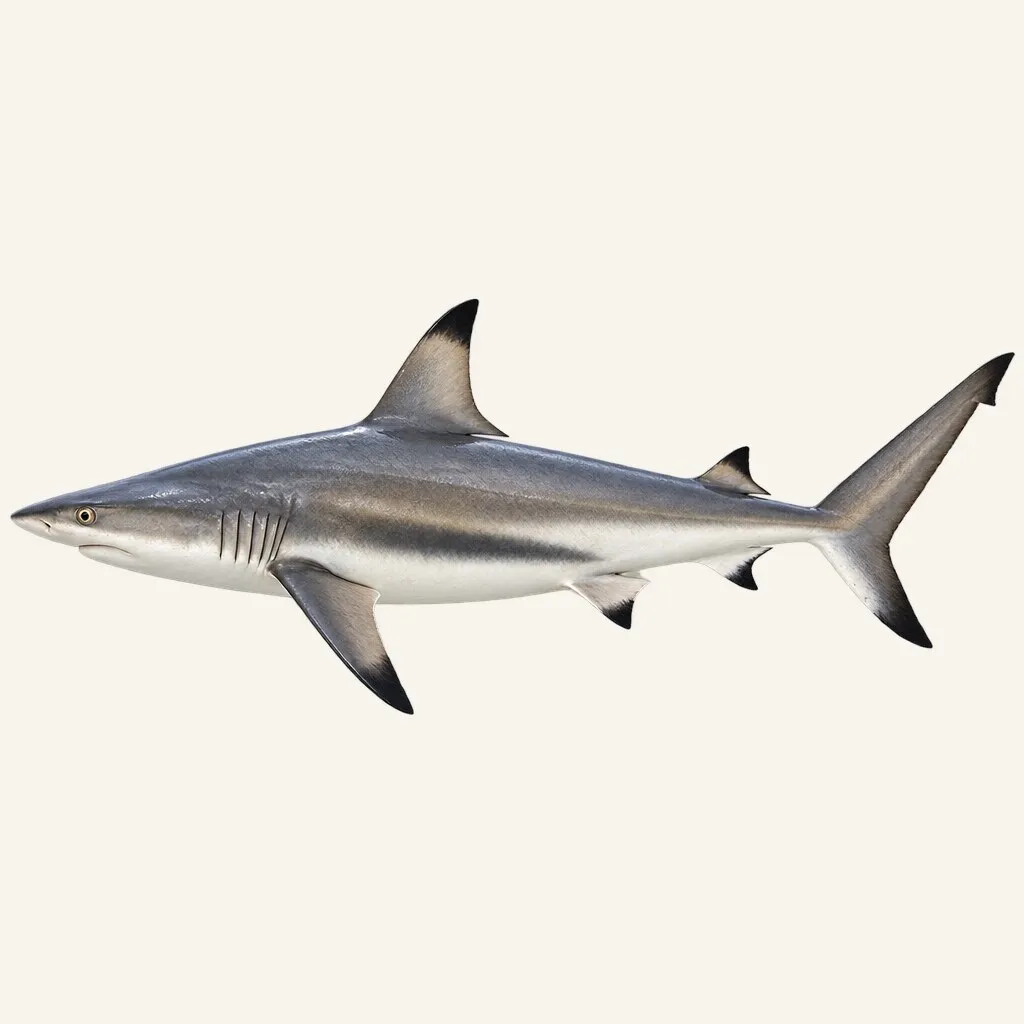
The blacktip shark is a slender coastal species easily recognized by the distinctive black tips on its pectoral, dorsal and caudal fins. Highly active near the surface, it hunts fish schools in warm coastal waters worldwide.
Calendar
Recorded in 32 countries
Australia · Austria · Bahamas · Cameroon · Congo - Brazzaville · Côte d’Ivoire · Czechia · Ecuador · Faroe Islands · French Guiana · French Polynesia · Gabon · Germany · Ghana · Guinea · Guinea-Bissau · Indonesia · Italy · Liberia · Malaysia · Maldives · Mexico · Mozambique · Nigeria · Puerto Rico · Senegal · Sierra Leone · South Africa · Spain · Svalbard & Jan Mayen · United Kingdom · United States
GBIF occurrence records — native and introduced populations combined.
Its range
The range covers warm water in all three oceans, from 45°N to 38°S, the Mediterranean included. Its shape rewards a close look.
This shark works continental shelves but also insular shelves, and the distinction changes everything. Hawaii, Tahiti, the Marquesas and the Galápagos offer nothing but a rim of shallow ground in the middle of deep water: a strictly coastal species would never reach them, a strictly oceanic one would not settle there. This one does both, so its distribution is not a continuous ribbon along the shores but a ribbon with isolated islets added, thousands of kilometres from any coast.
Identifying it
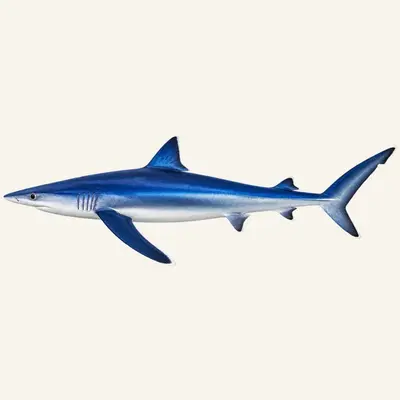
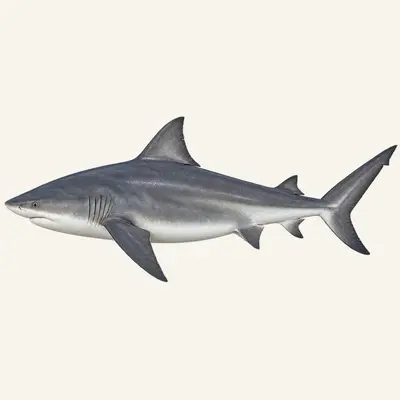
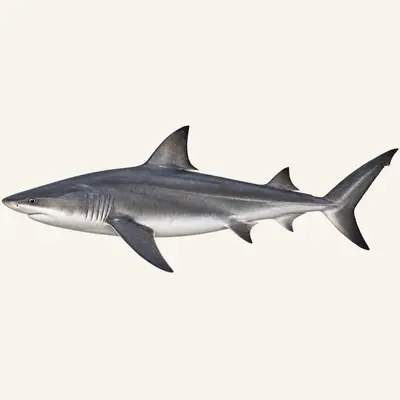
One black mark survives to adulthood, and it is the one on the pelvic fins. All the others — the tips of the dorsals, the pectorals, the anal and the lower caudal lobe — are black or dusky in a young fish and fade as it grows. An adult can therefore carry the name of the species without showing its badge, except for that spot, which persists.
A second mark reads along the flank of a fresh fish: a dark band runs backwards on each side and stops roughly above the origin of the pelvic fins. It stands out against a back of dark grey, ashy blue or dull bronze, over a white or yellowish-white belly.
The outline is a fast hunter's. Long, narrow, pointed snout; long gill slits; erect upper teeth with narrow cusps, built to hold rather than to shear; a high first dorsal. The midline of the back carries nothing between the two fins.
That absence is what sorts the species out. It is shared with the bull shark, whose snout is short and squared off where this one tapers to a fine point — the difference reads at a distance. Against the sandbar shark, which also carries an imposing first dorsal, the ridge alone is enough: one has it, the other does not. Sizes stay modest for the genus, a maximum published length of 2.86 m against a common length of 1.5.
Breeding
A female held alone in captivity produced young without a male. Parthenogenesis is documented in this species, and it is rare among sharks — but it is not a fallback mechanism: the offspring carry maternal material only, and nothing indicates that wild populations resort to it.
The ordinary mode is placental viviparity, one to ten pups per litter, ten to twelve months of gestation, birth at somewhere between 38 and 72 cm and most often between 55 and 66. Mating involves a distinct pairing with embrace.
Rhythm is what weighs. Females are thought to breed only every other year, they mature anywhere between 1.2 and 1.94 m, and the maximum age on record is just 12 years. A life that short, broken by blank seasons, leaves few litters behind each female.
Births happen close in. Pregnant females move to the coast to drop their pups, and both the pupping grounds and the nurseries lie in shallow water. The whole renewal of the species is therefore played out on a narrow strip of shoreline.
The water it needs
It holds river mouths, muddy bays, mangroves, lagoons and reef drop-offs. Depth runs from the surface to 140 m, but the bulk of the life happens in the top 30. Depending on the moment it sits near the bottom or works in midwater.
The young, for their part, are common along beaches. This separation of age classes, vertical and inshore at once, is why the two are seldom met together: the nursery is in the surf, the adults work further out and deeper.
Areas
- Estuaries and river deltas
- Shallow coastal bays
- Edges of coastal reefs
- Tropical beaches and surf zones
Techniques
- Bottom fishing from a boat
- Natural bait drift fishing
- Weighted bottom line in estuaries
- Shore fishing in shallow areas
Baits
- Whole or cut fish
- Fresh squid
- Large shrimp
- Mackerel or sardine chunks
What it eats
It eats mainly fish, pelagic and benthic, and fills in with small sharks, rays, cephalopods and crustaceans. None of that prey has to be crushed.
The dentition matches. Narrow erect cusps grip and pierce; they do not break shells. That points baits towards whole or cut fish and rules out the molluscs that other members of the family take readily.
How to catch it
It finishes its attack in the air. A blacktip drives up through a shoal of fish from below, mouth open, and carries its speed out of the water: it leaves the surface spinning on its axis and lands flat. That is not an accident of the fight but the normal end of a strike delivered vertically.
The behaviour says what to offer. This is a midwater pursuer working shoals, not a bottom-grubber and not a posted scavenger. A bait that behaves like a fish in the water column beats a motionless lump on the sand.
It is also one of the few sharks of this size taken regularly from the shore, precisely because its young live against the beaches. The consequence is a tackle one: a fish built for speed, hooked from the sand, goes a long way, and the drag has to be set beforehand rather than during.
The risk is concentrated at the unhooking. The species is implicated in very few attacks, but it is dangerous when provoked, and an animal held on dry sand is a provoked animal. The work is done in the water, the tail held, the head left under.
Regulated — Often governed by quotas, size limits, seasons, or reporting rules.
Dangerous — Risky handling: gear, release, and safety practices must be adapted.
Conservation · Vulnerable (IUCN) — This species is threatened with extinction. Always release it (no-kill), handle it with the utmost care and check local rules — fishing for it may be prohibited.
Conservation
The entire recruitment of the species happens in a few metres of water. Gravid females come inshore to give birth, the pups stay along the beaches, and that coastal strip is also the strip of harbours, dredging, fill and mangrove clearance. A stock can remain sound offshore and simply stop being fed, without a single adult capture being the cause.
The demography offers no margin to absorb the shock. This is the shortest-lived shark of its size class in the genus: twelve years on record, against thirty-four for the sandbar and forty for the dusky. Where those species can ride out a bad decade on longevity alone, this one has no such reserve, and a run of failed year classes is not something it can wait out.
Reproducing every other year narrows the margin further. Half the mature females in a population are out of the count in any given season, so the number of litters produced per year is half what the number of adults suggests.
Regulations
Check the local regulations in force (legal size limits, closed seasons, bag limits).
For guidance only. Legal sizes, quotas and open seasons vary by location and season: always check the local regulations in force before fishing.
Other names
Blacktip shark in English, and the epithet limbatus says the same thing in Latin: edged, hemmed. Most languages have kept the marking — requin bordé, Schwarzspitzenhai, squalo pinna nera all point at black tips.
The paradox is that these names describe a juvenile. In the adult only the pelvic spot is left, so the species carries everywhere the memory of a livery it loses. English speakers have a further confusion to guard against: the blacktip reef shark of Indo-Pacific lagoons is Carcharhinus melanopterus, a smaller and quite separate animal whose fin markings do not fade, and the spinner shark Carcharhinus brevipinna shares both the leap and much of the range.
Sources: fishbase.se · api.gbif.org