Bull shark
Carcharhinus leucas · Carcharhinidae
- Saltwater
- Sharks & rays
- Medium
- Regulated
- Dangerous
- Size
260–360 cm
- Weight
123–317 kg
- Lifespan
32 years
- Depth
1–164 m
Where to fish
- Estuary
- Rocky shore
Habitat icons: Flaticon
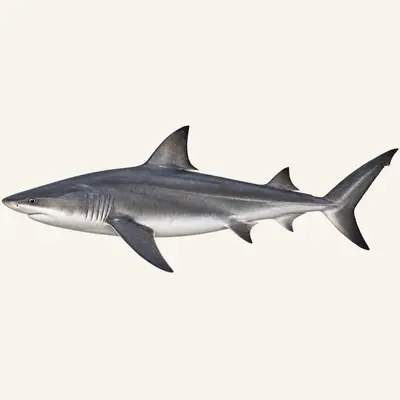
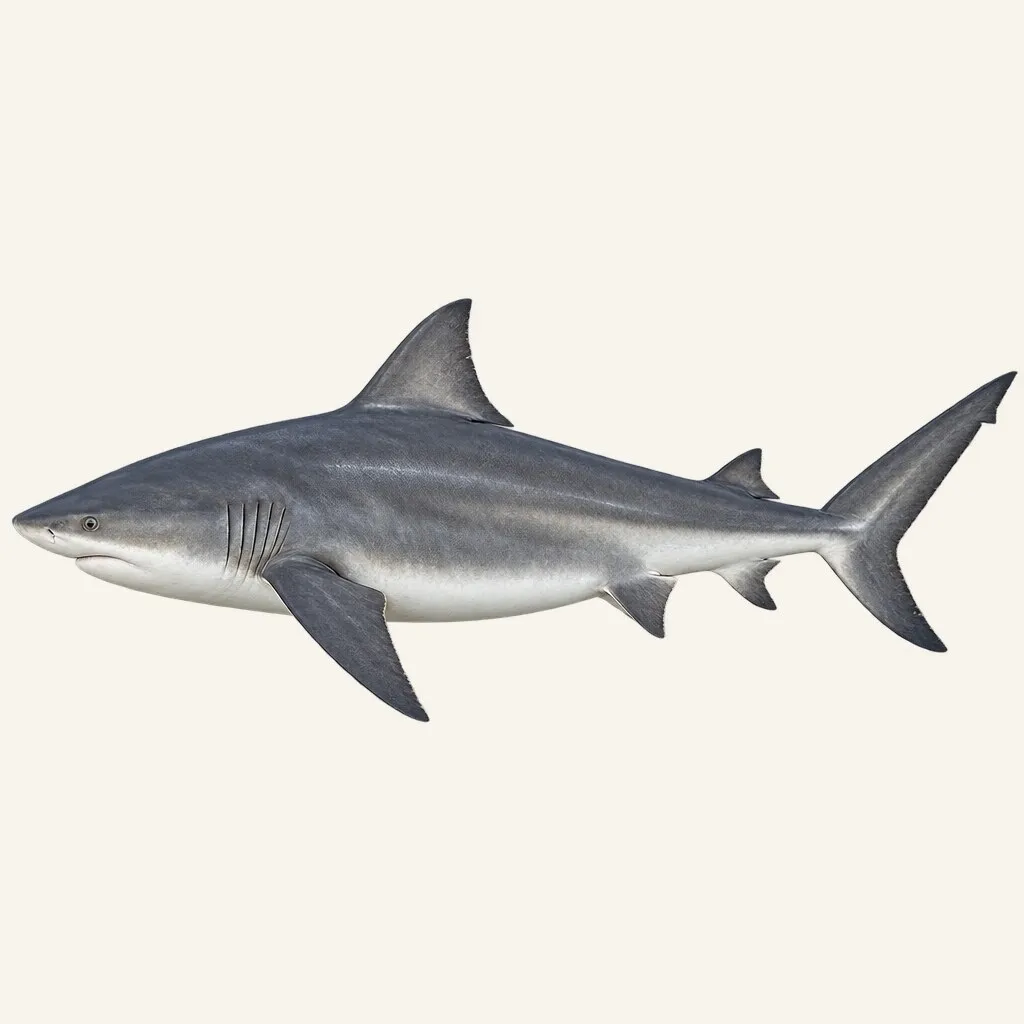
The bull shark is a stocky, broad-bodied shark recognizable by its short, rounded snout and uniform grey-brown coloration. It is one of the few sharks capable of traveling far into estuaries and even freshwater rivers.
Calendar
Recorded in 16 countries
Australia · Bahamas · Bangladesh · Brazil · Cameroon · Costa Rica · Faroe Islands · Fiji · French Guiana · Malaysia · Mexico · Mozambique · Puerto Rico · South Africa · United Kingdom · United States
GBIF occurrence records — native and introduced populations combined.
Its range
The species holds the warm seas of the world between 42°N and 39°S, and that boundary is thermal before it is geographical: what stops it towards the poles is temperature, not a coastline.
What extends the range, on the other hand, appears on no marine chart. This shark ascends rivers, and it is recorded in them as an ordinary freshwater fish: in West Africa from the Gambia to the Ogowe, and in the Cuanza in Angola. Lakes belong to its range too. A continent that looks empty on an ocean base map can be penetrated for hundreds of kilometres along its watercourses.
Identifying it
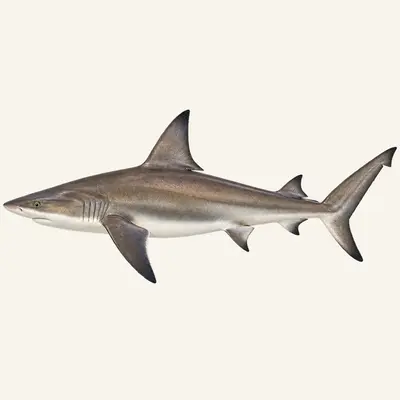
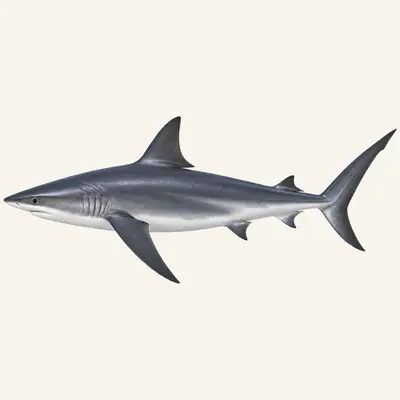
Run a finger down the midline between the two dorsal fins. On this shark it finds nothing: no ridge of skin joins the free rear tip of the first fin to the origin of the second. That single absence removes about half the grey requiem sharks of comparable size at a stroke, and it is the check to make before any other.
The head settles the rest. The snout is short, broad and frankly blunt — seen from above the muzzle is a truncated triangle where the offshore species taper to a point. The eyes are small for an animal of this bulk. The upper teeth are broad-based triangles with finely saw-edged margins. FishBase treats these three characters as sufficient on their own: no ridge, a battered-looking head, and that sawing dentition are not found together anywhere else in the genus.
Bulk finishes the portrait. The body stays fusiform but it is thick through, deep in the flank, heavy where the blacktip and the silky are lean. A female reaches four metres, a male three metres sixty.
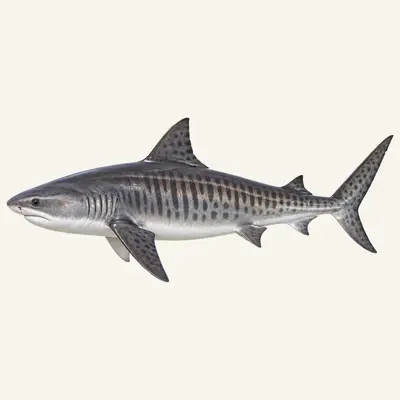
One caution belongs to the turbid water where the species is met. Two other large sharks share those estuaries and river mouths, Carcharhinus amboinensis and the Ganges shark Glyphis gangeticus. A big grey shark a long way up a river is therefore not automatically this one, and the line of the back is what has to be checked first.
Breeding
The female feeds her embryos through a yolk-sac placenta, the way a mammal feeds hers, and drops young of about 60 cm — the measured spread runs from 56 to 81. A litter holds at most 13 pups, usually fewer, after a gestation of ten to eleven months.
The calendar follows latitude rather than the species. Off Florida and in the Gulf of Mexico, and off South Africa as well, births fall in late spring or early summer. Off Nicaragua females carry all year, with a peak in spring and early summer. A given population therefore has its own season, and dates published elsewhere do not transfer to it.
Scars tell the rest of the story. Females frequently carry courtship marks; males are rarely seen bearing wounds from fighting each other. Mating is violent for one partner only, and nothing suggests that access to females is contested.
Maturity arrives late: ten to fifteen years, at somewhere between 1.6 and 2 m. Set against a maximum recorded age of 32 years, that is close to half a lifetime spent before the first litter.
The water it needs
It lives in very little water. The recorded depth range runs from 1 to 164 m, but the ordinary band is 1 to 30. Bays, estuaries, deltas, coastal lagoons, rivers and lakes: shallow ground, and usually coloured.
Both extremes of salinity are open to it. It enters fresh water and it also frequents hypersaline bays, where concentration exceeds that of the sea. A marine shark holds urea in its blood to match the osmotic pressure outside and avoid losing its water to the sea. In a river the arrangement reverses: water floods inward continuously, and the animal has to shed urea and pass a large volume of dilute urine. Both regimes cost energy, and this species alternates between them, sometimes within a single day.
Movement follows. One individual covers up to 180 km in 24 hours and shifts between fresh and brackish with no pattern anyone has resolved. Adults hold the approaches to estuaries and to freshwater inflows at sea; the young push up the rivers and turn up hundreds of kilometres from salt water. That river nursery lies beyond the reach of most marine predators, which is presumably what the physiological bill buys.
Areas
- Estuaries and river mouths
- Shallow sandy coastal flats
- Harbours and port areas
- Shallow tropical coastlines
Techniques
- Drifting live bait
- Slow-worked dead bait on bottom
- Coastal trolling
- Anchored chumming
Baits
- Whole live fish
- Squid
- Sardines
- Ray chunks
- Fish offal
What it eats
The list is wide enough to be informative in itself: bony fishes, other sharks, rays, mantis shrimps, crabs, squid, sea snails, sea urchins, mammalian carrion, sea turtles, and on occasion refuse. Nothing on it requires the sea.
That is what makes the river habitable. Physiology permits the crossing; diet makes it pay. A predator this unspecialised finds a living in water containing none of its usual marine prey. The urchins and the sea snails also show an animal that does not confine itself to what its cutting teeth appear to dictate.
How to catch it
Safety comes before technique here. The species is flagged as potentially dangerous, probably the most dangerous of the tropical sharks, and it is repeatedly implicated in attacks on people. Cases in fresh water stay rare: the risk concentrates where the animal hunts, which is the shallow, loaded coastal water where visibility is poor for everybody.
One fact argues for putting fish back. This shark is hardy and holds up in captivity better than most large sharks do. A fish fought briefly, kept in the water and unhooked without being lifted has a genuine chance of swimming off — which is not true of every species at this scale.
Range of movement governs prospecting. A hundred and eighty kilometres a day means no mark holds a resident bull shark. A sector that produces owes it to traffic rather than to tenancy: freshwater inflows, lagoon mouths and the holes at river mouths concentrate prey, and the animal calls on them.
Regulated — Often governed by quotas, size limits, seasons, or reporting rules.
Dangerous — Risky handling: gear, release, and safety practices must be adapted.
Conservation · Vulnerable (IUCN) — This species is threatened with extinction. Always release it (no-kill), handle it with the utmost care and check local rules — fishing for it may be prohibited.
Conservation
Renewal is slow at every step. Ten to fifteen years before first breeding, a gestation of nearly a year, thirteen pups at the outside, thirty-two years of life: the arithmetic leaves a female about ten litters in the best case.
The weak point sits in the geography rather than in the arithmetic. Young grow up in rivers and estuaries, which are precisely the waters people dam, dredge, straighten and load. A population can lose its recruitment while the sea holding its adults stays intact, and the failure only becomes visible a decade later, when the missing year classes should have reached breeding size.
That delay is the practical problem. Nothing in the catch tells a fishery that its nursery has gone, because the fish already at sea keep coming for years afterwards. By the time the gap arrives, the river works that caused it are twenty years old and nobody connects the two.
Regulations
Check the local regulations in force (legal size limits, closed seasons, bag limits).
For guidance only. Legal sizes, quotas and open seasons vary by location and season: always check the local regulations in force before fishing.
Other names
Bull shark in English, requin bouledogue in French, Bullenhai in German, tiburón toro in Spanish: four languages, one draught animal, and the name taken from the head. Brazilian Portuguese is more descriptive still with tubarão-cabeça-chata, the flat head.
Two regional names are worth more than the standard one. Zambezi shark in southern Africa and Lake Nicaragua shark in Central America were long treated as separate species in their own right, until it was established that these were the same animal, arrived from the sea by way of the river. The epithet leucas refers to white, meaning the belly — the least distinctive thing about the fish.
Sources: fishbase.se · api.gbif.org