Tope shark
Galeorhinus galeus · Triakidae
- Saltwater
- Sharks & rays
- Medium
- Regulated
- Size
160–193 cm
- Weight
19–45 kg
- Lifespan
55 years
- Depth
0–1,100 m
Where to fish
- Estuary
- Offshore
Habitat icons: Flaticon
Tope shark - coastal sea fish, worldwide. It moves into shallow waters to feed and to deeper coastal waters to over-winter
Calendar
Recorded in 37 countries
Argentina · Australia · Belgium · Brazil · Cameroon · Canada · Chile · Congo - Brazzaville · Côte d’Ivoire · Denmark · Equatorial Guinea · France · Gabon · Germany · Ghana · Guernsey · Guinea · Guinea-Bissau · Ireland · Isle of Man · Italy · Jersey · Liberia · Mexico · Netherlands · New Zealand · Nigeria · Norway · Peru · Portugal · Senegal · Sierra Leone · South Africa · Spain · Sweden · United Kingdom · United States
GBIF occurrence records — native and introduced populations combined.
Identifying it
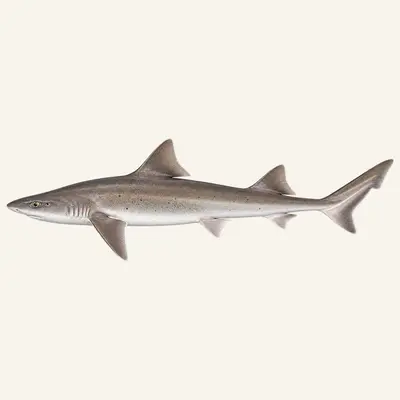
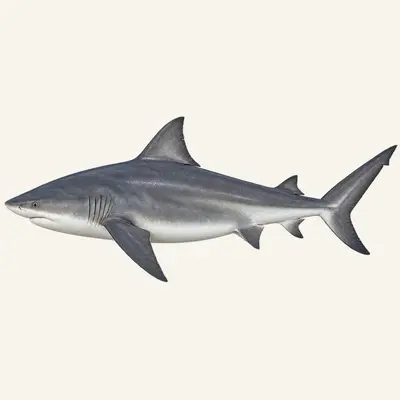
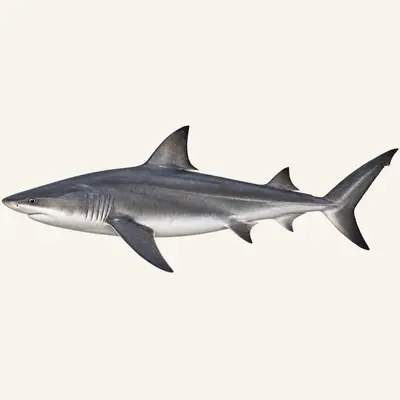
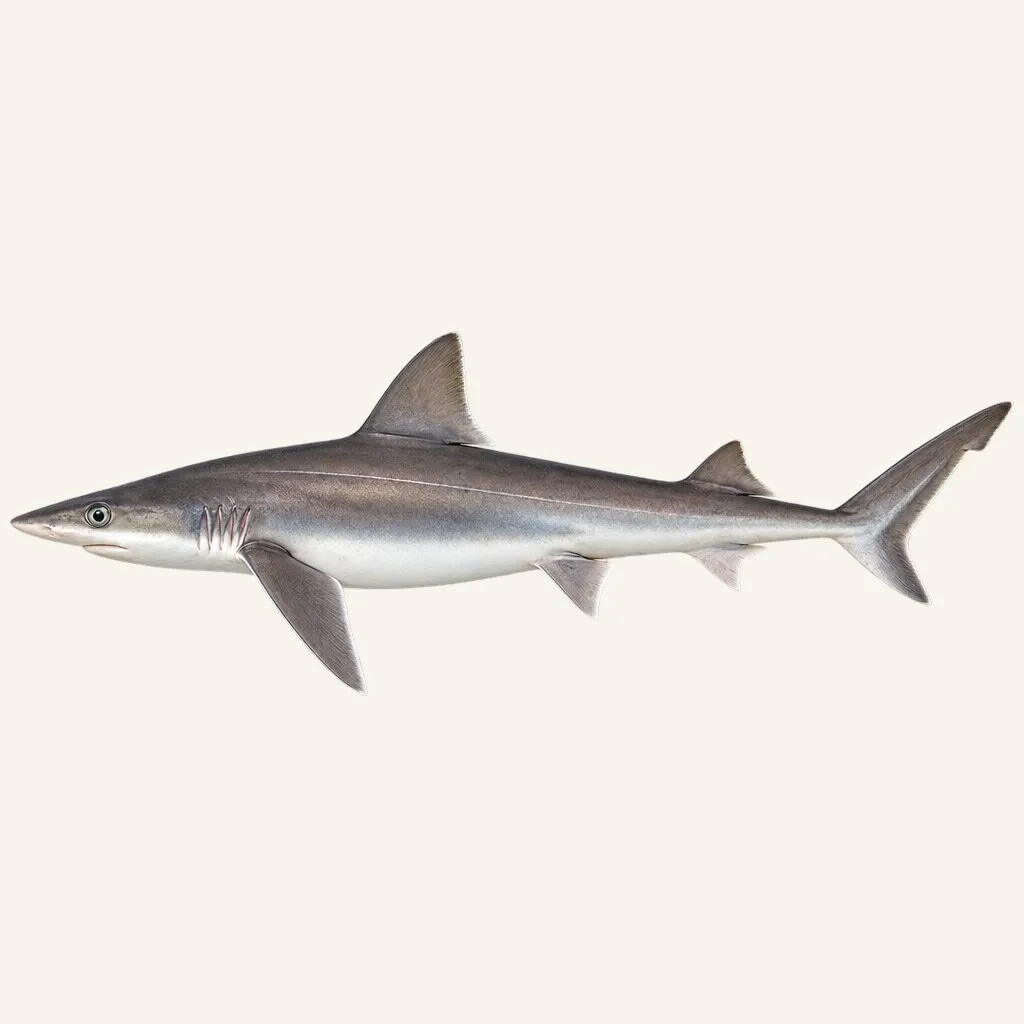
Two proportions carry the identification, and both are read off the fins rather than off the body.
The second dorsal is about as large as the anal fin — a matched pair, not a large fin above a small one, and the match is checkable from a photograph taken side-on.
The terminal lobe of the caudal — the short flap at the very end of the upper lobe, set off by a notch — is as long as the whole rest of the fin. That is a caudal built in two nearly equal halves, and it survives on a fish laid out on a deck.
The rest is a large houndshark: long pointed snout, big mouth, small blade-like teeth. Grey above and white below.
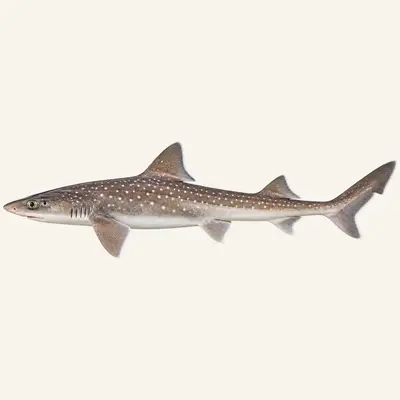
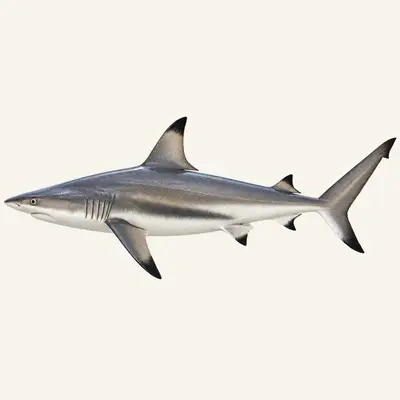
Young fish carry black markings on the fins that the adults do not. The markings go with age, and the change is complete enough that an angler who has only seen one age class regularly takes the other for a different species.
Length at first maturity averages 144.1 cm, in a bracket of 120 to 185.
Breeding
The mother supplies nothing after the egg. Development is aplacental and there is no yolk-sac placenta: the embryos live on their yolk and on nothing else for the whole of a twelve-month gestation.
What that buys is a large brood by shark standards — 6 to 52 pups, born at 30 to 36 cm, the average full-term embryo measuring 32. And it comes with a condition that decides most of what follows: litter size increases with the size of the mother. A large female is not one breeder among others. She is several.
The cycle is annual and it is pinned to the calendar. Ovulation happens in early summer and parturition is finished by January of the following year.
The early life is documented in southern Australian waters in more detail than most sharks get. Newborns and juveniles of 30 to 70 cm gather in nursery areas in shallow water, move out to deeper coastal water to overwinter, and most of them return to the same nurseries the following spring. From two years old they leave that pattern instead for eastern Bass Strait, where the bulk of the immature stock is found.
The water it needs
Mainly demersal, over the continental and insular shelves and out onto the upper slopes, from close inshore down to 550 m. It occurs in small schools, strongly migratory at the higher latitudes of a range running from 70 degrees north to 58 south, with pronounced partial segregation by size and sex in some areas.
Then there is the fact that does not fit. This shelf-dwelling bottom shark is frequently caught on floating tuna longlines over deep water, and is described as pelagic in the open ocean. A demersal animal taken on surface gear above abyssal depths is an apparent contradiction, and it is the truest statement about its amplitude on this page: the depth range is not a habitat description but a list of everywhere it has been found.
The movements match. Numbers of individuals tagged in New Zealand have been recovered in Australia, which is a crossing of the Tasman Sea.
Areas
- Coastal continental shelves
- Semi-pelagic temperate waters
- Estuaries and deep bays
Techniques
- Drifting with live or dead bait
- Coastal bottom fishing
- Bottom longline
Baits
- Whole mackerel
- Herring
- Squid
- Fresh fish fillet
What it eats
Fishes taken both on the bottom and in midwater, plus crustaceans, cephalopods, worms and echinoderms.
Worms and echinoderms at one end of that list and pelagic fish at the other describe an animal that forages through the sediment and hunts in open water in the same career. The teeth are consistent with it: small, but bladed, so they cut rather than crush, and a bladed dentition works on soft prey of every kind without committing the animal to any one of them.
How to catch it
This shark is available from the shore and from offshore boats alike, anywhere between the beach and 550 m, and that breadth is what puts it within reach of ordinary sea fishing across its whole range.
It lives in small schools, so a fish is a signal rather than an event: what one mark gives, it usually gives again. Since the schools are partially sorted by size and sex, the fish that follow will resemble the first one, and a session says more about which class was passing than about the population.
The teeth are small but they are blades. A wire or heavy abrasion-resistant trace is the working rule, and even a middling fish is handled with attention.
One entry in the record is more useful than it looks. The species adapts well in captivity if it is captured and handled carefully, which is a direct statement that individuals of this shark survive being caught when the handling is right. That is not true of everything with fins, and it is what makes release here worth doing properly rather than quickly. Maximum reported age is 55 years, so the animal going back over the side may have been swimming before the boat was built.
Regulated — Often governed by quotas, size limits, seasons, or reporting rules.
Conservation · Critically Endangered (IUCN) — This species is threatened with extinction. Always release it (no-kill), handle it with the utmost care and check local rules — fishing for it may be prohibited.
Conservation
Three traits compound, and the third makes the first two worse.
Maturity comes at around 144 cm, which on this species is late in the growth curve. Longevity reaches 55 years. And litter size scales with the size of the mother — so removing the large females does not take a proportional share of the reproduction, it takes more than its share. A fishery selecting for size is selecting against recruitment directly.
The shallow coastal nurseries are a second pressure, and one that operates independently of any fishing at all. Newborns and juveniles concentrate in a few metres of water for their first two years, and a few metres of water is where coastal development happens.
The transoceanic movement is the third. A stock that crosses the Tasman Sea cannot be managed by any one country, and the migratory species convention lists it on Appendix II for that reason — an instrument that obliges the states concerned to agree rather than one that sets a catch.
The commercial position leaves no slack in any of this. The species is fished heavily and deliberately, for human consumption, for squalene extracted from the liver, for the fins, and for fishmeal. Every part of the animal has a buyer, so nothing about the economics discourages a capture.
Regulations
Check the local regulations in force (legal size limits, closed seasons, bag limits).
For guidance only. Legal sizes, quotas and open seasons vary by location and season: always check the local regulations in force before fishing.
Other names
Three English names, and each one records a different thing about the fish. Tope is the plain British name, of obscure origin. School shark records the habit — small schools, which is exactly what the biology says. Soupfin shark records what was done with it: the fins went to soup, and the name outlasted the trade that coined it.
Two of the six languages on this page name a dog. German Hundshai and the English houndshark agree with each other, and both name the family rather than the species, so neither is a determination on its own.
French offers both milandre and requin-hâ, Spanish cazón, Italian canesca, Brazilian Portuguese cação-bicudo, the last of these picking out the pointed snout. Galeorhinus joins the Greek for a shark and for a nose, so the scientific name says what the Portuguese one does.
Sources: fishbase.se · api.gbif.org