Starry smooth-hound
Mustelus asterias · Triakidae
- Saltwater
- Sharks & rays
- Medium
- Size
154 cm
- Weight
4.8 kg
- Depth
0–350 m
Where to fish
- Estuary
- Beach
Habitat icons: Flaticon
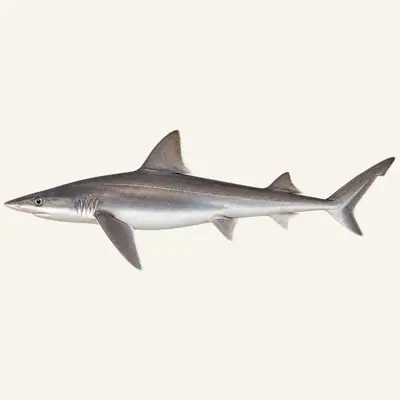
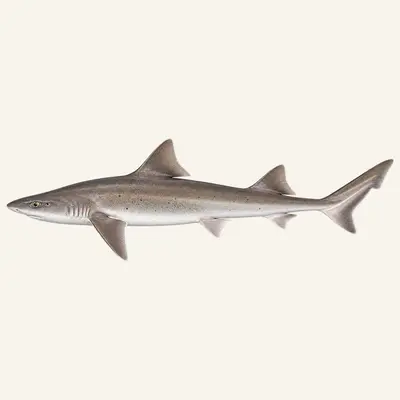
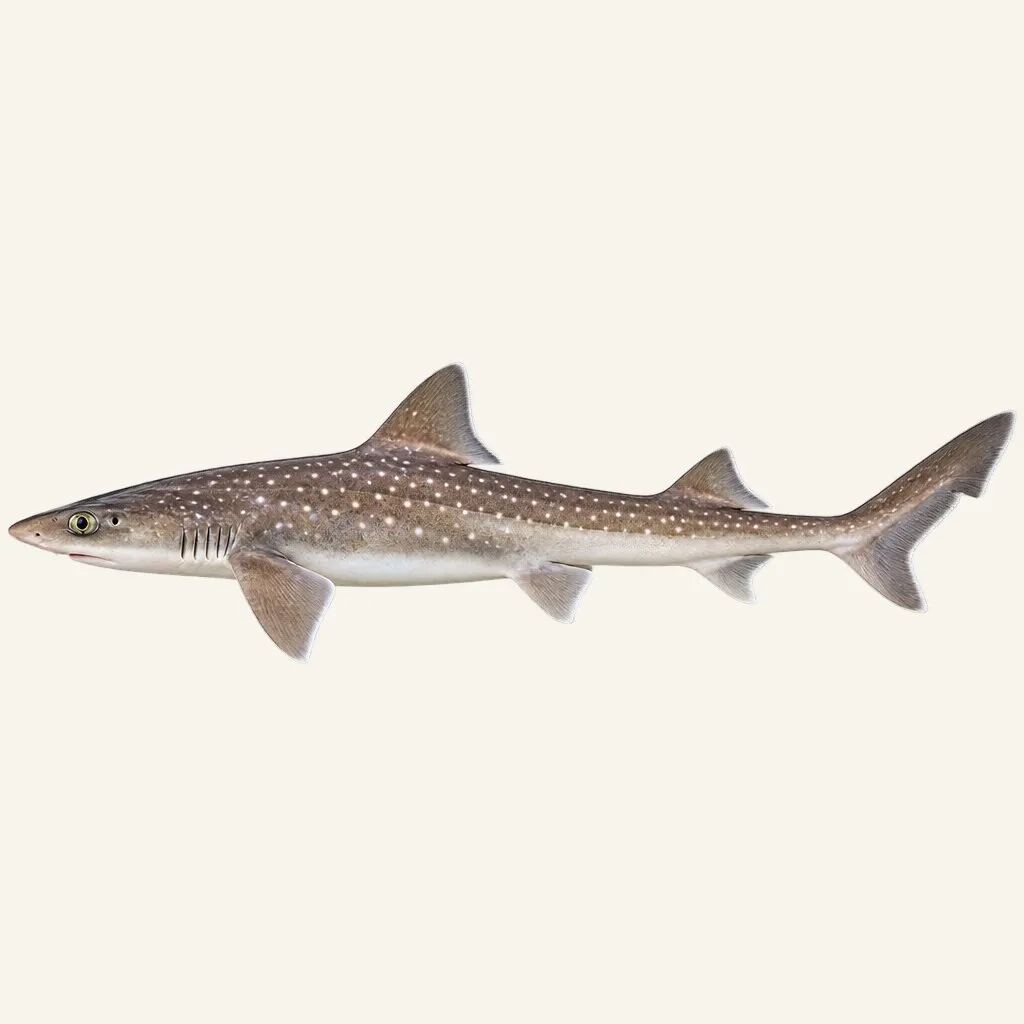
The starry smooth-hound is a slender coastal shark, grey-brown with distinctive small white spots along its flanks. It inhabits shallow sandy and gravelly bottoms along European coasts, from the Mediterranean to the North Sea.
Calendar
Recorded in 10 countries
Belgium · Croatia · France · Guernsey · Ireland · Isle of Man · Jersey · Netherlands · Norway · United Kingdom
GBIF occurrence records — native and introduced populations combined.
Its range
British Isles and the North Sea south to the Canary Islands, plus the Mediterranean and Mauritania: 61°N to 16°N.
Set against its congener, which continues down to South Africa, this species stops at the tropics. Both hold the same northern coasts and only one of them leaves the temperate zone, which means the two are genuinely mixed in the north while everything south of Mauritania is the other species by default.
Identifying it
The species is named for a character that cannot be relied on. Small white spots scatter over the grey back and supply both the English name and the scientific one, but they are faint or absent on some individuals — and the congener is described in the same literature as plain or black-spotted. A spotted smoothhound is therefore not automatically this one, and an unspotted smoothhound is not automatically the other.
It is worth saying plainly: colour will not finish the job on these two, and a photograph of a smoothhound is usually undeterminable.
What can be used is coarse. This species does not reach the size its congener does, and it matures at about 81 cm, with a reported range beginning at 85. Beyond that, determination on a fish in hand goes to dentition and denticles, which is exactly why the two continue to be confused in landings.
Breeding
Two species of one genus, running two different reproductive modes. Here the embryos are aplacental: fertilisation, then a closed account. Each pup lives on the yolk it was given and receives nothing further from its mother.
The output reflects the cheaper method. Litters run 7 to 15, more than the placental congener manages, and the young are born at about 30 cm rather than 39. More pups, each smaller, each on a fixed ration.
That is not a minor variation inside one design. A placental female can invest through gestation in response to what she finds to eat; a female of this species commits everything at ovulation and cannot add to it afterwards. Which of the two modes absorbs fishing better is not obvious from litter size alone, because the smaller pup begins life with fewer options.
The water it needs
Sand and gravel. The species is recorded as preferring clean granular ground, and it occurs from the intertidal zone to at least 100 m, with the full depth range running 0 to 350.
Clean sand and gravel banks are crab ground, and the section below explains why that amounts to saying the same thing twice.
It is common both inshore and offshore over continental and insular shelves — a shark of the shallow banks rather than of anywhere remote.
Areas
- Coastal sandy and gravelly bottoms
- Surf-casting beaches
- Bays and estuaries
Techniques
- Bottom fishing with paternoster rig
- Night surf casting
- Bottom longline
Baits
- Shore crab
- Shrimp
- Squid
- Ragworm
What it eats
Crabs, hermit crabs, lobsters and slipper lobsters. Crustaceans are not the leading item on a broader list here; they are very nearly the whole list, and the four names given are all decapods of clean granular bottoms.
A diet that specific makes bait selection trivial and mark selection everything. The fish is where those animals are, which means sand and gravel banks, and it is not somewhere else eating something different on a slow day.
How to catch it
Crab is the bait and there is no argument to have about it. The diet is crustacean almost to the exclusion of everything else, so a peeler or a hardback fished on clean sand or gravel is what the animal is already hunting for.
The ground is the real decision. Banks of sand and gravel in shallow water, worked on the tide, bait held on the bottom. Rough ground and deep water belong to another page.
Terminal tackle needs abrasion resistance rather than bite resistance: nothing in that mouth will cut a leader, and the skin will wear one through. The animal is not dangerous to handle.
Most fish met on those banks are close to or beyond the length at first maturity, about 81 cm, which puts the decision at capture on breeding adults rather than juveniles.
Conservation · Near Threatened (IUCN) — This species is in decline. Release your catch quickly and handle it with care — wet hands, as little time out of the water as possible.
Conservation
The warning about this species arrived from the effort side rather than the catch side. Its assessment, dated August 2020, rests on recorded and potential levels of exploitation rather than on a measured fall in numbers: the pressure is quantified and the decline is inferred from it.
That order of evidence is worth understanding. A commercially fished shark, used fresh and salt-dried, taken across a range from the North Sea to the Canaries, is under measurable pressure well before any abundance index registers the consequence — and by the time an index does, the removals causing it are years in the past.
The demography sets how long that lag runs. Seven to fifteen pups per litter, each on yolk alone, and first maturity around 81 cm: a female must reach a substantial size before she contributes anything at all, and the fishery works on the sizes she passes through getting there.
Its ground is the other exposure. Shallow sand and gravel banks are the most accessible and most heavily worked seabed there is.
Regulations
Check the local regulations in force (legal size limits, closed seasons, bag limits).
For guidance only. Legal sizes, quotas and open seasons vary by location and season: always check the local regulations in force before fishing.
Other names
Starry smoothhound, for those white spots — and the star turns up twice in the naming of European sharks without meaning the same fish either time. Asterias is the Greek star here; stellaris, the Latin one, belongs to the nursehound, a catshark of another family entirely. Neither name helps anyone find the other.
British usage compounds it. Anglers say smoothhound for both Mustelus species and sort them out afterwards, or not at all, and a third congener in the Mediterranean is the blackspotted smoothhound, so spotted on its own names nothing.
French says émissole tachetée and Dutch gevlekte gladde haai, both of them spotted rather than starry.
Sources: fishbase.se · api.gbif.org