Tiger shark
Galeocerdo cuvier · Carcharhinidae
- Saltwater
- Sharks & rays
- Medium
- Regulated
- Dangerous
- Size
500–750 cm
- Weight
1,583–807 kg
- Lifespan
50 years
- Depth
0–800 m
Where to fish
- Estuary
- Reef
- Offshore
Habitat icons: Flaticon
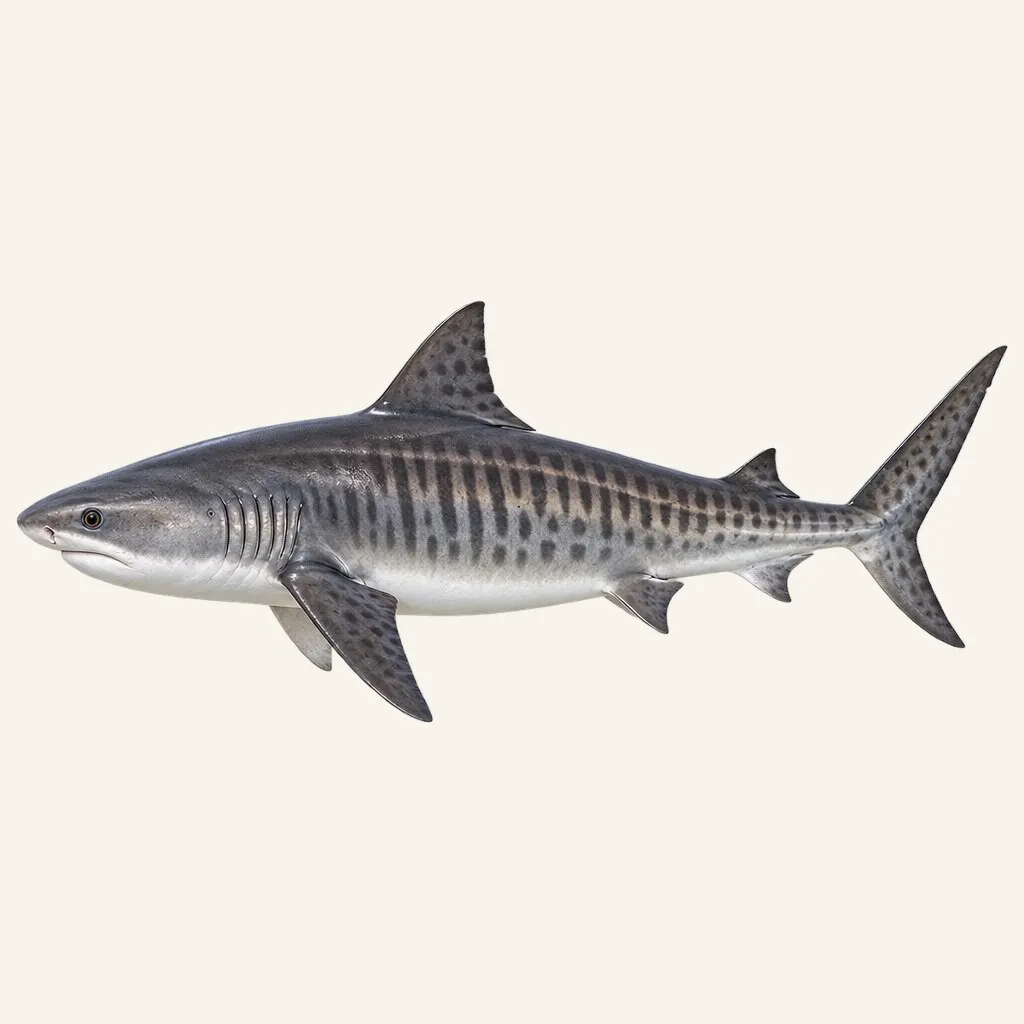
The tiger shark is a large coastal predator readily recognized by the dark transverse stripes along its flanks, more distinct in juveniles. Its broad, rounded snout, serrated teeth and wide-ranging diet make it one of the most formidable sharks.
Calendar
Recorded in 21 countries
Australia · Bahamas · Bangladesh · Brazil · Colombia · Ecuador · Faroe Islands · Fiji · France · French Polynesia · Germany · Iceland · Maldives · Mexico · New Caledonia · Norfolk Island · Puerto Rico · South Africa · Svalbard & Jan Mayen · United Kingdom · United States
GBIF occurrence records — native and introduced populations combined.
Its range
The range circles the globe between 62°N and 44°S, which takes in frankly temperate water: Iceland at one end, New Zealand at the other. The most northerly records correspond to incursions along the coasts rather than to any permanent presence.
The shape of that range rests on a contradiction. The animal ranks among the highly migratory species and does cross oceans, yet it is not oceanic: it stays tied to continental and insular shelves, and its passages through open water are passages, not a way of life. Hence its presence around isolated islands very far from any continent — Revillagigedo, Cocos, the Galápagos, Hawaii, Tahiti. Each island is a shelf, and one is enough for it to stop there.
Identifying it
The tooth is the master piece and it has no equivalent. Broad, cockscomb-shaped, coarsely serrated along its whole margin, deeply notched on its outer edge, the tip directed obliquely outwards. This is not a blade but a tin-opener: the notch holds, the serrations saw, the movement of the head does the rest. No other shark carries that dentition.
The snout goes with it. Very short and very broad, bluntly rounded, its length staying well below the width of the mouth — the exact inverse of the tapered profile of the high-seas hunters. The upper labial furrows are long, about as long as the snout, and reach forward to the level of the front of the eyes: an easy character to verify, and one that does not mislead.
The stripes, on the other hand, do mislead. Vertical and dark, doubled by rectangular spots on the flanks and fins, they fade with growth. A juvenile is distinctly tiger-marked; an adult of five metres may show no trace at all. Looking for the bars on a large fish leads to ruling the species out wrongly.
Two details of outline remain: the spiracles are small but clearly visible as slits, and the caudal keels are low.
Breeding
The embryos develop in the uterus with no placental link to the mother, which sets the species apart within its own family: the other requiem sharks feed their young through a placenta, this one does not. Each pup lives on its own reserves.
The litter is very large — ten to eighty-two, with up to eighty young measured — for newborns of 51 to 104 cm, most often around 60. A shark born at a metre has practically no predator from its first hour.
Gestation lasts thirteen to sixteen months, and mating takes place before gravid females have even given birth. There is therefore no recovery interval: the female goes straight on. That is what offsets the slowness of everything else, because maturity comes only at three metres — 2.1 to 3.5 m depending on the individual — for a lifespan of some fifty years.
The water it needs
This is a shark of the edge. It frequents estuaries, the approaches to wharves and jetties inside harbours, coral atolls and lagoons — places where the water is turbid, shallow and busy. It is bottom-associated more often than not, and moves readily into brackish water.
Ordinary depth runs from the surface to 140 m, with descents recorded to 350 around Tahiti and to 800 at the extreme. That amplitude belongs to an animal with no preferred level, which moves to wherever there is something to eat.
Its activity is nocturnal, and that one piece of information gathers up all the rest. A predator hunting at night, in loaded water, near the bottom, over ground used by swimmers and small boats, is not identifying what it approaches under the same conditions as a sight hunter in clear open water.
Areas
- Coral reefs
- Tropical estuaries
- Insular shallow flats
- Deep coastal waters
Techniques
- Night boat live bait fishing
- Dead bait on bottom
- Chumming and drifting
- Slow coastal trolling
Baits
- Whole rays
- Tuna chunks
- Large whole fish
- Giant squid
- Fish heads
What it eats
Its prey list is the longest ever drawn up for a shark, and what makes it interesting is not the length but the absence of any logic to it. Other sharks, rays, bony fishes, sea turtles and land tortoises, marine mammals up to porpoises and whales, seabirds, sea snakes, squid, gastropods, crustaceans, detritus. To which are added species nothing else will touch: the longhorn cowfish and the spot-fin porcupinefish, one toxic, the other armoured in spines.
The dentition is what makes that menu possible. A cockscomb tooth, notched and serrated, opens a turtle's shell and cuts up a cetacean carcass — two resources no other predator of its size can exploit. The animal is not omnivorous out of curiosity: it is omnivorous because its tool forbids it nothing.
The remainder of the list is more disturbing. It consumes carrion and refuse, and stomachs examined have yielded tin cans, pieces of metal and burlap bags. A predator that swallows metal is not sorting by taste: it tries first and spits out afterwards, or not at all.
How to catch it
Three facts govern this fishing, and the first is safety. The species is traumatogenic and ranks second behind the white shark for documented attacks, with at least twenty-seven traced to it. It frequents exactly the water where people swim and where boats are launched. A fish brought alongside a hull is still operational, and its dentition is built to saw through whatever it has hold of.
The second is the hour. It hunts at night, which is why live baits are fished after dark, at anchor or on the drift, over shallow ground. Chum makes full sense here: an animal that eats carrion follows a scent trail better than most predators, and it comes from a long way off.
The third is mass. Eight hundred and seven kilos published for a length of 7.5 m; a specimen of 7.4 m reportedly taken off Indo-China was announced at over three tonnes, a figure nothing corroborates and which gives the measure of what the accounts add. Even at the verified value, this is an animal that does not come aboard and is unhooked in the water, at a distance, with a long tool.
Regulated — Often governed by quotas, size limits, seasons, or reporting rules.
Dangerous — Risky handling: gear, release, and safety practices must be adapted.
Conservation · Near Threatened (IUCN) — This species is in decline. Release your catch quickly and handle it with care — wet hands, as little time out of the water as possible.
Conservation
The large litters mislead. Eighty pups per birth suggest a prolific species, when renewal actually turns on two other numbers: three metres before a first breeding, some fifty years of life. The female spends most of her existence reaching the size at which she begins to count, and that is the class fishing removes first, since large individuals are what people look for.
Its distribution makes the problem worse. Estuaries, harbours, lagoons, atoll margins: these are the most heavily fished waters on the planet, and a coastal shark has none of the offshore refuge available to an oceanic species.
It is also one of the few species whose reputation exposes it to organised culling. Several parts of the world have run such campaigns after attacks, naming it specifically. Those operations take adults, which is exactly the fraction renewal depends on, and they act on an animal that otherwise clears its own waters of carrion. What is removed as a hazard was doing sanitary work nobody had to pay for.
Regulations
Check the local regulations in force (legal size limits, closed seasons, bag limits).
For guidance only. Legal sizes, quotas and open seasons vary by location and season: always check the local regulations in force before fishing.
Other names
Tiger shark in every language of the catalogue, after the dark bars of the juvenile. The name therefore describes a young animal, and it becomes inaccurate on the large individuals where the pattern has gone — a case rare enough to be worth noting.
The epithet cuvier honours Georges Cuvier. The genus name Galeocerdo joins two Greek roots meaning weasel and fox, animals to which ancient authors readily compared sharks, without the resemblance being obvious to anyone since. English speakers should keep it apart from the sand tiger shark, Carcharias taurus, a slow reef-dwelling animal that shares nothing with it but a word.
Sources: fishbase.se · api.gbif.org