Blue shark
Prionace glauca · Carcharhinidae
- Saltwater
- Sharks & rays
- Medium
- Regulated
- Dangerous
- Size
335–400 cm
- Weight
274–206 kg
- Lifespan
20 years
- Water temp.
7–21 °C
- Depth
0–1,082 m
Where to fish
- Offshore
Habitat icons: Flaticon
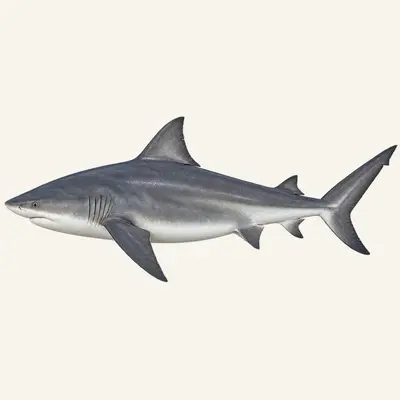
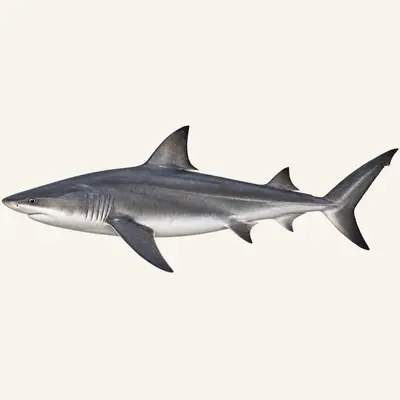
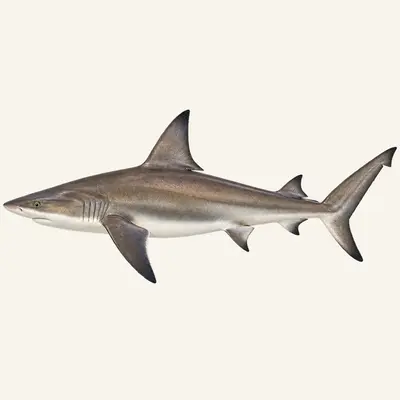
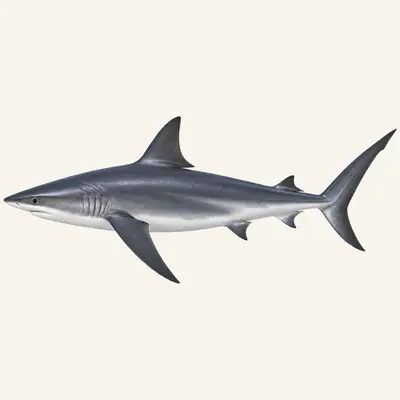
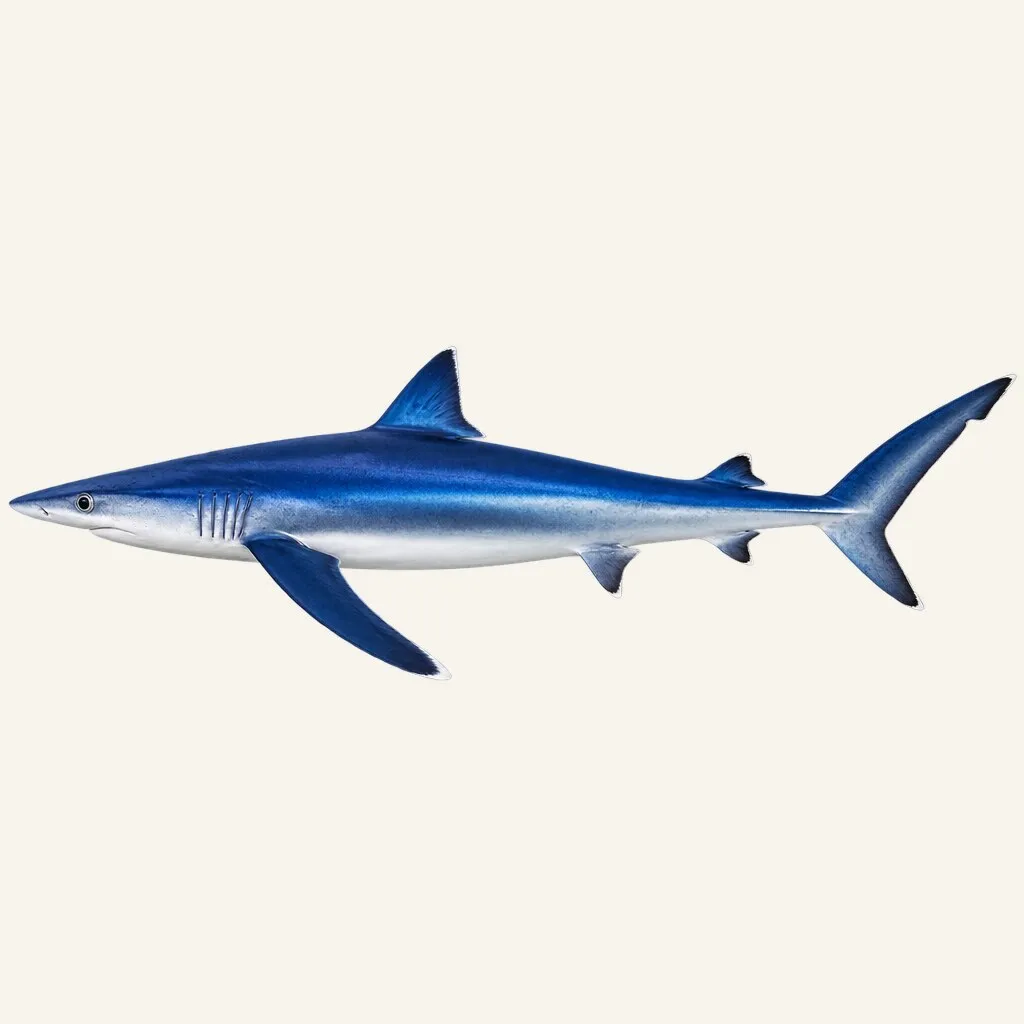
The blue shark is a large pelagic shark with a sleek, streamlined body, recognizable by its intense indigo-blue back and long pectoral fins. One of the most widespread shark species in the world, it roams open temperate and tropical oceans over very long distances.
Calendar
Recorded in 36 countries
Albania · Argentina · Australia · Benin · Brazil · Cameroon · Canada · Chile · Colombia · Côte d’Ivoire · Denmark · Faroe Islands · France · Gabon · Germany · Ghana · Greece · Greenland · Iceland · Indonesia · Ireland · Italy · Liberia · Mexico · Netherlands · New Zealand · Nigeria · Norway · Peru · Portugal · Sierra Leone · South Africa · Spain · Svalbard & Jan Mayen · United Kingdom · United States
GBIF occurrence records — native and introduced populations combined.
Its range
Circumglobal, from 70 degrees north to 55 south, across the three oceans and the Mediterranean, and probably the widest-ranging cartilaginous fish there is.
That reach is more surprising than it looks, because this is a cool-water animal: the recorded thermal band runs from 7 to 21 degrees, which excludes the surface of the entire tropical belt. The contradiction resolves downwards. Fifteen-degree water exists everywhere on the planet — under the equator it is simply deeper. The shark does not go round the tropics. It goes under them.
Individual movement matches the scale of the range. One animal tagged in New Zealand was recovered 1,200 km off the coast of Chile.
Identifying it
Run a hand along the back between the two dorsal fins. There is no ridge there, and the published diagnosis says so explicitly. Several of the requiem sharks of comparable build carry one — the silky shark's own description is written around the position of a dorsal fin on a ridged back — so an unridged interdorsal space on a slim blue-backed shark narrows the field very quickly.
The build is the second half of it: slim and long, with a long conical snout and a large eye. The pectorals are long and narrow, cut like a glider's wing, and their tips darken, as does the tip of the anal fin. The upper teeth are triangular, curved and saw-edged.
Colour, when the animal is alive, is dark blue over the back, bright blue along the sides and white beneath. It is a real pigment and not a trick of the light on the water.
Breeding
This shark breeds on a bony fish's schedule, and that is the fact around which the rest of the page has to be arranged.
Development is placental. The embryos are supplied by the mother throughout, and the numbers she carries are unlike anything else in the group: 15 to 30 pups in an ordinary litter, a recorded span of 4 to 135, and as many as 80 counted inside a single female. They are born at 35 to 44 cm after nine to twelve months.
Two figures for maturity are on record and they do not sit comfortably together. One account gives sexual maturity at 250 cm and four to five years of age; the measured length at first maturity averages 199.1 cm, in a bracket of 170 to 221. Either way the animal is breeding within a few years of birth, and either way it is doing so at a size well below what an adult reaches.
A few years to maturity, a gestation under a year, and thirty pups a go. No large shark in this catalogue renews itself faster.
One item of sexual dimorphism deserves recording because it falls on nothing usual. At equal size, maturing and adult females have a thicker skin layer than males. The source gives the observation without an explanation; it sits next to another, that mating involves a pairing with an embrace, and the two answer one another without needing to be joined up in words.
A single foetus from the South Atlantic has been described with craniofacial duplication, the first such case reported in the species — a curiosity rather than a pattern, and the sort of thing that only surfaces in an animal examined in very large numbers.
The water it needs
An open-water fish that only approaches the coast where the continental shelf is narrow. The usual band runs from the first metre down to 220, with most activity above 150, while the deepest record reaches 1,082 m. It is reported from estuaries and tolerates brackish water.
Epipelagic, a thousand metres, and an estuary: three statements that cannot all describe a fish loyal to one layer. It occupies whatever depth holds its temperature range, and that depth changes with latitude and with the season.
Areas
- Deep offshore pelagic waters
- Oceanic convergence zones
- Major offshore fishing grounds
- Edges of submarine canyons
Techniques
- Drift chumming
- Drifting bottom line
- Offshore trolling
- Live bait fishing in open water
Baits
- Mackerel or tuna chunks
- Whole squid
- Fresh sardines
- Chumming with chum bag
What it eats
The prey list half contradicts the animal's reputation, and it repays reading in full. Herring, mackerel and butterfish are midwater fish. Cod, haddock, pollock, the hakes and flounders are not — they live on or near the bottom.
A shark described as epipelagic that eats flatfish is not staying at the surface. The diet, more than the depth records, is what shows the real vertical amplitude of the animal.
Around those come small sharks, squid, pelagic red crabs, the occasional sea bird, cetacean carrion and garbage. The last two entries carry weight. A predator that exploits floating carcasses tracks a scent over long distances, and a predator that swallows rubbish is not inspecting much before it tries.
How to catch it
Scent beats sight, and that follows directly from the diet. An animal accustomed to finding carrion in open water will come a long way up a trail, and nothing in its experience gives it a reason to be suspicious of one.
Temperature then organises the search. Seven to 21 degrees is the cool side of the offshore thermal fronts, and in the tropics it is a band lying well below the surface. Looking for this shark in the warmest water of a sector is an error of layer as much as of latitude.
Geography closes the question. The species only comes inshore where the shelf pinches in, which restricts to a handful of coasts the places it can be reached from land. Everywhere else it has to be gone out to.
It is regarded as potentially dangerous to people. Its flesh sells fresh, dried, salted and frozen, the hide goes to leather and the fins to soup.
Regulated — Often governed by quotas, size limits, seasons, or reporting rules.
Dangerous — Risky handling: gear, release, and safety practices must be adapted.
Conservation · Near Threatened (IUCN) — This species is in decline. Release your catch quickly and handle it with care — wet hands, as little time out of the water as possible.
Conservation
The biology is not the weak point here, which is what makes the case worth setting out. Maturity within a few years, a gestation shorter than a year, fifteen to thirty pups a litter: this shark rebuilds faster than most animals its size, and it ought to absorb a level of fishing that would ruin others.
What weighs on it is sheer volume. It occupies precisely the depth band and the temperature range in which offshore longlines work, in all three oceans, across millions of hooks set for other species. Nobody targets it and everybody meets it. It is the most incidentally caught shark on the planet, and the quantity removed bears no relation to any effort directed at it.
Its low unit value makes that worse rather than better. A fish of minor commercial interest attracts no jealously defended quota, does not head any landings table, and vanishes into the statistical category of non-target catch. A species nobody counts because nobody is looking for it can decline for a long time before the signal appears anywhere.
And no jurisdiction owns the population. An individual tagged in New Zealand and recovered off Chile has crossed the waters of several states and long stretches of high seas in between. That dispersal is why the species was brought under the migratory species convention, whose Appendix II obliges range states to work out arrangements with one another, and why its international trade is now tracked through CITES.
Regulations
Check the local regulations in force (legal size limits, closed seasons, bag limits).
For guidance only. Legal sizes, quotas and open seasons vary by location and season: always check the local regulations in force before fishing.
Other names
Blue shark is unambiguous in English, which is unusual in a group where most names cover several animals. The word is doing plain descriptive work, and it describes the living fish rather than the one on the quay.
Other languages divide on that point. German Blauhai, Spanish tiburón azul and Portuguese tubarão-azul all take the blue. Italian breaks away with verdesca, built on green, and French names the hide rather than the animal — requin peau bleue, blue-skin shark, a tanner's distinction, and a fair one given that the hide of this species really is worked into leather.
The scientific name looks somewhere else again. Prionace joins the Greek roots for a saw and a point, and refers to the serrated teeth; glauca is the blue-green of the sea. The genus holds this species and no other.
Sources: fishbase.se · api.gbif.org