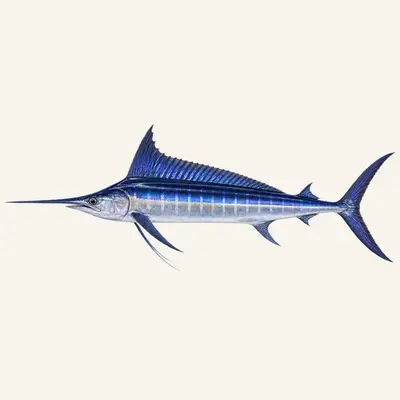
Black marlin
Istiompax indica · Istiophoridae
- Saltwater
- Coastal
- Hard
- Regulated
- Size
380–465 cm
- Weight
531–750 kg
- Water temp.
15–30 °C
- Depth
0–915 m
Where to fish
- Reef
- Offshore
Habitat icons: Flaticon
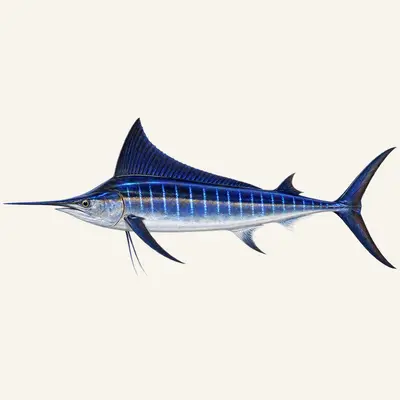
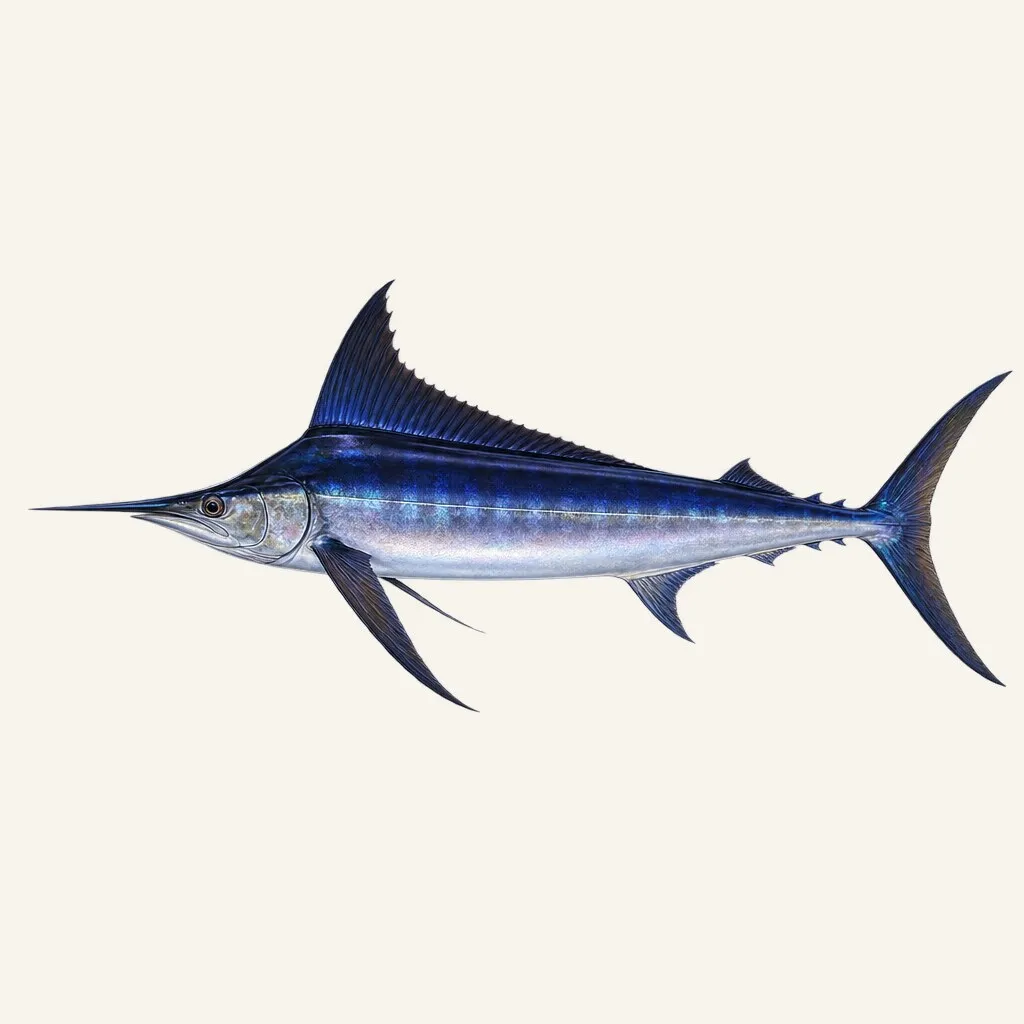
The black marlin is a large pelagic billfish identified by its robust body, stiff non-retractable pectoral fins, and flattened bill. It roams tropical and subtropical open waters across major oceans, hunting large prey such as tuna and mackerel.
Calendar
Recorded in 12 countries
Australia · Chile · Colombia · French Polynesia · Japan · Mayotte · Mexico · Mozambique · New Caledonia · New Zealand · Réunion · Vanuatu
GBIF occurrence records — native and introduced populations combined.
Its range
Tropical and subtropical Indo-Pacific, entering temperate water on occasion, between about 44 degrees north and 47 south.
One detail is worth relaying accurately because it is regularly mistold. Stray individuals do migrate into the Atlantic, by way of the Cape of Good Hope, and the record is explicit that the existence of Atlantic breeding stocks is unlikely. An Atlantic capture is therefore a biogeographical accident and not the leading edge of a population. It says something about the individual and nothing about the species.
Identifying it
The pectoral fins are falcate and rigid, on 19 or 20 rays. Rigid is the operative word, and the catalogue description carried on this page puts what follows from it in plain terms: they are non-retractable, and do not fold flat against the body the way a billfish pectoral normally does. Worth noting how that character is being asserted, because it gets repeated carelessly. The diagnosis consulted here records the stiffness as a property of this animal; it does not rank it against the other billfishes, and neither will this page.
The bill is the second thing to check, and it is a proportion rather than a shape. Robust, but not very long. A heavy-set beak on a fish this size is unusual enough to be worth a second look before anything else is measured.
The first dorsal stands lower than the greatest depth of the body and drops away towards the rear. Its membrane is blue-black, and the description states two absences on it and on the fish: no spots on the membrane, and no spots on the flanks. Light blue vertical bars appear sometimes, and sometimes not.
The body is elongate and not much compressed, densely covered in small embedded scales that each carry one or two sharp points. Thirty-nine to fifty soft rays in the first dorsal, 16 to 21 in the anal, no spines.
Breeding
Spawning is thought to happen in water of around 27 to 28 degrees, and egg counts from ripe ovaries have totalled about 40 million per female.
Forty million is the largest such figure in this catalogue, and it describes a strategy rather than a capacity. There is no nest, no substrate and no attendance in open blue water. Everything is released at once into a moving mass of water, dispersal does the work that guarding does elsewhere, and the survival rate that number implies is the price of the method.
The narrow spawning temperature is the constraint sitting underneath it. Thirty degrees of tolerated range for the adult against three degrees for the spawn means the water in which this fish can breed is a fraction of the water in which it can live.
The water it needs
The animal lives above the thermocline, in surface water, mostly within the first 200 m of a column recorded to 915. That upper layer is warm and mixed, and its floor is a temperature boundary rather than a depth: the fish stops where the cold water starts, and the depth at which that happens moves with the sector and the season.
Where it holds inside that layer is the part that matters to anyone looking for it. The record puts it often near shore, close to land masses, islands and coral reefs — not in the middle of the basin. This is a fish of the ocean's edges and its interruptions.
Its tolerated band runs from 15 to 30 degrees, which reaches further into cool water than several of the tropical billfishes manage.
Areas
- Deep tropical offshore waters
- Deep reef edges
- Insular deep-water zones
Techniques
- Heavy offshore trolling
- Live bait with large baits
- XXL surface lures
- Deep trolling
Baits
- Whole rigged bonito
- Large mackerel
- Giant squid
- Large vinyl lures
What it eats
Fishes, squids, cuttlefishes, octopods and large decapod crustaceans — and, when they are abundant, mostly small tunas.
That last clause places the animal. A predator whose staple is tuna sits above everything the open ocean assembles beneath it, since the tunas are themselves the fast predators of the surface layer. Small decapods at one end of the list and tuna at the other also mean the diet is not narrow: it takes what the warm layer offers, and what the warm layer offers best is what it eats most.
How to catch it
The two facts that matter are both about position rather than method. The fish holds the layer above the thermocline, and it holds it near coasts, islands and reefs. That is not the fishing of the open basin but of its margins, which is a different day and a different distance from port.
Identification at the boat comes down to the pectorals. Sizes overlap heavily across the large billfishes and colour is unreliable on a fish that is being fought; a stiff, sickle-shaped pectoral that will not lie against the flank is the character available at the moment it is needed.
The flesh is of good quality and is prepared as sashimi in Japan, sold refrigerated or frozen. A fish brought aboard has a market, so releasing one is a decision taken against a value rather than in the absence of any.
Regulated — Often governed by quotas, size limits, seasons, or reporting rules.
Conservation
Forty million eggs per female is a large reproductive capacity and it is conditional. It is what a female produces once she is large enough to produce it, and nothing in that figure protects the fish that have not reached that size.
The pressure sits on the spawning requirement rather than on the range. An animal confined to the surface layer, needing 27 to 28 degrees to breed, has a reproductive habitat considerably narrower than a distribution map suggests — and a map of the range is what this page shows you, not a map of where the species can actually spawn.
Its habit of holding near coasts, islands and reefs compounds this. The concentrations occur in water worked by coastal fleets and by distant-water fleets alike, two efforts of entirely different character landing on the same fish, neither counted against the other.
Regulations
Check the local regulations in force (legal size limits, closed seasons, bag limits).
For guidance only. Legal sizes, quotas and open seasons vary by location and season: always check the local regulations in force before fishing.
Other names
Black marlin. The colour word describes neither the back, which is dark blue, nor the belly, which is silvery white, and the fins it might describe are dark brown. It survives because it separates this fish from the blue marlin in a single syllable, which is what a working name is for.
The genus is the trap. Istiompax was detached from Makaira, so the whole of the older literature — catch series, tagging returns, early stock appraisals — files this animal as Makaira indica. Anyone reconciling a long time series has to know that the two names carry the same fish.
Indica points at the Indian Ocean, which is one third of a range that also covers the Pacific.
Sources: fishbase.se · api.gbif.org