Atlantic spadefish
Chaetodipterus faber · Ephippidae
- Saltwater
- Coastal
- Medium
- Size
50–90 cm
- Weight
3.5–9.0 kg
- Depth
3–35 m
Where to fish
- Estuary
- Reef
- Rocky shore
Habitat icons: Flaticon
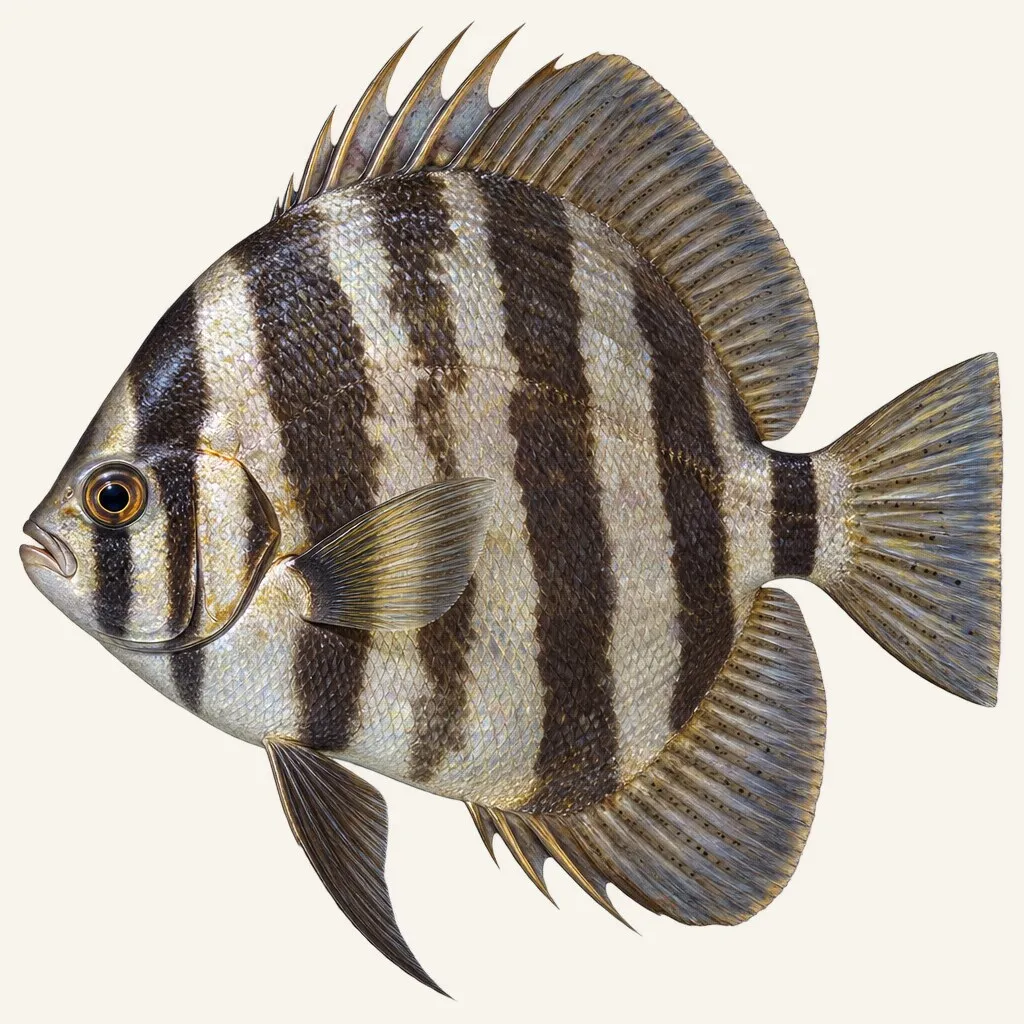
A deep-bodied, laterally compressed coastal fish, silvery with dark vertical bars, schooling around structures.
Calendar
Recorded in 18 countries
Bahamas · Belize · Brazil · Colombia · Cuba · French Guiana · Guadeloupe · Haiti · Honduras · Martinique · Mexico · Panama · Puerto Rico · Suriname · Trinidad & Tobago · U.S. Virgin Islands · United States · Venezuela
GBIF occurrence records — native and introduced populations combined.
Its range
Massachusetts and the northern Gulf of Mexico to Rio Grande do Sul in Brazil — a strictly coastal, continuous strip with no isolated island population anywhere on it.
The shape follows the life cycle. Juveniles need estuaries and adults hold structure in shallow water; neither stage has any use for open ocean, and neither has a means of crossing one.
Identifying it
A disc. The body is very deep and strongly compressed, the snout very blunt, and no other fish of the western Atlantic carries that outline.
Bold, irregular, blackish vertical bars cross it, and they fade with age. An old individual can look almost plain, which is the first thing to know before identifying this species from a photograph of a large one.
The second dorsal and the anal fins carry high forward lobes, so the silhouette stands nearly as tall through the fins as the body is deep. The mouth is small, the maxilla of an adult stopping beneath the nostrils, and there are no teeth on the roof of the mouth. The scales are ctenoid, the head and fins scaled, and the gill cover ends in a blunt point. Nine dorsal spines, then 21 to 24 soft rays; three anal spines and 17 or 18 rays.
Juveniles look like a different animal. In their black phase they are dark all over and hang at an angle in very shallow estuarine water, passing for a dead leaf, for the sterile pods of red mangrove, or for any other piece of drifting rubbish.
Breeding
Maturity from 12 cm is the only reproductive figure on record, and it is worth setting against a common length of 50: this fish breeds at a quarter of the length it will reach, and the great majority of any population is therefore mature.
Nothing else is recorded — no season, no fecundity, no spawning ground. The species has been reared in captivity, which is usually where such details come from first.
The water it needs
Shallow coastal water of every description: mangrove, sandy beaches, wrecks and harbours, from 3 to 35 m. Off south-eastern Brazil the recorded band is 23 to 45 m, deeper than anywhere else, which is a reminder that a depth range is a regional statement rather than a property of the animal.
Adults form very large schools — up to 500 fish — and they form them on structure. That is the working fact about the species: it is not a fish to search for, it is a fish to find once.
One habit belongs to nothing else in the record. It circles divers.
Areas
- Wrecks and artificial reefs
- Jetties and bridge pilings
- Buoys and nearshore structures
- Estuaries
Techniques
- Light bait fishing
- Float fishing
- Fishing near structures
- Drift fishing
Baits
- Jellyfish
- Shrimp
- Marine worms
- Small crabs
- Squid pieces
What it eats
Benthic invertebrates — crustaceans, molluscs, annelids, cnidarians — and plankton as well.
The cnidarians are the entry that repays attention. An animal taking jellyfish and hydroids with a small toothless mouth is not crushing anything: it is picking, one item at a time. Jellyfish is accordingly a standard bait here, which very few species can be said to share.
The plankton explains the schools in midwater. A fish that feeds on suspended material has a reason to hold above a wreck instead of on the bottom of it, and that is where the school will be seen.
How to catch it
Wrecks, artificial reefs, bridge pilings and jetties. The structure holds the school, and the school is the fishery.
The mouth is the difficulty. It is tiny, and it belongs to a fish that can weigh several kilogrammes, so hooks are small and baits are reduced to fragments — a piece of jellyfish, a scrap of shrimp, a section of marine worm. The mismatch between the size of the fish and the size of the bait is what catches people out.
Then the shape. A disc turned broadside presents a large surface to the water, and a fish of common length, 50 cm, resists in a manner unrelated to its mass. Tackle gets chosen for the surface, not for the weight.
One question has to be settled before a fish is kept. Reports of ciguatera poisoning are on record for this species. Ciguatera is a property of the food chain in a particular place rather than of a fish in general, so the question is about the water the fish came out of, and only local advice answers it.
Conservation
Two habitats carry this species and both are among the most heavily modified on its coasts. The juveniles are estuarine, and their black phase depends on shallow, cluttered, debris-laden water — precisely what dredging and tidying remove. The adults depend on structure.
The schooling is what a fishery has to weigh. Five hundred fish on one wreck is a local aggregation at a single known position, and it can be taken in a way a dispersed population cannot.
The species is reared in captivity and kept in public aquariums, which takes part of the ornamental demand off the wild stock. The commercial fishery is minor; the pressure that matters here is on the ground rather than on the fish.
Regulations
Check the local regulations in force (legal size limits, closed seasons, bag limits).
For guidance only. Legal sizes, quotas and open seasons vary by location and season: always check the local regulations in force before fishing.
Other names
Atlantic spadefish, and the spade is the outline. German Atlantischer Spatenfisch translates it directly, Spanish uses paguara in the Caribbean, French disque portugais.
Portuguese is the informative one. Paru-branco, white paru, files the fish among the parus, which in Brazil are the marine angelfishes — where its outline puts it and its family does not. This is an ephippid, and the resemblance to a pomacanthid is convergence on the same reefs.
Sources: fishbase.se · api.gbif.org