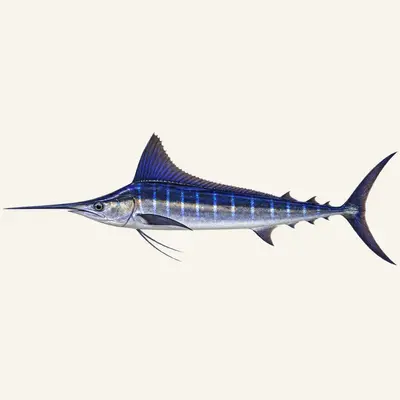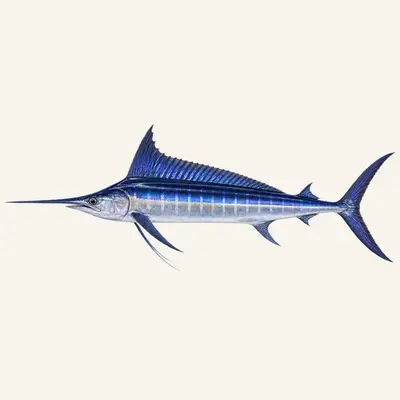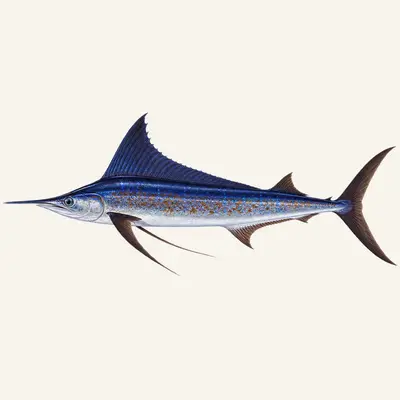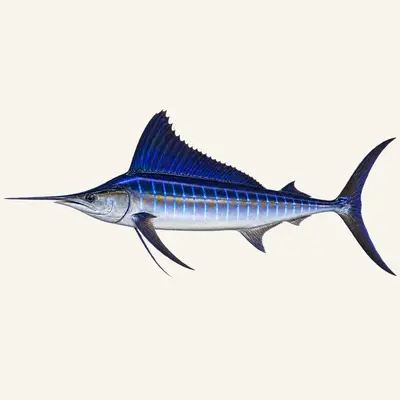
Longbill spearfish
Tetrapturus pfluegeri · Istiophoridae
- Saltwater
- Big pelagics
- Hard
- Regulated
- Size
165–254 cm
- Weight
41–58 kg
- Depth
0–200 m
Where to fish
- Offshore
Habitat icons: Flaticon
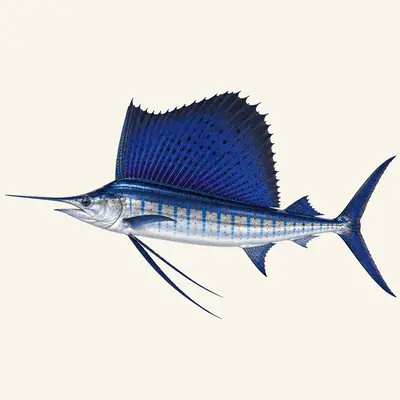
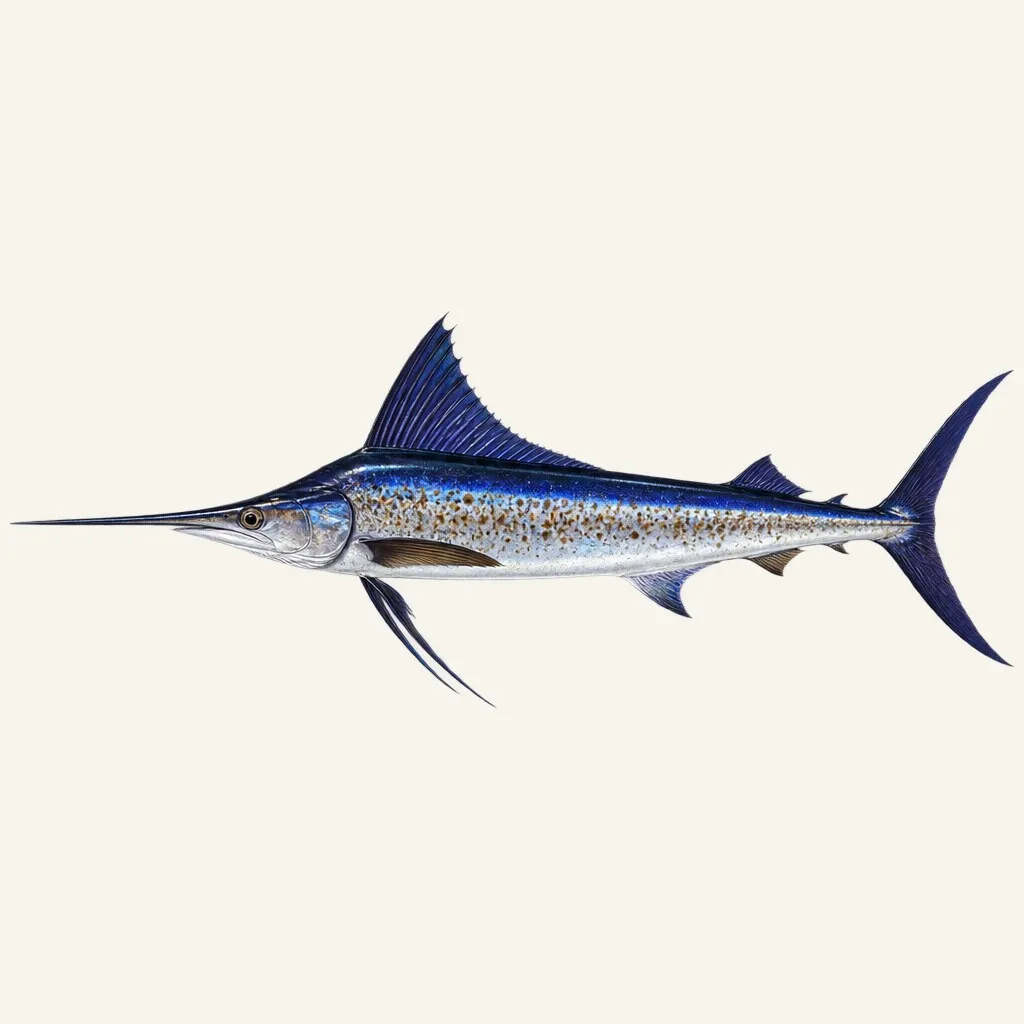
The longbill spearfish is a slender, medium-sized billfish with a tall anterior dorsal fin and a long, fine bill. This Atlantic pelagic species is distinguished from the white marlin by its smaller size and more streamlined profile.
Calendar
Recorded in 5 countries
Colombia · French Southern Territories · Guadeloupe · Martinique · United States
GBIF occurrence records — native and introduced populations combined.
Its range
The species occupies offshore water across the whole Atlantic, from 44 degrees north to 33 south, and from the longitude of the Gulf of Mexico to that of the Gulf of Guinea.
Density is very uneven: the fish is far more abundant in the west of the basin than in the east. That lopsidedness takes on a particular meaning if the population really is single, as the maturation calendar suggests. It would then be not two stocks of unequal weight but one stock whose mass sits along a single shore.
Identifying it
Twenty-four vertebrae. The figure does not separate this fish from its close relatives — it is the count for the whole family — but it rules out everything else, and on a truncated carcass brought back to the dock it serves better than an outline.
The rest of the description is an inventory of fin colours, and it should be taken as exactly that: this is how animals that all resemble one another get told apart. The pelvic fins are blue-black with a frankly black membrane. The first anal fin is dark blue and lightens to silvery white at its base, while the second anal is a blackish brown — two neighbouring fins in different shades, a checkable detail and one rarely set out elsewhere.
The ground colour of the flank is the second useful point. It is silvery white splattered with brown, where the shortbill spearfish carries the same speckling over a blue flank. The back is blue-black, the belly silvery white, the dorsal fins dark blue, the pectorals blackish brown and occasionally tinged with greyish white.
The dorsal fin holds nothing but soft rays, 50 to 57 of them, and the anal 18 to 21.
This is the longest spearfish in the genus and it stays light for that length; a fish of the common size measures 165 cm.
Breeding
The most important fact on this page is a fact about the calendar. Maturation in adults is observed at the same time in the northern and the southern hemisphere — at the same time, not in the same local season. Fish north and south of the equator ripen together by the clock, while one is in summer and the other in winter.
The conclusion the authors draw from it is a heavy one: such synchrony suggests that the Atlantic holds a single homogeneous population. Two separate stocks would have no reason to agree on dates and would each follow the thermal rhythm of its own hemisphere.
A second point, independent of the first: females probably spawn only once a year. One release rather than a series spread through the season, which means a missed spawning is a lost year with no way of making it up inside the same cycle.
The water it needs
Its usual band of water does not begin until 100 m and extends to 200. The detail changes everything: the two other spearfishes on the Atlantic side are recorded from the surface down to 200 m, so this one habitually lives below where their whole range ends.
The species is nonetheless described as living above the thermocline, which places that boundary deeper than 100 m in the water it uses. The portrait is of an animal settled in the lower half of the mixed layer rather than pinned to the surface.
Its domain is the high seas, away from the shelves.
Areas
- Offshore blue Atlantic waters
- Thermal front zones
- Around Atlantic islands
Techniques
- Slow surface trolling
- Live bait fishing
- Surface lures
- Deep trolling
Baits
- Rigged ballyhoo
- Small mackerel
- Natural squid
- Whole sardines
What it eats
Pelagic fishes and squid, in the main. This is the menu of an open-water hunter that takes its food from the layer it occupies — low enough to meet forage that surface predators never see.
How to catch it
Depth is what sets this fishing apart from the other Atlantic billfish. A spread of lures towed behind a boat works the first few metres; the band where this spearfish usually holds starts a hundred metres below that. Fish taken at the surface are the upper fringe of its distribution, and a bait sent down — lead, downrigger, a longline set deep — reaches the layer where it actually lives.
The sector counts as much as the depth. The western side of the Atlantic carries the bulk of the numbers, and the difference from the eastern side is not marginal.
The diet points to fish and squid, whole, rigged to hold together at trolling speed. No imitation of a bottom invertebrate makes any sense for an animal that never goes down to look for one.
The species counts among recognised gamefish and its flesh is marketed frozen, both of which are worth knowing before deciding the fate of a capture.
Regulated — Often governed by quotas, size limits, seasons, or reporting rules.
Conservation
One spawning a year per female is the figure that calls for restraint. In species that release in successive batches, a season that goes wrong is partly corrected within the same season; here nothing is corrected. A ripe female taken before her annual release represents a whole year of reproduction lost for that individual, not a fraction of a season.
The probable single population makes that worse rather than better. One Atlantic stock means no separate fraction is held in reserve: what is taken on one side of the basin comes off the same body of fish as what is taken on the other, and the effort adds up in full.
Then there is the geography of abundance. The mass of the fish sits in the west, where the high-seas fleets and the sport fisheries are thickest, and the sparser eastern fraction cannot repopulate the other shore for the simple reason that it is part of it.
No growth data and no size at maturity appear in the record for this species, which makes it impossible to relate a catch to the state of the stock.
Regulations
Check the local regulations in force (legal size limits, closed seasons, bag limits).
For guidance only. Legal sizes, quotas and open seasons vary by location and season: always check the local regulations in force before fishing.
Other names
Longbill spearfish in English. The genus was sorted on the length of a bill, one species to an ocean, and this fish and its Indo-Pacific counterpart say the exact opposite of each other in every language.
Catch reports frequently reduce both to "spearfish", which in the Atlantic is genuinely ambiguous: this species and the roundscale share the basin, and the second is separated from the first on characters nobody checks in a hurry.
The epithet commemorates a personal name, as often happens with large pelagic fish described late — this one only in the middle of the twentieth century.
Sources: fishbase.se · api.gbif.org