Common dolphinfish
Coryphaena hippurus · Coryphaenidae
- Saltwater
- Big pelagics
- Medium
- Size
100–210 cm
- Weight
6.8–40 kg
- Lifespan
4 years
- Water temp.
21–30 °C
- Depth
0–85 m
Where to fish
- Rocky shore
- Offshore
Habitat icons: Flaticon
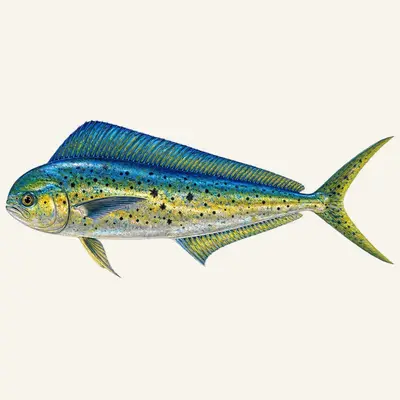
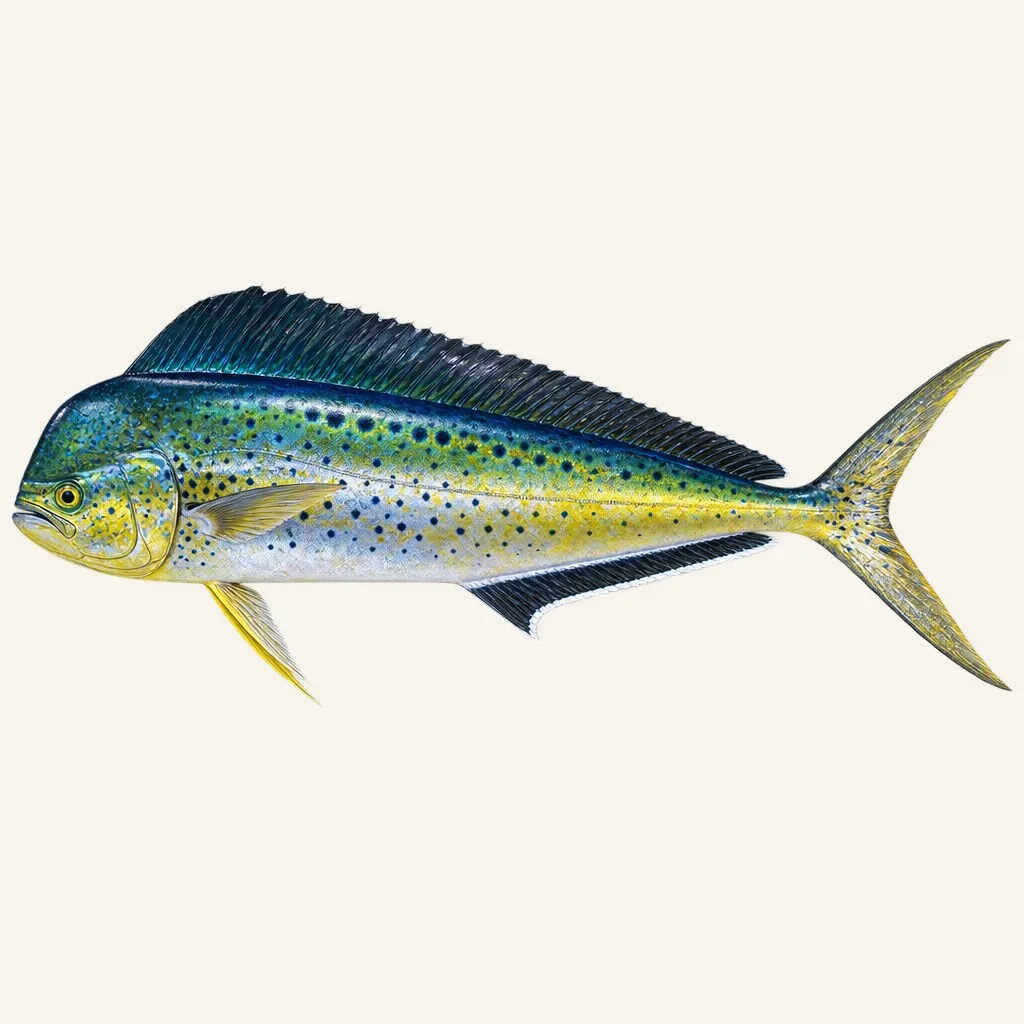
The common dolphinfish, also known as mahi-mahi, is easily recognized by its blunt forehead and long dorsal fin running from head to tail. Its vivid iridescent yellow-green flanks with bluish highlights fade rapidly after death. A fast-swimming pelagic fish of tropical and warm temperate oceans worldwide.
Calendar
Recorded in 78 countries
Angola · Anguilla · Antigua & Barbuda · Australia · Bahamas · Barbados · Bermuda · Brazil · British Indian Ocean Territory · British Virgin Islands · Canada · Cape Verde · Caribbean Netherlands · Cayman Islands · Chile · China · Colombia · Comoros · Costa Rica · Côte d’Ivoire · Croatia · Cuba · Dominica · Dominican Republic · Ecuador · El Salvador · Faroe Islands · France · French Guiana · French Polynesia · French Southern Territories · Gabon · Ghana · Greece · Guadeloupe · Guatemala · Guinea · Guyana · Haiti · India · Indonesia · Israel · Italy · Jamaica · Japan · Lebanon · Liberia · Madagascar · Martinique · Mauritius · Mayotte · Mexico · Mozambique · New Caledonia · Oman · Panama · Peru · Philippines · Portugal · Puerto Rico · Réunion · São Tomé & Príncipe · Seychelles · Sierra Leone · Somalia · South Africa · South Korea · Spain · Suriname · Taiwan · Tanzania · Thailand · U.S. Virgin Islands · United Kingdom · United States · Venezuela · Wallis & Futuna · Yemen
GBIF occurrence records — native and introduced populations combined.
Its range
Tropical and subtropical water in the Atlantic, the Indian Ocean and the Pacific alike, between 21 and 30 degrees.
The lower of those two figures is the one that does the work, and it acts as a season rather than as a wall. An animal whose entire life fits inside a year cannot hold ground through a cold period and wait for it to end. The margins of this range are therefore occupied through the warm months and given up again, and the fish that appear at a high latitude next summer will not be the ones that left this one. At its edges the map is a summer map.
Identifying it
Sex reads off the forehead. Mature males carry a prominent bony crest at the front of the head, which squares the profile off almost vertically; females keep the rounded outline. Few fish advertise their sex as plainly, and this one can be called at a distance, on an animal still alongside the boat. What it does not do is name the species — the smaller dolphinfish builds a crest of its own — so it answers the second question rather than the first.
Body depth answers the first. In an adult of this species the greatest depth stays under a quarter of the standard length: a long fish rather than a deep one, and the difference from its congener is a matter of proportion rather than of any single feature.
The fins run the length of the animal. One dorsal starts above the eye and reaches almost to the tail on 58 to 66 rays, with no spine anywhere in it. The anal fin does the same from the vent back, on 25 to 31 rays, and its leading edge is concave — hollowed out, not bowed. The pectoral is more than half the length of the head. There are 31 vertebrae, and the lateral line carries at least 200 scales.
Colour is the first thing anyone notices and the least reliable thing to identify by, because it does not survive the fish. Alive, the back is metallic blue-green, the sides silver with a golden wash, and a row of dark spots or golden blotches runs below the dorsal with one or two more rows on and below the lateral line. The dorsal and anal are black, the anal edged in white. Within minutes of death all of it collapses to grey with a green tinge.
Breeding
Maturity arrives four to five months after hatching, and three months in captive fish. Very few bony fishes are recorded doing it faster, and every other fact about the species is downstream of that one.
Spawning takes place in the open sea, and probably nearer the coast as water temperature climbs. In East African waters the season may run from March into early June, with release happening inshore. In the western Pacific the sexes are present in roughly equal numbers through the season. In the western Atlantic spawning is spread across an extended period rather than concentrated.
The species also spawns in captivity of its own accord, with no artificial inducement of any kind. Very few marine fish do that, and it confirms how few conditions the mechanism actually requires.
Length at first maturity averages 55.8 cm, recorded from 35 cm to 93.1.
The water it needs
Adults are found in open water and near the coast alike, in schools, between the surface and 85 m but usually in the top five to ten. The tolerated band runs from 21 to 30 degrees, and the fish accepts brackish water.
That double occupation follows from the growth rate. An animal that has to add most of its length inside a single year cannot afford to wait in one kind of water for conditions to improve. It goes where the food is, from the open ocean to the shoreline, and its presence anywhere is rarely durable. A concentration found this week is a poor prediction for next month.
Areas
- Around wrecks and floating objects
- Sargasso weed lines
- Around offshore FADs
- Blue surface waters
Techniques
- Fast surface trolling
- Cast-and-retrieve with colorful lures
- Live bait fishing
- Surface jigging
Baits
- Colorful surface lures
- Small live fish
- Natural squid
- Feathered jigs
What it eats
It eats almost every form of fish there is, plus zooplankton, crustaceans and squid.
The absence of selectivity is not idleness. A predator that reaches breeding size in four months has to convert an enormous quantity of food in a very short time, and refusing anything would be a metabolic error. The diet is broad because the schedule is tight.
How to catch it
Anything adrift will do the concentrating, and the fishery worked that out long before it had a name for it. Bundles of bamboo reeds and planks of cork are the traditional attracting devices, put out to gather the fish before the nets are set. The rest of the catch comes from trolling and from tuna longlines, occasionally from drift nets.
The growth rate is what makes the fishing unusual, and it is worth stating in its practical form. The oldest recorded fish is four years old, and a fish at the common length of the catch has spent months rather than years getting there. There is no reservoir of old individuals to find, no thirty-year specimen anywhere in the population, and the fish on the ground this season were mostly not alive last one.
Two things are decided at the moment of capture. The crest identifies the sex, and the colour is already going: the blue and gold that make the animal recognisable are gone within minutes, so anything to be recorded from the live fish has to be recorded immediately.
Ciguatera poisoning has been reported from this species. Whether it is a concern for a given fish is a local question, and the answer is held locally.
Conservation
The contrast with the other large pelagics is total, and it is instructive. Maturity in four months, spawning spread over a long season, reproduction that works in a tank without help, and a life of four years together produce a stock that rebuilds itself within a season or two.
This is one of the very few heavily fished pelagic species whose biology genuinely absorbs the pressure put on it. A fishery here is working on something closer to an annual crop than to a standing stock, and the year-to-year swings that follow are a property of the animal rather than a symptom.
Which moves the question elsewhere. What deserves watching is not the headcount but the attracting devices, because a floating structure gathers everything that answers to floating structure — including juveniles of species that cannot replace themselves in a year, and including animals nobody was fishing for. The device is neutral about what it assembles.
Regulations
Check the local regulations in force (legal size limits, closed seasons, bag limits).
For guidance only. Legal sizes, quotas and open seasons vary by location and season: always check the local regulations in force before fishing.
Other names
Common dolphinfish is the formal English name and mahi-mahi, borrowed from Hawaiian, is the one on the menu. The reason for that substitution is straightforward: the older English name for the fish was simply dolphin, and a restaurant cannot sell dolphin without answering a question about mammals. Mahi-mahi solved a marketing problem, and it has since spread into general use.
The name is not species-specific, though. It covers this fish and its smaller relative without distinction, so a fillet sold under it says nothing about which of the two it came from. Dorado in Spanish and lampuga in Italian have the same breadth.
The scientific name is older than any of that. Coryphaena comes from the Greek for a crest — the bony one on the male's head — and hippurus means horse-tailed.
Sources: fishbase.se · api.gbif.org