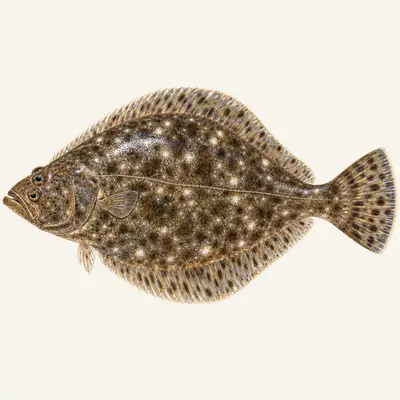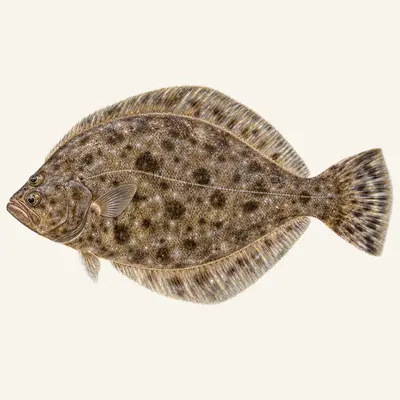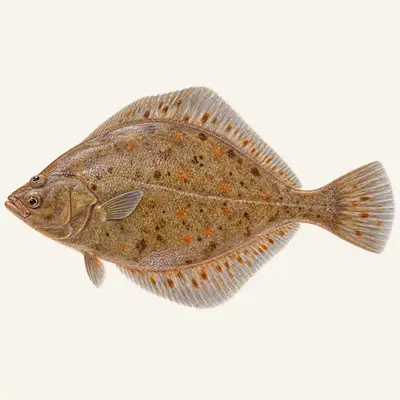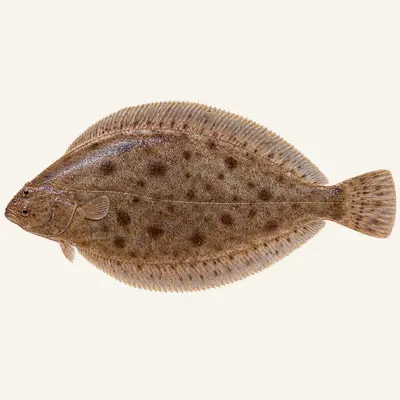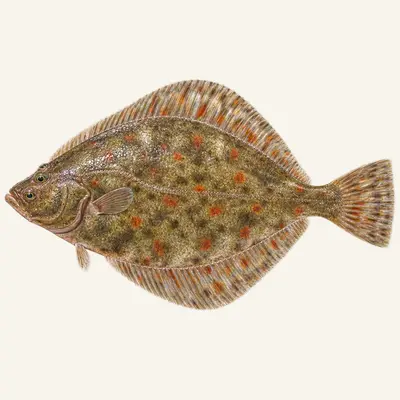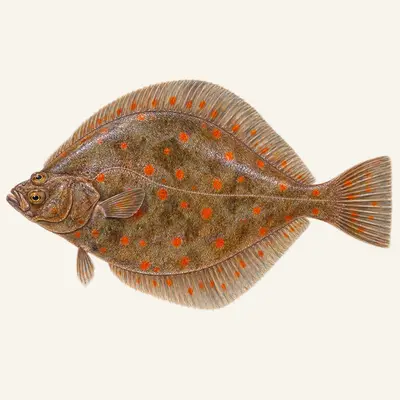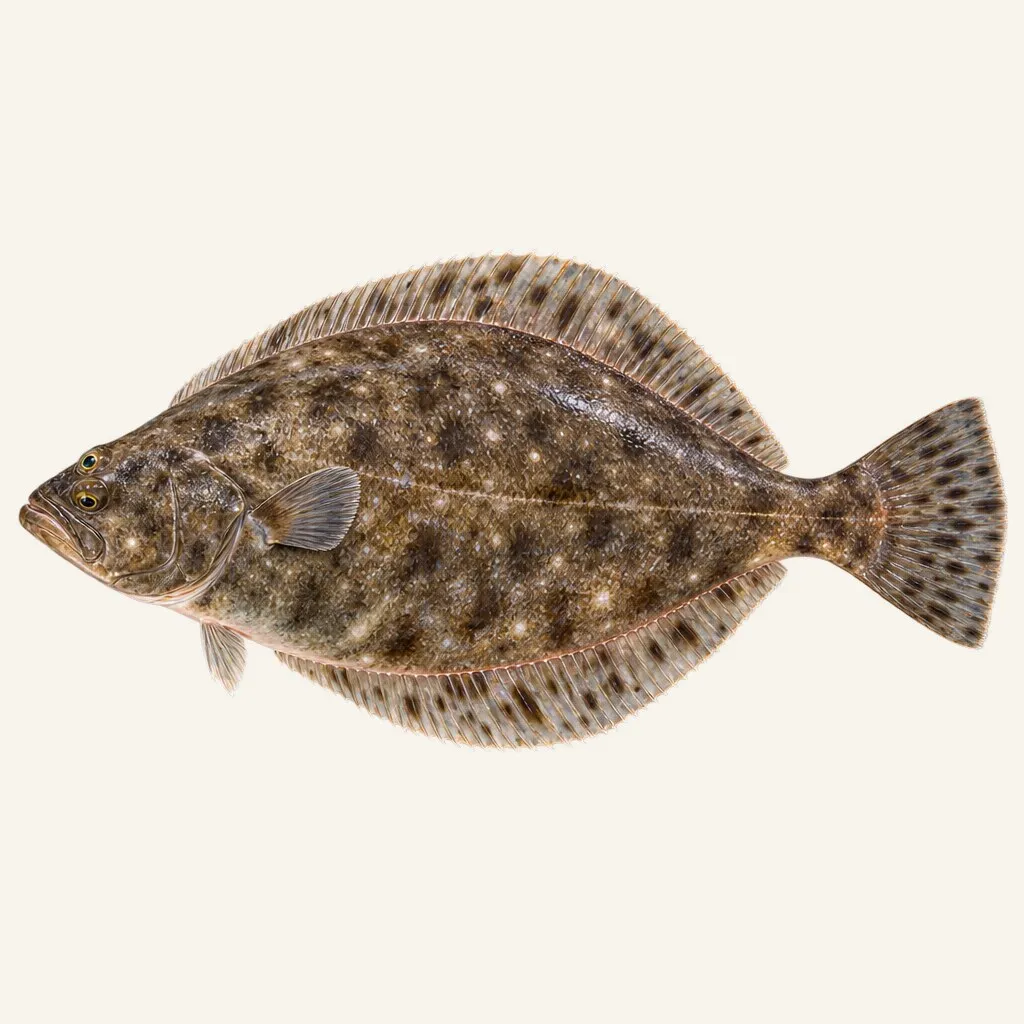
California Halibut
Paralichthys californicus · Paralichthyidae
- Saltwater
- Flatfish
- Medium
- Size
50–152 cm
- Weight
1.3–33 kg
- Lifespan
30 years
- Depth
0–183 m
Where to fish
- Estuary
- Beach
Habitat icons: Flaticon
Large predatory flatfish of the North American Pacific coast, prized for its fine flesh and energetic fight.
Calendar
Recorded in 2 countries
GBIF occurrence records — native and introduced populations combined.
Its range
From the Quillayute River in northern Washington to southern Baja California, with a separate presence in the northern Gulf of California.
That last population is the one to stop on. The northern Gulf is a hot, enclosed inland sea. Finding there a species whose main range reaches the Pacific North-West indicates a thermal amplitude far wider than a coastal map suggests, and it is the strongest thing in the file about what this animal will tolerate.
Twenty-four degrees of latitude separate the two ends. The range is long, narrow and carried by a single coastline.
Breeding
A female spawns 12 or 13 times a year, at intervals of 7 to 14 days. That is not a spawning season, it is a regime, and it occupies a large part of the calendar.
The technical detail behind it has practical consequences. Fecundity is indeterminate and ovarian development asynchronous: the oocytes do not ripen in a single wave, so a season's total cannot be read off one ovary sampled once. The output of this animal is estimated over time, never counted.
Pairing is distinct — a formed pair rather than a crowd over a piece of ground.
Maturity settles around 47.3 cm, in a tight bracket of 47 to 51.3, which is late for the genus. Spawning then brings the adults inshore: they move up into shallow water to do it.
The water it needs
Sand, near the shore. Adults hold coastal sand bottoms, and the useful band runs from the surface down to 60 m even though the species is recorded to 183.
Three ages occupy three separate places. Larvae settle in bays and estuaries, juveniles hold beyond the surf line, adults the coastal sand. An enclosed bay can therefore carry an entire nursery without ever producing a large fish, and the sand where the adults lie shelters no juveniles at all. Prospecting one of the three tells you nothing about the other two.
Areas
- Southern California
- San Francisco Bay
- Baja California coast (Mexico)
- Sheltered estuaries and bays
- Surf zone beaches
Techniques
- Soft plastic lures on a jig head
- Slow bottom drifting
- Live bait fishing (anchovy, sardine)
- Bottom-bouncing cast and retrieve
- Jigging
Baits
- Live anchovy
- Sardine
- Soft plastic lures (grub, swimbait)
- Squid strips
- Small baitfish
What it eats
Three elements of a single sentence change the fishing: the adult hunts by day, it takes squid, and it does so often well off the bottom.
A flatfish leaving the bottom to hunt in the water column is not an occasional curiosity in this species; it is the ordinary method. Squid in particular cannot be taken by an animal lying under a film of sand.
Daytime activity completes the picture, and it is uncommon among bottom predators, most of which work the dark.
How to catch it
The consequence is immediate. This fish is caught between the bottom and mid-water rather than on the bottom. A worked lure, a live bait on the drift, a jig lifted clear of the sand — everything that operates above the substrate is in play, where other flatfishes insist on a bait dragged in contact with it.
Coastal sand is the ground to look for, and the first sixty metres are enough of it. Spawning also brings the adults up into shallow water, which puts fish that otherwise hold offshore within reach of the shore for part of the year.
Then the teeth. The species is recorded as a biter and classed as traumatogenic: it cuts if it is handled without care. Pliers, a grip behind the head, and nothing in the mouth.
Conservation
Thirty years of life against maturity at 47 cm makes this a slow animal. It has nothing in common on that point with its two Atlantic congeners, which breed from around 28 to 35 cm and do not see nine years.
What follows is that any fish caught belongs to a stock accumulated over decades, and a missing year class stays legible in it for a long time afterwards. A population 30 years deep does not repair itself inside the life of a management plan.
The mixed fishery adds its share. This is simultaneously a major sport fish and a commercial catch taken in trammel nets, a gear that sorts neither species nor size.
Then the nurseries. Larvae in the bays, juveniles behind the surf line: reproduction depends on bays and estuaries, which are the most heavily developed sectors of this coast, and the dependence is invisible from the ground where the adults are caught.
Regulations
Minimum size limit and bag limits apply in California (about 56 cm / 22 in); always check local regulations.
For guidance only. Legal sizes, quotas and open seasons vary by location and season: always check the local regulations in force before fishing.
Other names
California halibut is a borrowed name, and the loan does damage here. The true halibuts are Hippoglossus, and one of them — the Pacific halibut — works the same seaboard further north. Two fish on one coast under one word, in different families, at different depths, on different diets.
Spanish reaches for a third family again: lenguado de California files the animal with the soles. Between the two languages the same fish is called after a halibut and after a sole, and it is neither.
The genus name is built from para, beside, and ichthys, fish — which at least commits to nothing.
Sources: fishbase.se · api.gbif.org