Cobia
Rachycentron canadum · Rachycentridae
- Saltwater
- Coastal
- Medium
- Size
110–200 cm
- Weight
11–68 kg
- Lifespan
15 years
- Water temp.
17–32 °C
- Depth
0–1,200 m
Where to fish
- Rocky shore
- Offshore
Habitat icons: Flaticon
Cobia - pelagic species found in tropical waters worldwide.
Calendar
Recorded in 21 countries
Australia · Cameroon · Colombia · Congo - Brazzaville · Côte d’Ivoire · Equatorial Guinea · Gabon · Ghana · Guinea · Guinea-Bissau · India · Indonesia · Japan · Liberia · Mexico · Mozambique · Nigeria · Puerto Rico · Senegal · Sierra Leone · United States
GBIF occurrence records — native and introduced populations combined.
Its range
Tropical and subtropical water worldwide, with one large and clean absence: the eastern Pacific, and the Pacific Plate, which it reaches only marginally. A species that circles the globe and skips an entire ocean margin is describing a barrier, not a gap in the sampling.
Elsewhere it is continuous. The western Atlantic from Canada and Bermuda, and from Massachusetts, down to Argentina, taking in the Gulf of Mexico and the whole Caribbean. The eastern Atlantic from Morocco to South Africa. The Indo-West Pacific from East Africa and from Hokkaido in northern Japan through to Australia.
The northern names on that list — Canada, Hokkaido — sit at the cold edge of a 17-degree floor, and belong to the margins of the range rather than to its body.
Identifying it
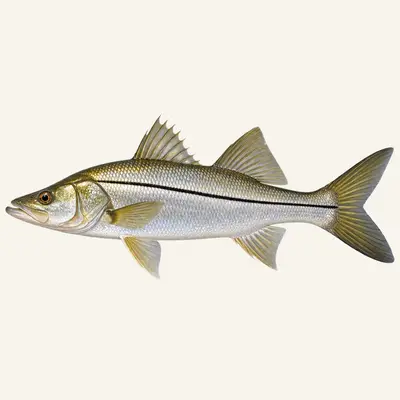
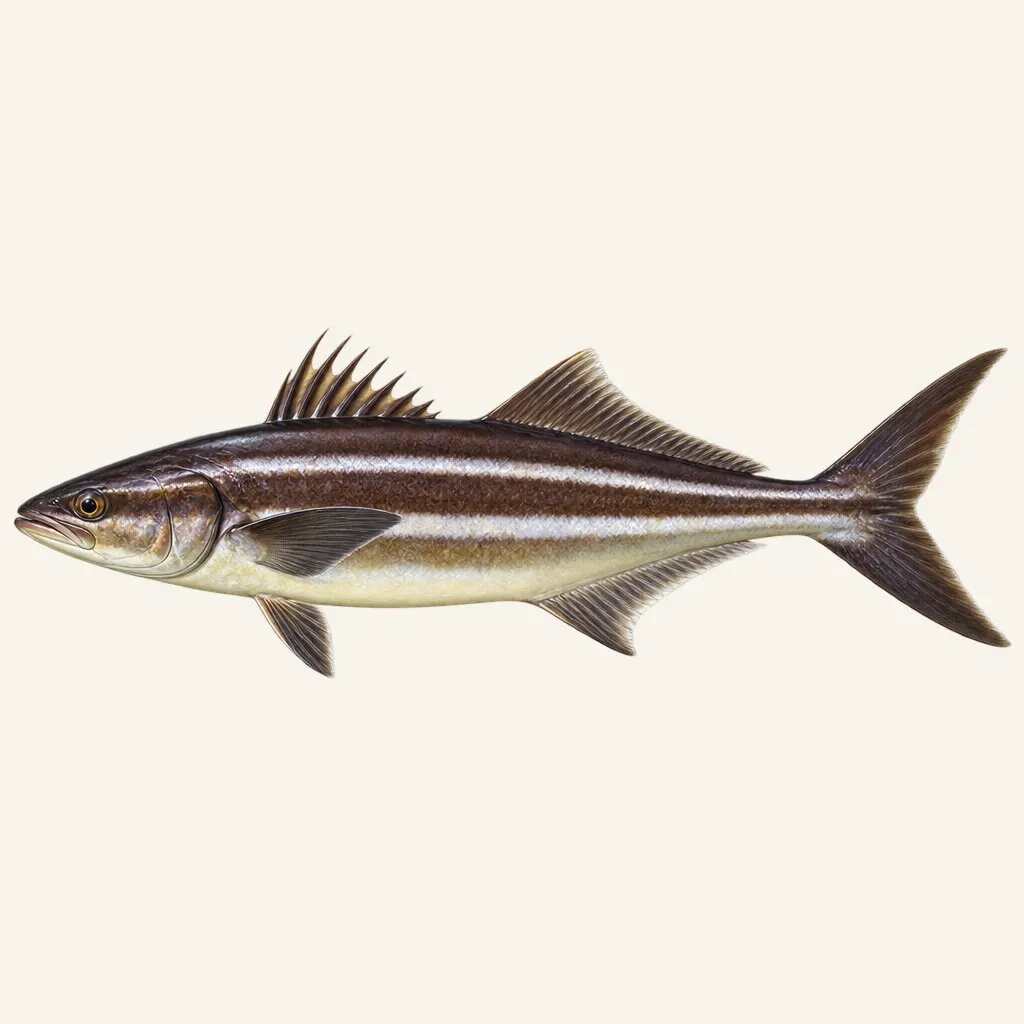
The first dorsal is not really a fin. It is a row of eight short, strong spines standing separately along the back, with no membrane joining them — usually eight, within a count of seven to nine — so what the profile shows is a line of individual points rather than a triangle of fin. Nothing about a fish in the water is easier to check.
The head is broad and flattened from above. The two narrow silvery bands running the length of the dark brown back and sides are sharply defined, and the belly is yellowish.
The tail changes shape with age, which catches people out. In an adult it is lunate to emarginate, with the upper lobe longer than the lower. In a young fish it is rounded, and its central rays are drawn out into a prolongation. A juvenile and an adult of this species do not have the same silhouette from behind.
Behind the spines, 26 to 33 soft rays in the second dorsal; two or three spines and 22 to 28 rays in the anal.
The general outline suggests a shark, and several of the English names were built on that impression. The isolated spines and the lunate tail settle it immediately.
Breeding
The species forms spawning aggregations during the warm months in the western Atlantic, and both the eggs and the larvae are planktonic.
That combination is worth taking apart. A fish that lives dispersed against scattered objects has a problem no schooling species has: finding another of its kind at the right moment. The aggregation solves it, at the cost of putting a normally solitary animal into one place at a predictable time of year. What follows is entirely hands-off — eggs and larvae go into the plankton, with no site, no substrate and no attendance.
Maturity is recorded from 43 cm, in an animal whose common length is 110 and whose maximum reported age is 15 years.
The water it needs
The list of grounds is longer than almost any comparable fish gets, and it is worth reading as a list: mud, sand and gravel bottoms; coral reefs; rocky shores; mangrove sloughs; inshore around pilings and buoys; offshore around drifting and stationary objects; and estuaries on occasion. The depth column runs to 1,200 m and the thermal band from 17 to 32 degrees.
One thing joins all of it. Every item on that list is a vertical structure or an interruption in an otherwise uniform space. This fish holds against something — a piling, a buoy, a wreck, a floating log, a reef edge — and that attachment to objects is what organises everything about finding it.
A note on what the record does not say. It describes the species around objects, drifting or fixed, and does not mention it accompanying large animals. English-speaking anglers will expect that part of the story; it is not in the published account consulted here, and it is not asserted on this page.
It forms small groups and will chase small pelagic fish inshore.
Areas
- Offshore wrecks and structures
- Coastal pelagic zones
- Deep passes and channels
- Buoys and floating aggregations
Techniques
- Live bait fishing at surface
- Soft lures and jigs
- Coastal trolling
- Wreck and structure fishing
Baits
- Live fish
- Shrimp
- Crabs
- Squid
What it eats
Crustaceans, crabs included, along with small fishes and squid.
Crabs are the informative entry. A fish that takes them is working the bottom or the structure it is holding against, not the open water above it, and that fits the whole habitat description rather than sitting oddly beside it. The diet is a bottom and structure diet carried by an animal with a pelagic outline.
How to catch it
The record contains one sentence that decides how this fishery works: it is caught in small quantities because of its solitary behaviour. This is not a species taken in numbers from a mark. It is one fish at a time, against one object, and a day's fishing is a series of separate encounters rather than a session on a shoal.
The objects are therefore the plan. A cobia is looked for on or close to a structure and never in open water with nothing in it, and moving between structures is the method rather than a way of filling time between them.
The gear is simple by the standards of the size involved. Handlines, and trolling pelagically offshore over the continental shelf, are what the record gives. Nothing in that requires the fish to be deep, and much of what is caught is caught near the surface next to something floating.
The diet points the bait, and the crabs point it somewhere unexpected for a fish of this profile: crustacean imitations belong in the box alongside the fish imitations, and the crab is the entry most anglers under-use.
Conservation
Two mechanisms bear on this species and both come from its habits rather than from its numbers.
The first is the spawning aggregation. An animal that spends the year scattered across an enormous range in ones and twos gathers, at a predictable season and in predictable places, into the only concentration it ever forms. Everything that is difficult to catch for eleven months is available at once, and a fishery that finds the aggregation is fishing the whole local stock rather than a sample of it.
The second is the fidelity to structures. A fish that holds against pilings and buoys is reachable from the infrastructure itself, without a boat and often without anyone recording it. That effort is diffuse, cheap and very hard to measure, which is a different problem from a fleet with a licence.
The species is also farmed commercially in marine systems. That has an effect worth naming: when a fish is both farmed and caught, the market stops depending on the wild stock, and landings can fall a long way without demand falling with them. A price signal that would otherwise flag a decline stops working.
Regulations
Check the local regulations in force (legal size limits, closed seasons, bag limits).
For guidance only. Legal sizes, quotas and open seasons vary by location and season: always check the local regulations in force before fishing.
Other names
Cobia in five of the six languages on this page — French, English, Spanish, German and Italian all use the same word, which is unusual enough to be worth noticing. Brazilian Portuguese is the exception with bijupirá.
English keeps two alternatives, and both were coined by looking at the fish. Black kingfish takes the colour, and sergeant fish takes the pair of silvery stripes along the flank for a rank badge. Behind them sits the shark-like outline that made the resemblance obvious to everyone who saw one at the surface.
Rachycentron joins the Greek for a spine and for a sting or point, which names the row of isolated dorsal spines exactly. The epithet canadum means of Canada, which sits oddly on a fish of tropical and subtropical seas — though the range does reach Canada at its northern edge, the coldest corner of an otherwise warm-water distribution.
The species is the only member of its family, and that is the practical reason nothing else really looks like it.
Sources: fishbase.se · api.gbif.org