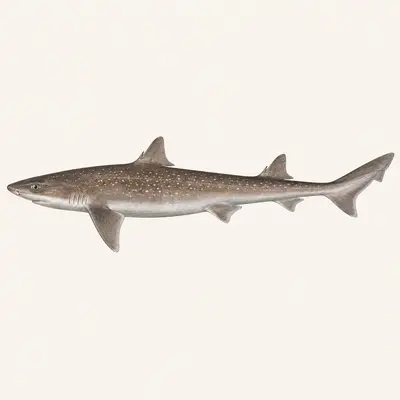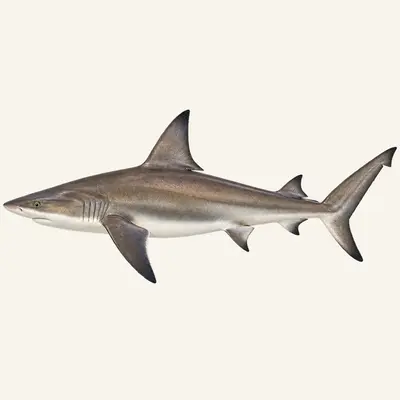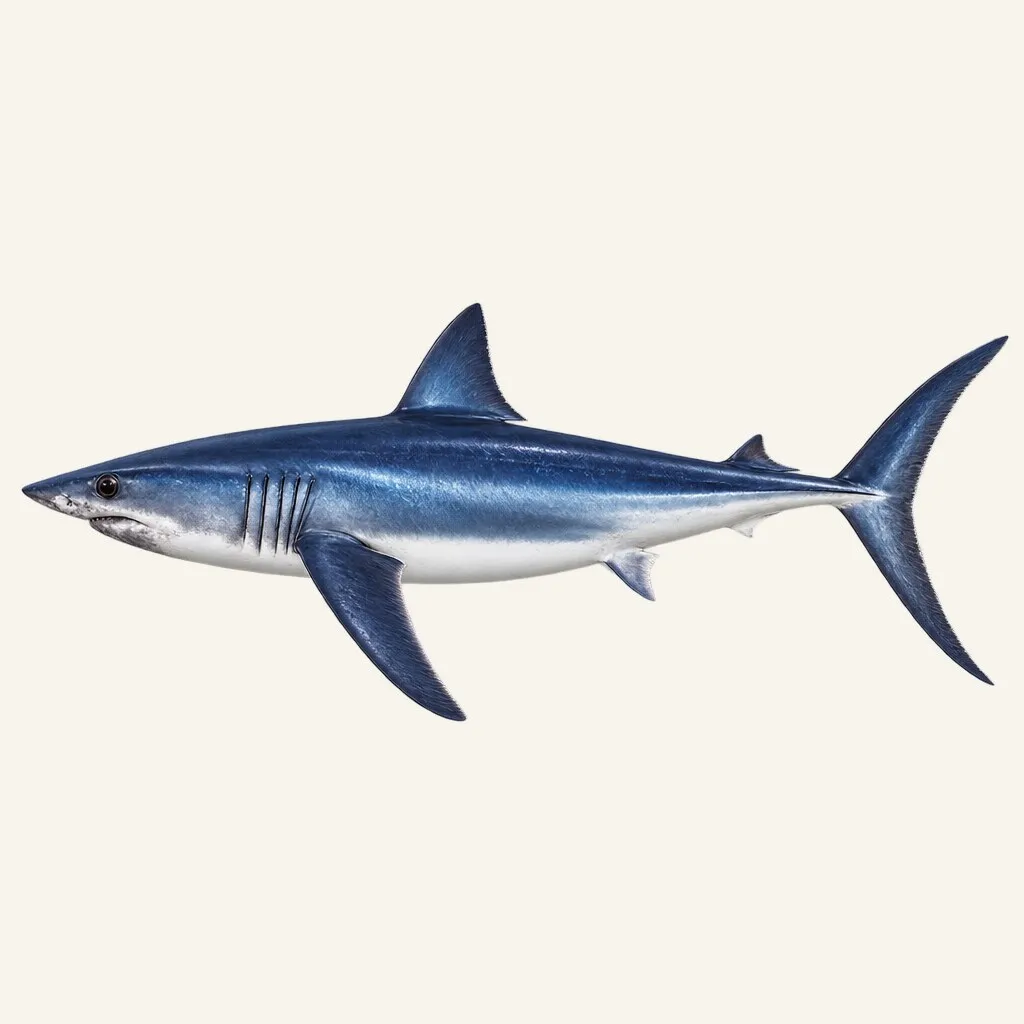
Longfin mako
Isurus paucus · Lamnidae
- Saltwater
- Sharks & rays
- Hard
- Protected
- Regulated
- Dangerous
- Size
200–427 cm
- Weight
92 kg
- Depth
0–1,752 m
Where to fish
- Offshore
Habitat icons: Flaticon
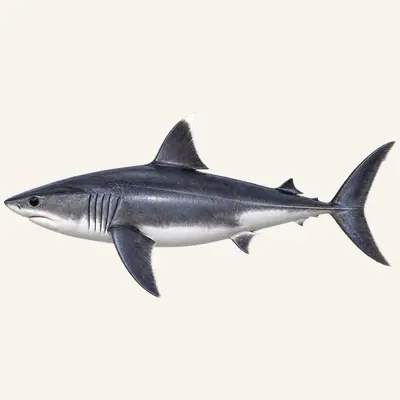
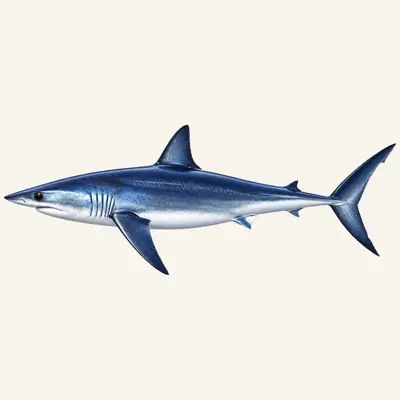
The longfin mako shark is a slender, pelagic shark with characteristically long, narrow pectoral fins that set it apart from the shortfin mako. A fast predator of deep and offshore waters, it hunts squid and pelagic fish.
Calendar
Recorded in 19 countries
Australia · Bahamas · Brazil · Canada · Chile · Colombia · Faroe Islands · French Southern Territories · India · Indonesia · Japan · New Caledonia · Portugal · Réunion · South Africa · Sri Lanka · Taiwan · United Kingdom · United States
GBIF occurrence records — native and introduced populations combined.
Its range
The known range is not a range: it is a list of points. The Gulf Stream and Florida, Cuba, southern Brazil, Guinea, Ghana, Madagascar, Taiwan, the vicinity of Phoenix Island, north of Hawaii.
Those localities cover three oceans without drawing any continuity, and the gaps between them do not measure the animal's distribution but the scarcity of the observations. An epipelagic shark that descends to 1,752 m, in a band running from 46°N to 38°S, is almost never met except by chance.
Identifying it
The pectorals rule. They equal the length of the head and often exceed it, and their tips stay broad in the young as well as in the adult. This is the only member of the genus in that case.
The snout follows. It is narrowly to bluntly pointed, rarely truly acute, where its relative carries a drawn-out spike. The cusps of the front teeth, upper and lower alike, are straighter, and their tips are not turned backwards.
The colour pattern adds a third sign, and it is the quickest to read on a fish at the boat. The back is dark blue and the belly white, but the underside of the snout and the area around the mouth carry dusky mottling. That zone is immaculate in the shortfin mako.
The tail is lunate with a very long lower lobe. Maximum recorded length is 4.27 m, with 4.17 for a measured female and 2 m for an ordinary individual.
Breeding
The litter runs to two or eight pups, and two is the figure most often reported. Once the yolk is exhausted, the embryos consume the ova the mother continues to release.
Newborns measure 97 to 120 cm. That is close to twice the birth length of the shortfin mako, from a female that matures smaller — around 2.16 m, within a bracket of 2.05 to 2.28. The species therefore concentrates a very large investment on very few offspring, and the two pups it usually produces are already a metre long when they leave her.
Reproduction here too involves a pairing in which the partners embrace. Females are supposed to approach land to give birth, though the point has never been established.
Areas
- Deep tropical high seas
- Blue pelagic waters
- Subtropical offshore zones
- Warm oceanic trenches
Techniques
- Deep offshore trolling
- Pelagic live bait fishing
- High-seas chumming and drifting
- Fast offshore lures
Baits
- Mackerel
- Bonito
- Squid
- Tunas
- Pelagic fish
What it eats
Stomach contents are too few to settle the question. The presumed diet pairs schooling fishes with pelagic cephalopods, inferred from the morphology and the habitat rather than from direct observation.
Protected — Sensitive or protected species depending on area: check local rules before taking action.
Regulated — Often governed by quotas, size limits, seasons, or reporting rules.
Dangerous — Risky handling: gear, release, and safety practices must be adapted.
Conservation · Endangered (IUCN) — This species is threatened with extinction. Always release it (no-kill), handle it with the utmost care and check local rules — fishing for it may be prohibited.
Conservation
A litter of two cannot be made up. That is what exposes the species to a level of removal other sharks of comparable size would absorb without harm.
The decline attributed to it has in fact never been counted: it is inferred from the level of exploitation, actual or potential, for want of the population monitoring that does not exist for an animal encountered this rarely. The species is managed on an estimate of what is probably happening to it.
Its value is concentrated at the extremities. The meat is of lower quality than the shortfin mako's, but adult fins fetch high prices and the jaws are highly prized, with skin and cartilage completing the list. A shark whose price lies in its fins is taken even when the carcass is worth nothing.
The practical difficulty lies elsewhere again. The two makos resemble each other closely enough to be confused once landed and cut up, which blurs the statistics for both. What is recorded as one species may be the other, and neither figure can be trusted to describe what was actually taken.
Regulations
Check the local regulations in force (legal size limits, closed seasons, bag limits).
For guidance only. Legal sizes, quotas and open seasons vary by location and season: always check the local regulations in force before fishing.
Other names
Longfin mako in English, named from the pectorals, and French uses mako longimane to the same effect. The adjective stands term for term against the shortfin of its relative, so both languages name the animal by the one character visible at a distance. Its size and its dentition place it among the potentially dangerous species.
Sources: fishbase.se · api.gbif.org