Opah
Lampris guttatus · Lampridae
- Saltwater
- Big pelagics
- Hard
- Size
101 cm
- Weight
270 kg
- Depth
0–200 m
Where to fish
- Offshore
Habitat icons: Flaticon
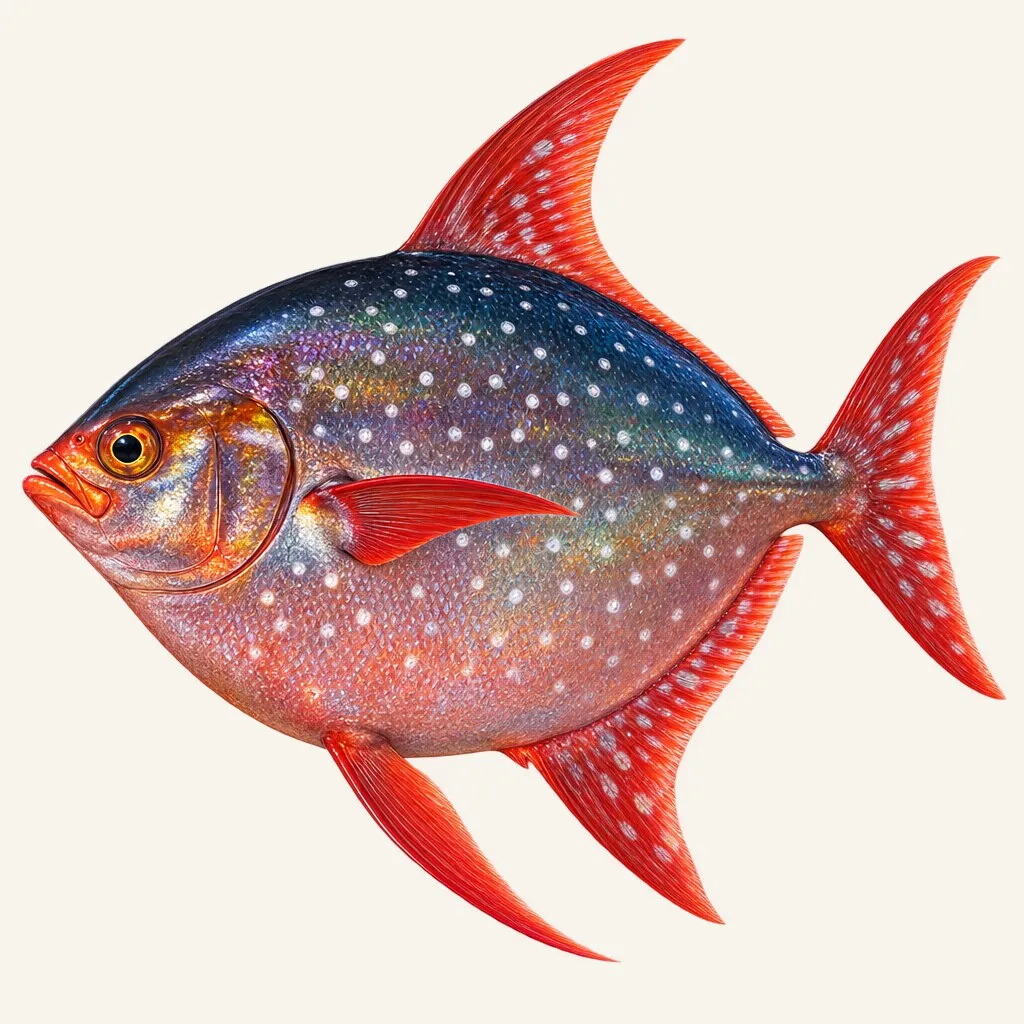
The opah or moonfish (Lampris guttatus) is a large deep-pelagic fish with a strongly compressed oval body covered in blue-grey skin dotted with white spots, brilliant red fins, and a silvery-pink belly. The sole member of the Lampridae, it is one of the very few endothermic fish, able to maintain a body temperature warmer than the surrounding water.
Calendar
Recorded in 4 countries
Australia · Chile · Ireland · New Zealand
GBIF occurrence records — native and introduced populations combined.
Its range
The North Atlantic, the Irish Sea, the North Sea and the Mediterranean included.
The record contradicts itself here, and the contradiction is informative. Alongside that North Atlantic distribution, the same source carries an environmental span running from 75 degrees north to 60 degrees south across all longitudes — a global range and a regional one, in the same entry.
A 2018 taxonomic review is what separates them. That paper reviewed this species and described three new species out of it, which means the worldwide range recorded earlier belonged to several animals and the name now applies to the North Atlantic fraction. The global figures are a residue of the older, broader usage. Any opah reported from another ocean before that work may well be one of the fishes since removed from this name, and the incompatible length and weight in the size record are the same artefact seen from another angle: measurements of different species, filed together.
Identifying it
Colour does the work here, which is rare enough to be worth saying. The back is a dark steely blue shading into green, shot through with silver and purple iridescence; the belly is rosy; the whole body is covered with silvery spots set in irregular rows. The caudal and dorsal fins carry a light mottling, the fins and the jaws are vermillion, and there is gold around the eye. Those spots are what the species is named for.
The fins carry the rest of the identification. The caudal is broadly lunate. The pectorals are long and falcate. And the pelvic fins are built to the same shape as the pectorals and are slightly longer than them — a fish with two matched pairs of long curved fins rather than one pair of paddles and one pair of stabilisers.
The body is deep and laterally compressed. There are no spines: 48 to 55 soft rays in the dorsal, 33 to 41 in the anal, over 43 vertebrae.
Nothing usable is published on size at maturity. The length and weight given as maxima cannot describe the same animal — the two figures are incompatible by an order of magnitude — and the reason for that is taken up below.
Breeding
One word is the whole of the published record: the species probably spawns in the spring.
Probably. There is no fecundity figure, no length at first maturity, no spawning site and no confirmed season. That is unusual for a fish of this size and market value, and the reason is partly the one set out below — for most of the time this name has been in use, it has not been attached to a single animal, so nothing observed under it can be assigned with confidence.
The water it needs
Oceanic, epipelagic and mesopelagic, recorded from the surface to 200 m, and apparently solitary.
That last word governs everything else. A solitary open-ocean fish is not found by locating an aggregation, because there is no aggregation to locate; encounters with this species are one at a time. The published note that it turns up occasionally as by-catch in tuna fisheries follows directly from it — that is how most of them are seen, one fish at a time, by boats fishing for something else.
Areas
- Deep open sea offshore
- Cold water upwelling zones
- Underwater canyons
- Pelagic seamounts
Techniques
- Deep jigging
- Deep live bait fishing
- Pelagic longlining
- Deep trolling
Baits
- Heavy deep jig
- Natural squid
- Pelagic live bait (mackerel)
- Large soft lure
What it eats
Midwater fishes and invertebrates, squid above all.
The diet places the animal in the layer its habitat description already suggests, hunting prey that lives away from the surface and away from the bottom. Squid as the staple of a large deep-bodied fish is a hunting problem rather than a grazing one: a single prey item, taken deliberately, in water without cover for either party.
How to catch it
The propulsion is the fact to build on. This fish swims by flapping its pectoral fins.
That is a genuine departure from the way almost everything else in open water moves. A tuna or a marlin drives from the tail and uses the pectorals to steer; this animal rows, and the long falcate pectorals with their matching pelvic pair are the apparatus for it. It explains the shape — a deep, flat body with the fins mounted well forward is a hull built for a rowed stroke rather than for a tail-beat — and it sets expectations for how a hooked fish will behave, since a rowing animal is not built for the straight-line sprint that a tail-driven one opens with.
Beyond that, the fishing is incidental by nature. The species is a minor commercial catch and a recognised gamefish, and it is taken occasionally as by-catch in tuna fisheries: solitary, mesopelagic, and not the target of any directed effort.
It is rated a good food fish, marketed fresh and frozen, and prepared as sashimi. A fish that comes up will be kept, which is the ordinary consequence of a species nobody is looking for having a value once it arrives.
Conservation
Nothing documented presses on this species, and the useful thing to say is about the accounting rather than the animal.
The name was redefined in 2018. Every landing series, every survey and every published measurement compiled before then describes a group of fishes rather than this one, so there is no usable history for the animal now called by this name. A change in the North Atlantic fraction over the last few decades could not be recovered from the figures, because the figures were never kept separately.
The solitary habit adds a second constraint of the same kind. A species that occurs one fish at a time cannot be surveyed by finding concentrations of it, and it reaches the record mainly as an incidental capture in a fishery aimed elsewhere — which makes its apparent abundance a function of how much tuna fishing is going on rather than of how many opah there are.
Regulations
Check the local regulations in force (legal size limits, closed seasons, bag limits).
For guidance only. Legal sizes, quotas and open seasons vary by location and season: always check the local regulations in force before fishing.
Other names
Opah in English. Moonfish is also used, though that word is attached to several unrelated fishes and settles nothing on its own.
The epithet guttatus means spotted, for the silvery spots in their irregular rows, and it is the one part of the name that has never been in doubt. The species sits in the Lampridae, within the order Lampridiformes — a small group with no close resemblance to the tunas and billfishes it is caught alongside.
The name itself is the thing to be careful with, for the reason given under distribution: an opah in a paper from before 2018 is not necessarily this species, and the identification has to be recovered from the ocean it was caught in rather than from the binomial.
Sources: fishbase.se · api.gbif.org