Atlantic bluefin tuna
Thunnus thynnus · Scombridae
- Saltwater
- Big pelagics
- Medium
- Regulated
- Size
200–458 cm
- Weight
113–684 kg
- Lifespan
32 years
- Water temp.
3–30 °C
- Depth
0–985 m
Where to fish
- Offshore
Habitat icons: Flaticon
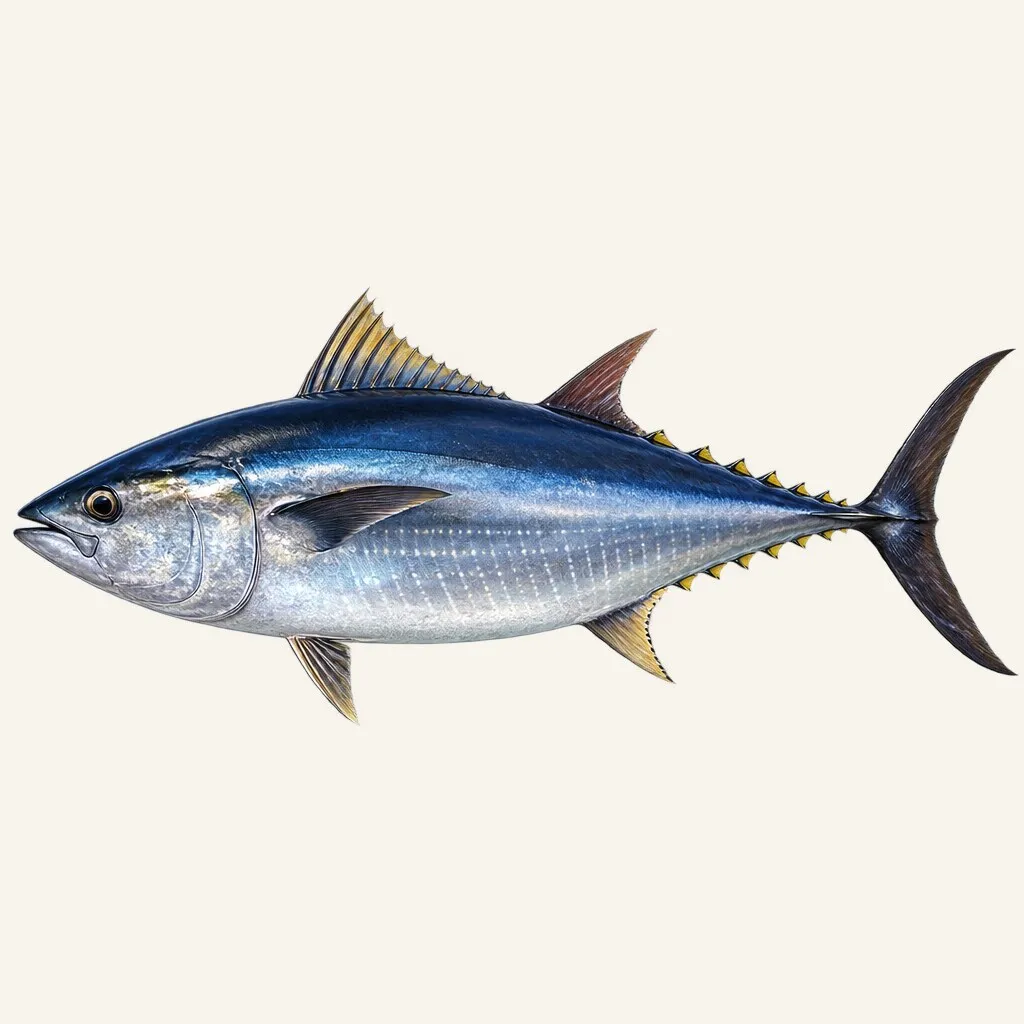
Atlantic bluefin tuna - a powerful, highly migratory pelagic predator and one of the largest of all tunas.
Calendar
Recorded in 14 countries
Bahamas · Canada · Cuba · Denmark · France · Italy · Mexico · Netherlands · Norway · Portugal · Spain · Sweden · United Kingdom · United States
GBIF occurrence records — native and introduced populations combined.
Its range
What the range really describes is a thermal tolerance of 3 to 30 degrees, and no other tuna spans anything like it. It takes in the Lofoten Islands at one end and tropical spawning water at the other, and the physiology permitting both is the same: this animal holds its swimming muscle above the temperature of the sea around it instead of matching it.
The two limbs of the range are therefore not two ranges but two feeding arcs hung off one capability. A separate subpopulation persists off South Africa, well outside either of them, and there are records from Mauritania.
Identifying it
The pectoral fin is short — under 80 per cent of head length — and on a tuna that is the character which closes the file. An albacore's pectorals run to a third of the body and beyond; a small bigeye's are nearly as long. Nothing else in the genus puts a stubby pectoral on that much bulk through the shoulders.
The body carries its greatest depth near the middle of the first dorsal base, and the second dorsal stands taller than the first. Below the lateral line the flank turns silvery white and takes a pale pattern of colourless bars alternating with rows of colourless dots, printed on the lower half of the animal and nowhere above it.
Fin colour makes a set worth memorising. First dorsal yellow or bluish, second reddish-brown, anal and finlets a dull yellow rimmed with black. The median caudal keel is black in an adult, and that one detail separates this fish from the southern bluefin, whose keel is yellow.
The counts, if it comes to counts: 12 to 14 dorsal spines, 13 to 15 soft rays behind them, 13 to 16 rays in the anal, 39 vertebrae, and a swim bladder present.
Past roughly 200 kg none of this is needed. The published records disagree with one another at the top end, and every one of them puts the species beyond any other scombrid; in the Atlantic a tuna of that mass has no rival for the identification.
Breeding
Fish go back to the ground they came from. Spawning concentrates in the Gulf of Mexico and in the Mediterranean, and tagging shows individuals rejoining one or the other according to their origin, that fidelity settling in once maturity is reached.
The consequence runs past biology into management. Two populations that share an ocean to feed and never mix to breed are two stocks. They rebuild separately, and good condition in one does nothing about a collapse in the other.
They do not even run at the same rate. A female over 205 cm fork length averages 30 to 60 million eggs in the west against 13 to 15 million in the east — a factor of three inside one species.
Spawning is done in batches, at intervals of one to two days in the Mediterranean, from June to August, in surface water of 22.5 to 25.5 degrees. The Gulf of Mexico runs a little warmer, to 27.5.
Development is documented closely. The egg measures 1.0 mm, goes straight into the water column and hatches in two days; at 24 degrees the embryo takes about 32 hours and the larval stage about 30 days. A larva is 2.8 mm at hatching.
Mature fish and larvae have both turned up a long way from either ground, around the Bahamas and in the central North Atlantic. Other spawning areas are therefore in use, and the inventory of them is not closed.
Maturity arrives at about 103 cm, within a range of 97 to 110. That is less than a quarter of the maximum length.
The water it needs
Recorded depths reach 985 m; the working range is the top hundred. The fish is oceanic for most of the year and closes on the coast seasonally.
Membership of a shoal is decided by dimensions rather than by relatedness. One group may hold this species alongside albacore, yellowfin, bigeye and skipjack, provided all of them are of comparable build. Size class is the criterion, which is why locating a shoal tells an angler what weight of fish is under the boat before it tells him what kind.
Areas
- Open sea and offshore areas
- Upwelling zones
- Offshore seamount edges
- Straits and migratory passages
Techniques
- Offshore trolling
- Live bait (mackerel)
- Vertical heavy jigging
- Surface popping
Baits
- Live mackerel
- Natural squid
- Large trolling lures
- Artificial flat fish lures
What it eats
It hunts by sight, and the precision matters: a visual predator is tied to the lit layer and to the hours when prey can be picked out against it.
What it takes moves in numbers — anchovies, sauries and hakes among the small schooling fishes, with squid and red crabs alongside. A hunter that works in a group feeds on animals that assemble in one.
How to catch it
Growth is the fact that ought to govern every decision taken over a large fish. A juvenile puts on about 30 cm a year, which is already slower than the other tunas and the billfishes manage. After maturity the rate collapses: roughly ten years are needed to cover two thirds of the maximum length, and the species lives to 32 years, to 40 in the western Atlantic.
A bluefin over two metres is therefore not a fish that grew well. It is an old fish, and there is no accelerated version of one.
The rest follows from sight and from the shoal. Surface indications — working birds, bait balled at the top, a current line — identify a size class as much as a species, because the shoal has already sorted itself by build. Finding small fish does not lead to large ones.
Access to this fishery is managed internationally wherever it is prosecuted, and the conditions attached to it are read with the competent authority before the boat leaves.
Regulated — Often governed by quotas, size limits, seasons, or reporting rules.
Conservation
This is the one large pelagic whose collapse and partial recovery are both documented at ocean scale. Heavy overfishing had made the fish scarce across much of its range. The international management that followed produced a measurable rebuild in both stocks, and the global verdict was revised upward in January 2021 after three decades pointing the other way.
That result does not transfer between stocks. Natal fidelity means the western and the eastern populations have to be rebuilt separately, and the threefold gap in eggs per large female means the same reduction in effort does not buy the same response on both sides of the ocean.
Farming muddies the figures. What is practised on this species is cage fattening of fish caught alive, not reproduction in captivity: the tonnage reported as aquaculture came out of the wild stock, and it adds to the removal instead of substituting for it.
Regulations
Check the local regulations in force (legal size limits, closed seasons, bag limits). Highly regulated species — verify ICCAT quotas and mandatory licences.
For guidance only. Legal sizes, quotas and open seasons vary by location and season: always check the local regulations in force before fishing.
Other names
Atlantic bluefin tuna, and the geography in that name is load-bearing. Bluefin covers three species, one to an ocean, and the Pacific and southern fish carry trajectories that have nothing to do with this one. A report that drops the adjective is not usable.
English names the fin. The Romance languages name the flesh — thon rouge, atún rojo, tonno rosso — and German follows them with Roter Thun. Japanese adds toro for the fatty belly, which is a cut and not a fish, and which arrives on English menus in that sense.
Genus and epithet repeat each other: thynnus is the Greek and Latin word for the tuna, fixed on the animal long before anyone counted its vertebrae.
Sources: fishbase.se · api.gbif.org