American eel
Anguilla rostrata · Anguillidae
- Freshwater
- Migratory
- Medium
- Size
50–152 cm
- Weight
0.2–7.3 kg
- Lifespan
43 years
- Water temp.
4–25 °C
- Depth
0–464 m
Where to fish
- River
- Lake
- Pond
- Estuary
Habitat icons: Flaticon
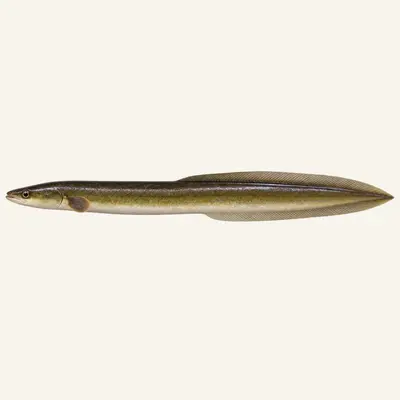
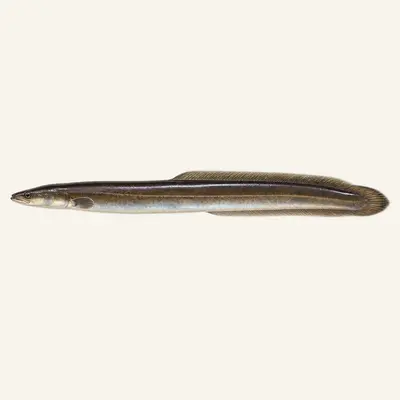
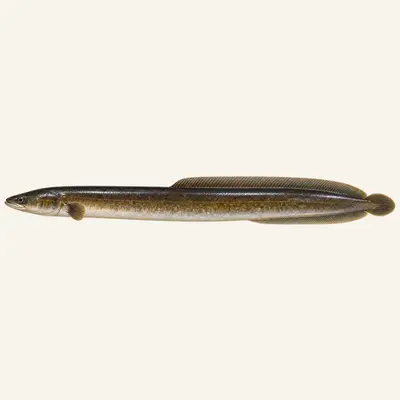
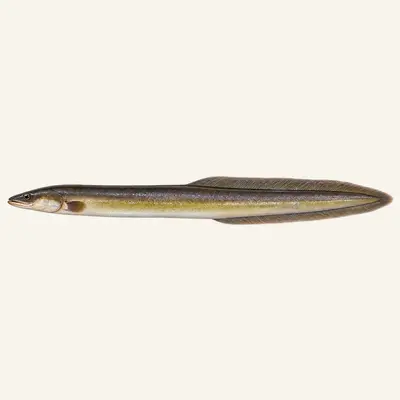
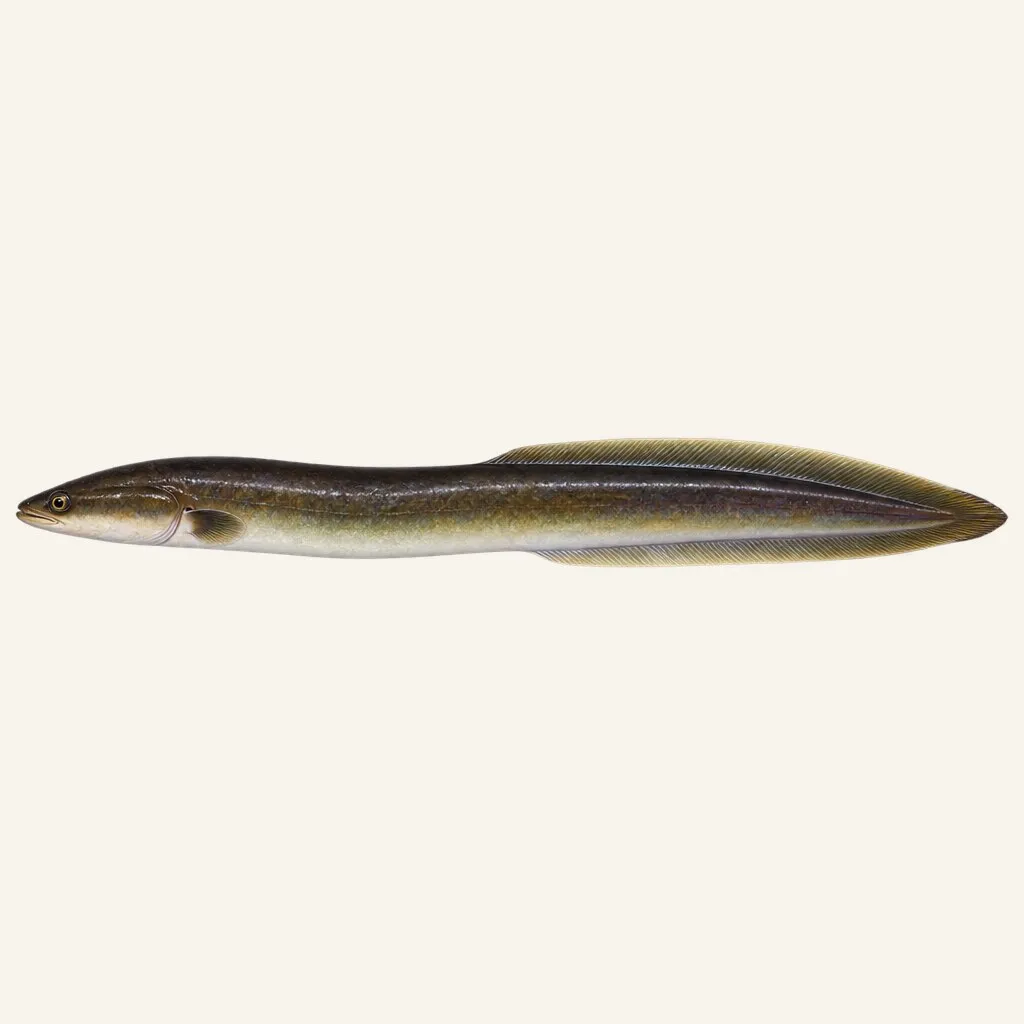
The American eel is a catadromous fish that spends most of its life in freshwater before migrating to the Sargasso Sea to spawn. Its serpentine body, covered in thick mucus and tiny scales, displays a brownish-green back and a yellowish to whitish belly.
Calendar
Recorded in 4 countries
Canada · Costa Rica · Guadeloupe · United States
GBIF occurrence records — native and introduced populations combined.
Its range
The growing range runs from Greenland down the Atlantic coast of Canada and the United States to Panama, and through much of the West Indies as far as Trinidad. Sixty degrees of latitude, from water at 4 degrees to water at 25, occupied by one species with one breeding site.
That shape is not the result of the fish spreading. It is the result of where the current puts the larvae. An animal that hatches at a single mid-ocean point and drifts has no say in the matter, and the northern and southern limits of the range are the limits of the drift, not the limits of tolerance.
The map therefore shows a feeding ground with a hole in it. The place the whole species must reach to reproduce lies inside the range and holds no resident fish at all.
Identifying it
Vertebrae settle it. This eel carries 103 to 111, its transatlantic counterpart 110 to 120, and no external character separates the two with the same confidence. Identification of an eel is a count before it is a look.
The head is the best of the outward guides. It is rather long, the eyes are small and set well forward on it, the lips are thick, and the lower jaw runs past the upper. The gill opening sits on the flank, ahead of the lower half of a well-developed pectoral. The tail fin is rounded and merges with the dorsal and the anal.
Three characters belong to the skeleton and are what the formal descriptions rest on: the caudal vertebrae bear no transverse processes, the frontal bones remain paired instead of fusing, and the premaxillae are no longer distinct elements in an adult. The pectoral girdle carries seven to nine radial elements, and as many as eleven in a young fish.
Colour proves nothing and is known not to. Most individuals are white or pale underneath and brownish to blue-black over the back, with enough variation on either side of that to make shade useless as evidence. One mark is worth keeping: young fish carry yellow along the edges of the dorsal and anal fins.
Breeding
Departure comes in autumn, and it is the only one the animal will make. The spawning ground is placed between 20 and 30 degrees north and 60 and 75 degrees west, in the Sargasso, and the adults do not return from it.
The animal that leaves is visibly not the animal that lived in the river. The upper surface of the pectorals darkens, the lateral line becomes prominent, the diameter of the eye increases and the visual pigments inside it change, and the whole body turns a silvery bronze. That last change is the one everybody notices and the least important of the four: an eye rebuilt for blue oceanic light is a deep-sea adaptation grown by a fish that has never seen the sea.
Sex determines how far inland an individual will have gone. Females grow larger than males and run very much further upstream, which sorts a catchment by sex rather than by age — males low down, females in the headwaters. The consequence is straightforward: a big eel taken far above the tide is a female.
Age at first spawning is where this species becomes strange. It ranges from under 10 years to more than 40 in fresh water. Two eels leaving the same river on the same autumn night can be three decades apart in age, and neither of them shows it.
The water it needs
Streams, rivers, and lakes with mud or silt on the bottom, most often permanent watercourses with continuous flow rather than seasonal ones. This is a fish that needs its water to still be there next year, since it may have thirty more of them to spend in it.
By day it is under something. Undercut banks, deep pools, the shelter of sunken timber and boulders: the animal spends daylight wedged into cover and comes out when the light goes. Anything written about where this species lives describes where it hides, because that is when anybody sees it.
The recorded depth reaches 464 m, which belongs to the marine phase and not to the river. Nothing in a stream corresponds to it.
Areas
- Muddy banks
- Under bridges
- Deep river pools
- Marshes and ponds
Techniques
- Bottom fishing static rig
- Night crawler on light leader
- Nocturnal live-bait fishing
- Static line with natural bait
Baits
- Earthworms
- Fish chunks
- Shrimps
- Crayfish
What it eats
The prey list is one of the longest in the catalogue, and its length is the point. Larvae of mayflies, dragonflies, stoneflies, beetles, caddisflies and moths; snails, oligochaete worms, amphipods, isopods and mysids; and fish taken from the perch, minnow, bullhead catfish, sucker and eel families.
That last family is not a slip. It eats eels, and in North American fresh water the only anguillid available to it is itself.
No item on the list is a specialisation. This is a bottom feeder working by smell in water it cannot see through, taking whatever the night puts within reach, and the breadth of the diet is why the species colonises small headwater brooks and large silted rivers with equal success.
How to catch it
The commercial gear says where the fish are and when. Adults are taken in pots and on trot lines, both of them set and left; elvers and glass eels are taken in fine-mesh fyke nets and dip nets at the point where they arrive. Two entirely different fisheries, two entirely different stages, and only one of them involves a fish that has done any growing.
For rod fishing the daytime cover is the whole answer. Undercut banks and the deep holes around sunken wood are where the fish spends the light, and it feeds outward from them after dark, so a bait laid within a few metres of that cover beats one laid in open water fifty metres away.
The mucus is a barrier against infection before it is an inconvenience. Gripping harder does not improve the hold on a fish coated in it; it strips the layer and leaves the skin open. A wet cloth laid over the body, without squeezing, does what a bare hand cannot.
The maximum reported age is 43 years. Fish of that order exist in ordinary rivers, look like any other large eel, and have spent four decades in the same few hundred metres of water waiting to make a single journey.
Conservation · Endangered (IUCN) — This species is threatened with extinction. Always release it (no-kill), handle it with the utmost care and check local rules — fishing for it may be prohibited.
Conservation
Decline is documented from Greenland to Panama, and the causes are the ordinary ones stacked together: turbines and weirs across the migration route, drained coastal wetland, contaminated sediment in the exact habitat the animal lives in, and a fishery on the juveniles as they enter the estuaries.
What makes this species hard to manage is the spread in age at maturity. When the same river holds fish that will leave at eight and fish that will leave at forty, a collapse in the number of juveniles arriving takes decades to show up in what gets caught. The adult classes already in the river carry on producing catches long after the supply behind them has stopped. By the time the signal is unmistakable, the event that caused it is thirty years old.
The sex split makes barriers worse than they look. Females are the ones that run to the headwaters, so females are the ones that meet the greatest number of obstructions on the way up and again on the way down. A structure halfway up a catchment does not remove a random sample of the population; it removes the half that carries the eggs.
Regulations
Check the local regulations in force (legal size limits, closed seasons, bag limits).
For guidance only. Legal sizes, quotas and open seasons vary by location and season: always check the local regulations in force before fishing.
Other names
American eel is the standard name, and it is one of the few common names in this family that maps onto exactly one species. The epithet rostrata means beaked and refers to that long head.
Two confusions recur in English. The American and European eels are separate species that breed in the same part of the Sargasso, which is why they turn up in the same sentence without being the same animal, and why the glass eels of the two are talked about as one commodity when they are not one stock. And the word eel gets attached in North America to fish that are not eels at all, the lamprey most persistently, which is not even a jawed fish.
Sources: fishbase.se · api.gbif.org