Atlantic Spanish mackerel
Scomberomorus maculatus · Scombridae
- Saltwater
- Big pelagics
- Medium
- Size
91 cm
- Weight
5.9 kg
- Lifespan
5 years
- Water temp.
20–30 °C
- Depth
10–35 m
Where to fish
- Estuary
- Offshore
Habitat icons: Flaticon
Spanish mackerel - a coastal schooling predator that frequents warm surface waters.
Calendar
Recorded in 2 countries
Puerto Rico · United States
GBIF occurrence records — native and introduced populations combined.
Its range
The range covers the western Atlantic from Canada and Cape Cod down to Miami, plus the Gulf of Mexico coasts from Florida to the Yucatán. It is absent from the Bahamas, and that gap is genuinely useful: a spotted Spanish mackerel in Bahamian water is a different species.
Three fish have been persistently confused with this one, and they are worth naming because the confusion is still present in the literature: Scomberomorus tritor in the eastern Atlantic, Scomberomorus sierra in the eastern Pacific, and Scomberomorus brasiliensis in the Caribbean and along the Atlantic coast of South America. A record attributed to this species from outside the range above almost certainly belongs to one of them.
Identifying it
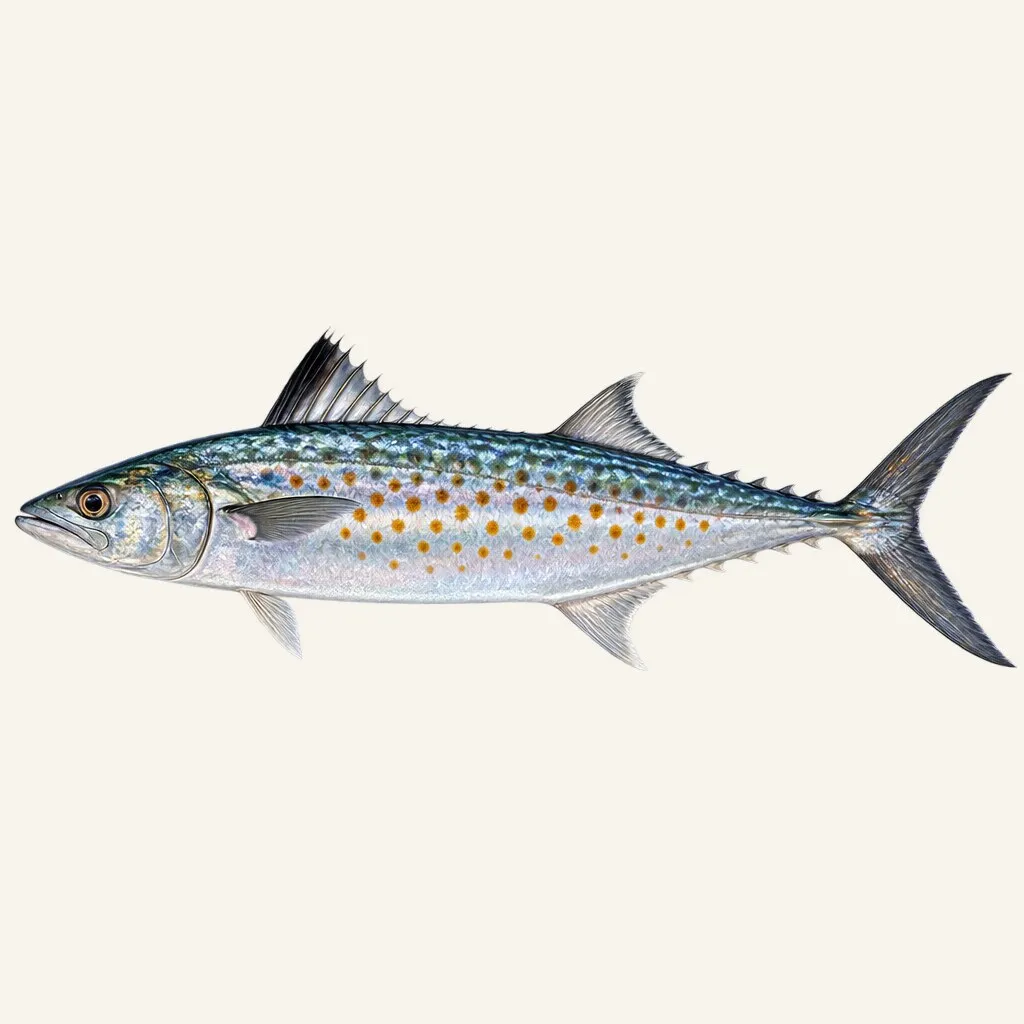
Three rows of spots along a silver flank, round to elliptical, and orange while the fish is alive. They darken to a dull grey within an hour of death, which is why the descriptions and the photographs so often disagree. The species is named for them.
The first dorsal is black at the front and black again along the trailing edge of its rear portion. That double marking separates it from the king mackerel of the same coast, whose adults carry no black on the forward part of that fin at all.
The lateral line curves down gradually towards the caudal peduncle, without the abrupt step its larger relative shows.
Vertebrae run 51 to 53 — 21 or 22 in front of the tail and 30 or 31 behind — which is the highest count in this group and settles any case the external marks leave open. Scales are small and cover the body; the interpelvic process is small and forked; there is no swim bladder.
The water it needs
Large schools travelling long distances along the shore, in 10 to 35 m of water at temperatures between 20 and 30 degrees. This is an inshore fish that moves rather than an offshore fish that arrives.
Larvae are found at the surface between 19.6 and 29.8 degrees, at salinities from 28.3 to 37.4 parts per thousand — a wider envelope than the king mackerel needs, and a fish able to spawn successfully across a broader stretch of coast.
Areas
- Shallow coastal waters
- Estuaries and inlets
- Around artificial structures
- Active current areas
Techniques
- Cast-and-retrieve with spoons
- Light trolling
- Drifting with live bait
- Light jigging
Baits
- Silver or gold spoons
- Small live fish
- Live shrimps
- Soft plastic lures
What it eats
Small fish, mainly clupeoids and anchovies, with a small proportion of penaeid shrimps and cephalopods.
Feeding on shoaling prey is what makes shoaling worthwhile for the predator: a school of bait is a target that rewards numbers, and hunting it alone gives up most of the advantage. Diet and social structure are the same fact seen from two sides.
How to catch it
The methods on record describe the fish exactly: casting, live-bait fishing, jigging and drift fishing. Every one of them addresses a moving mass in open water, and none of them is a technique for working a mark.
Aerial spotting is used to locate the schools, which puts the difficulty in its proper place. The problem is finding a mobile concentration somewhere along a very long coast; catching it once found is comparatively straightforward, and that ratio should shape how a day is planned.
One biological figure changes how a whole population reads. The maximum reported age is five years. This is a short-lived, fast-turning fish, and the king mackerel it is caught alongside reaches 26. The same coast, the same nets, and a fish that replaces itself in two seasons next to one that takes a quarter of a century.
Conservation
A five-year life span and maturity around 40 cm produce a stock that rebuilds quickly. The same arithmetic produces a stock that empties quickly, because at any moment it rests on very few year classes at once.
Two consecutive poor recruitment years are therefore enough to strip a fishery, where a long-lived species would absorb the same failure across the older cohorts still present. Nothing has gone wrong with the fish when that happens; the structure simply has no reserve in it.
That is why the two Spanish mackerels of this coast cannot share a management approach. Effort that a fast-turning stock shrugs off in three years is effort that removes the top of a slow one permanently, and landings that arrive mixed give no indication of which is happening.
Regulations
Check the local regulations in force (legal size limits, closed seasons, bag limits).
For guidance only. Legal sizes, quotas and open seasons vary by location and season: always check the local regulations in force before fishing.
Other names
Atlantic Spanish mackerel in full, and in American usage simply Spanish mackerel — the unqualified form means this species and no other along that coast.
Elsewhere it means something else entirely. The whole genus carries the Spanish tag, so in Australia Spanish mackerel is a 70 kg Indo-Pacific fish, and in the eastern Pacific it is the sierra. The adjective is inherited from old usage and indicates neither origin nor range; it is a group label that behaves like a species name, which is the single most reliable way to misidentify a mackerel in conversation.
Sources: fishbase.se · api.gbif.org